


Sodium Sulfate Filler Masterbatch for T-Shirt Bag Production
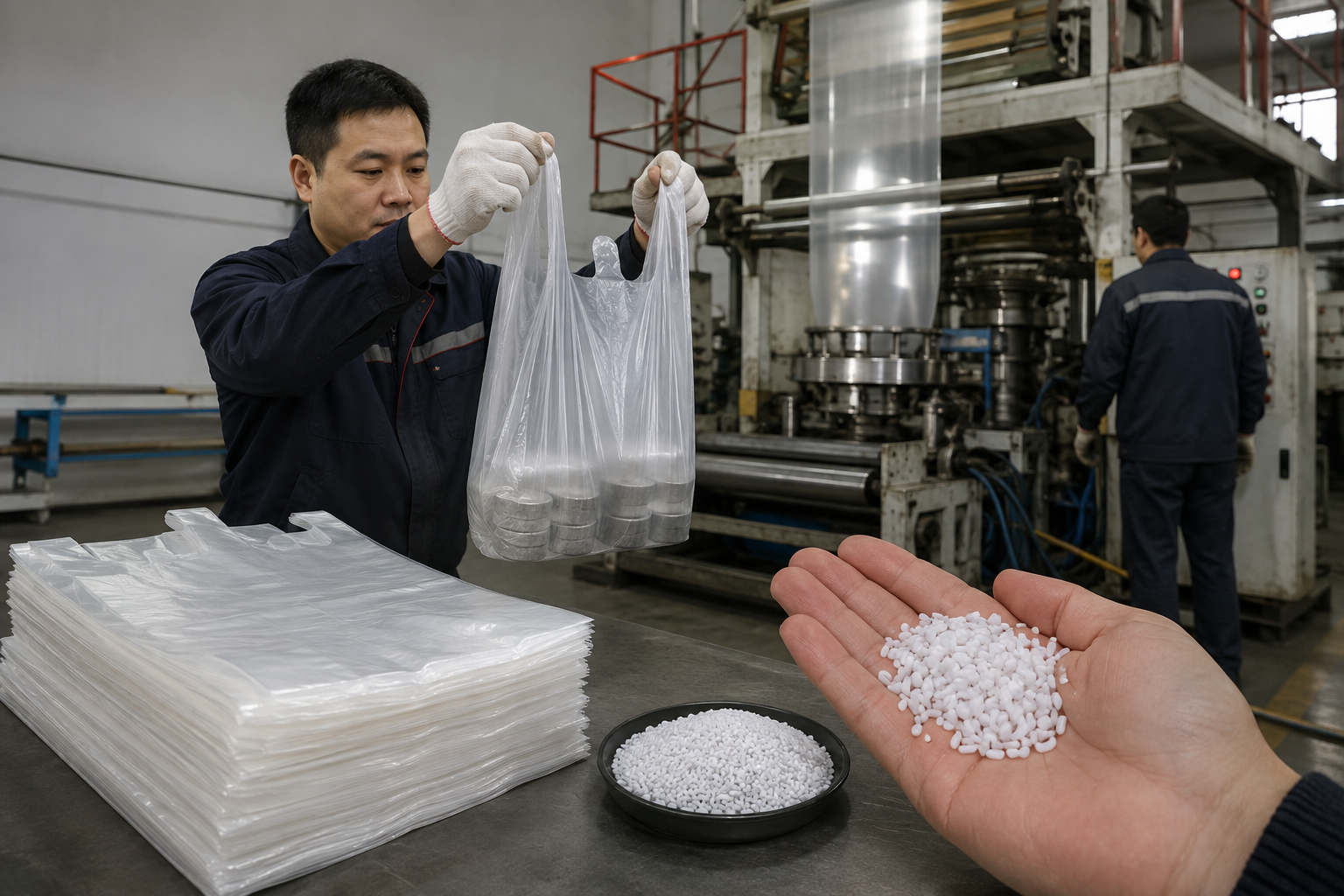
T-shirt bags—also called vest bags, carrier bags or shopping bags—are produced in large quantities and face strong price competition.
Manufacturers need to control raw-material costs while maintaining stable film blowing, reliable bottom sealing and sufficient handle strength.
Sodium sulfate filler masterbatch may provide a practical cost-reduction option for suitable HDPE, LDPE and mixed-PE T-shirt bag formulations. It can replace a controlled portion of plastic resin, subject to production and finished-bag testing.
The correct dosage is not determined only by the price of the masterbatch. Bag thickness, resin composition, handle design, load requirement and production equipment must all be considered.
What Is Sodium Sulfate Filler Masterbatch?
Sodium sulfate filler masterbatch is a granular functional additive made from finely processed sodium sulfate, a compatible carrier resin and selected processing additives.
It may also be known as:
Na2SO4 filler masterbatch
Sodium sulfate filling masterbatch
Sodium sulfate transparent filler masterbatch
PE cost-reduction masterbatch
Functional filler masterbatch
The material is supplied in granule form for convenient feeding and mixing with PE resin.
In suitable applications, it may help reduce virgin resin consumption while maintaining acceptable appearance, processability and finished-product performance.
What Is a T-Shirt Bag?
A T-shirt bag is a lightweight plastic carrier bag with two integrated handles. Its shape resembles a sleeveless shirt, which gives the product its common English name.
Typical applications include:
Supermarkets
Retail stores
Grocery shops
Takeaway services
Markets
General merchandise packaging
Household use
T-shirt bags may be produced from HDPE, LDPE, LLDPE, recycled PE or combinations of these materials.
Their quality is influenced by more than film-body strength. The handle and bottom-seal areas are particularly important.
Why Use Sodium Sulfate Filler Masterbatch?
Raw materials represent a major part of T-shirt bag production costs.
In a suitable formulation, sodium sulfate filler masterbatch may offer:
Reduced consumption of PE resin
Lower formulation cost
Convenient granule feeding
Good dispersion with a compatible grade
Acceptable transparency or translucency
Stable production under suitable conditions
Flexible use in virgin or recycled PE blends
These potential benefits must be verified using the actual production line and finished bag.
The lowest formula cost per kilogram does not always produce the lowest cost per qualified bag.
HDPE T-Shirt Bags
HDPE is widely used for thin T-shirt bags because it can provide a characteristic stiffness and film feel.
When testing sodium sulfate filler masterbatch in an HDPE formulation, monitor:
Film-bubble stability
Thickness uniformity
Surface appearance
White spots
Tear behavior
Handle strength
Bottom-seal strength
Bag weight
Thin HDPE film can be sensitive to localized weak points. Good dispersion and accurate dosage control are therefore important.
A formulation that works in a thicker bag may not be suitable for an ultra-thin HDPE bag.
LDPE T-Shirt Bags
LDPE may be used when the manufacturer requires a softer film, different appearance or particular sealing behavior.
During an LDPE trial, evaluate:
Film softness
Transparency and haze
Bubble stability
Tensile strength
Elongation
Seal quality
Cutting performance
Handle deformation
The masterbatch carrier should be compatible with the LDPE system and processing temperature.
LDPE/LLDPE and Mixed-PE Formulations
LLDPE is often blended with other PE resins to support selected mechanical properties.
A T-shirt bag formulation may contain:
HDPE
LDPE
LLDPE
Recycled PE
Color masterbatch
Sodium sulfate filler masterbatch
Other functional additives
When introducing a new filler, keep the main resin blend stable during the first trial.
Changing the PE ratios, filler dosage and machine settings simultaneously makes it difficult to determine what caused a performance change.
What Determines the Suitable Dosage?
There is no universal sodium sulfate filler masterbatch ratio for every T-shirt bag.
The practical dosage depends on:
PE resin type
Film thickness
Bag width and length
Handle dimensions
Required load capacity
Virgin/recycled resin ratio
Transparency requirement
Bag color
Film-blowing equipment
Sealing and cutting method
Customer specifications
Begin with the supplier’s recommended starting ratio. Increase it gradually only after the completed bags pass the required tests.
Handle Strength Is a Critical Requirement
The handle area is often the first part of a T-shirt bag to fail.
Stress becomes concentrated around:
Handle cutouts
Handle corners
Thin sections
Uneven film areas
Small notches
Sealing transitions
Adding filler may change elongation, tear propagation and puncture behavior.
The bag should therefore be tested with a realistic load rather than approved only by pulling a flat film sample by hand.
Bottom-Seal Performance
The bottom seal carries much of the product load.
Possible seal problems include:
Peeling
Brittle seal lines
Partial bonding
Burn-through
Uneven sealing
Failure during lifting
After changing the formulation, review:
Sealing temperature
Pressure
Contact time
Machine speed
Cooling time
Film thickness
Filler dosage
A film that runs successfully on the blown-film machine may still require different settings during bag conversion.
Film Thickness and Uniformity
Uneven film thickness can create weak handles and seals.
Measure the film at several positions across its width:
Left edge
Left-center
Center
Right-center
Right edge
Also check the actual handle and bottom-seal areas.
Do not compare two formulas if their samples have significantly different thicknesses. A thicker trial bag may appear stronger while also weighing more and producing fewer pieces per ton.
Transparency and Appearance
Depending on the market, T-shirt bags may be:
Transparent
Translucent
White
Black
Colored
Printed
Sodium sulfate filler masterbatch may help retain an acceptable transparent or translucent appearance in suitable formulas, but it should not be described as completely invisible.
Appearance depends on:
Masterbatch dosage
Film thickness
PE resin
Dispersion
Recycled-material quality
Cooling conditions
Color masterbatch
Evaluate the finished bag under consistent lighting.
Color and Printing
T-shirt bags may contain color masterbatch or printed branding.
Introducing sodium sulfate filler masterbatch may affect:
Color shade
Opacity
Surface gloss
Ink appearance
Printing uniformity
Color matching should be performed with the final production formula.
If the bag will be printed, test:
Ink adhesion
Print sharpness
Surface consistency
Drying
Rub resistance, where required
Do not approve the formulation based solely on unprinted film.
Using Recycled PE
Recycled PE may provide additional cost advantages, but its quality can vary.
Possible variations include:
Melt flow
Polymer composition
Moisture
Contamination
Color
Odor
Mechanical performance
Existing filler content
When testing sodium sulfate filler masterbatch with recycled PE:
Use a consistent recycled batch.
Record the complete formula.
Inspect moisture and contamination.
Begin with a conservative filler dosage.
Test finished-bag strength and sealing.
Increase the ratio only after the first trial passes.
Do not expect filler masterbatch to correct severely degraded or contaminated recycled material.
Recommended Production Trial
Step 1: Record the Original Formula
Document every PE resin, recycled material and additive.
Step 2: Record Production Data
Include:
Film thickness
Bag dimensions
Bag weight
Extrusion temperature
Output
Bag-making speed
Scrap rate
Current load-test result
Step 3: Select a Compatible Grade
Provide the supplier with the main PE type, film thickness and bag specification.
Step 4: Start with a Controlled Dosage
Accurately weigh and evenly mix the sodium sulfate filler masterbatch.
Step 5: Observe Film Blowing
Check:
Feeding stability
Melt pressure
Film bubble
Frost line
Film width
Thickness uniformity
Surface appearance
Die deposits
Step 6: Convert Film into Finished Bags
Run the film through the actual cutting, punching and sealing equipment.
Step 7: Test the Completed Bags
Test handles, bottom seals, film body and actual-use performance.
Step 8: Calculate the Cost per Qualified Bag
Include material cost, bag weight, output, scrap and production efficiency.
Recommended Finished-Bag Tests
Bag Weight
Weigh multiple bags and calculate an average.
Dimensional Check
Confirm bag length, width, gusset and handle dimensions.
Thickness Check
Measure several points across the bag.
Static Load Test
Suspend a controlled load for a defined period and inspect the handles and seal.
Repeated-Lifting Test
Lift the loaded bag several times under consistent conditions.
Drop Test
Drop a loaded bag from a controlled height and inspect for failure.
Handle Tear Test
Check whether small cuts or stress points spread easily.
Seal Test
Inspect the full width of the bottom seal.
The test conditions should match the customer’s actual specification.
Common Production Problems
Handles Tear Easily
Check filler dosage, film thickness, LLDPE content, cutting quality and recycled-resin strength.
Bottom Seal Opens
Review sealing temperature, pressure, time, film thickness and formulation.
Film Bubble Becomes Unstable
Check mixing, moisture, extrusion temperatures, recycled-material consistency and carrier compatibility.
White Spots Appear
Check masterbatch dispersion, machine cleanliness, screen condition and processing temperature.
Bag Becomes Too Hazy
Review dosage, thickness, base resin and recycled-material quality.
Bag Weight Increases
Measure actual film thickness and calculate the effect of formulation density on qualified output per ton.
How to Calculate the Real Saving
First calculate the formula cost:
Formula cost per kg = Σ (material percentage × material price per kg)
Then calculate:
Material cost per bag = formula cost per kg × bag weight in kg
Also include:
Film-blowing scrap
Handle-punching waste
Bag-making rejects
Energy consumption
Production speed
Machine cleaning
Customer rejection risk
The most economical formula is the one that produces the lowest repeatable cost per qualified T-shirt bag.
Information to Send the Supplier
Provide:
HDPE, LDPE and LLDPE grades
Virgin/recycled ratio
Complete current formula
Bag dimensions
Film thickness
Bag weight
Handle design
Required load capacity
Bag color
Printing requirements
Production equipment
Target cost reduction
Bag or film samples
This information allows the supplier to recommend a more relevant grade and starting dosage.
Sodium Sulfate Filler Masterbatch from Xinfeng
Xinfeng manufactures sodium sulfate filler masterbatch for suitable HDPE, LDPE and mixed-PE blown-film applications, including T-shirt bags.
Our functional additive range also includes:
High-transparency toughening additives
Color masterbatch
Antiblock masterbatch
Desiccant masterbatch
Other plastic functional additives
We select products according to the customer’s resin system, equipment, bag specifications and cost target.
Send us your current formulation and T-shirt bag sample to request a suitable sodium sulfate filler masterbatch trial.
Frequently Asked Questions
Can sodium sulfate filler masterbatch be used in HDPE T-shirt bags?
A compatible grade may be evaluated in suitable HDPE formulations. Thin-film dispersion, handle strength and sealing must be tested.
Can it be used in LDPE bags?
Yes, suitable grades may be tested in LDPE or LDPE/LLDPE formulations.
Will it make the handles weaker?
Any filler may affect mechanical properties as the dosage changes. Test the actual punched handles under the required load.
Does the bag-making temperature need adjustment?
Possibly. The sealing window may change after the formulation is modified, so temperature, pressure and contact time should be tested.
Can it be used with recycled PE?
It may be used in suitable recycled PE formulations. Recycled-material consistency, moisture and contamination must be controlled.
What is the recommended dosage?
There is no universal ratio. It depends on the resin, thickness, handle design, load requirement and equipment.
How should savings be calculated?
Calculate the complete production cost per qualified bag, including bag weight, scrap, output and rejects.
Request a T-Shirt Bag Trial Sample
Send Xinfeng your:
PE formulation
Bag dimensions
Film thickness
Finished-bag weight
Required load capacity
Current production issue
Target cost reduction
We can recommend a suitable sodium sulfate filler masterbatch grade and starting trial plan.
Send us a message now for quotation.
WhatsApp: https://wa.memessage/IRZROGA5F2RQO1
WhatsApp:+86 17835035161