


How to Test Sodium Sulfate Filler Masterbatch Before Bulk Purchasing
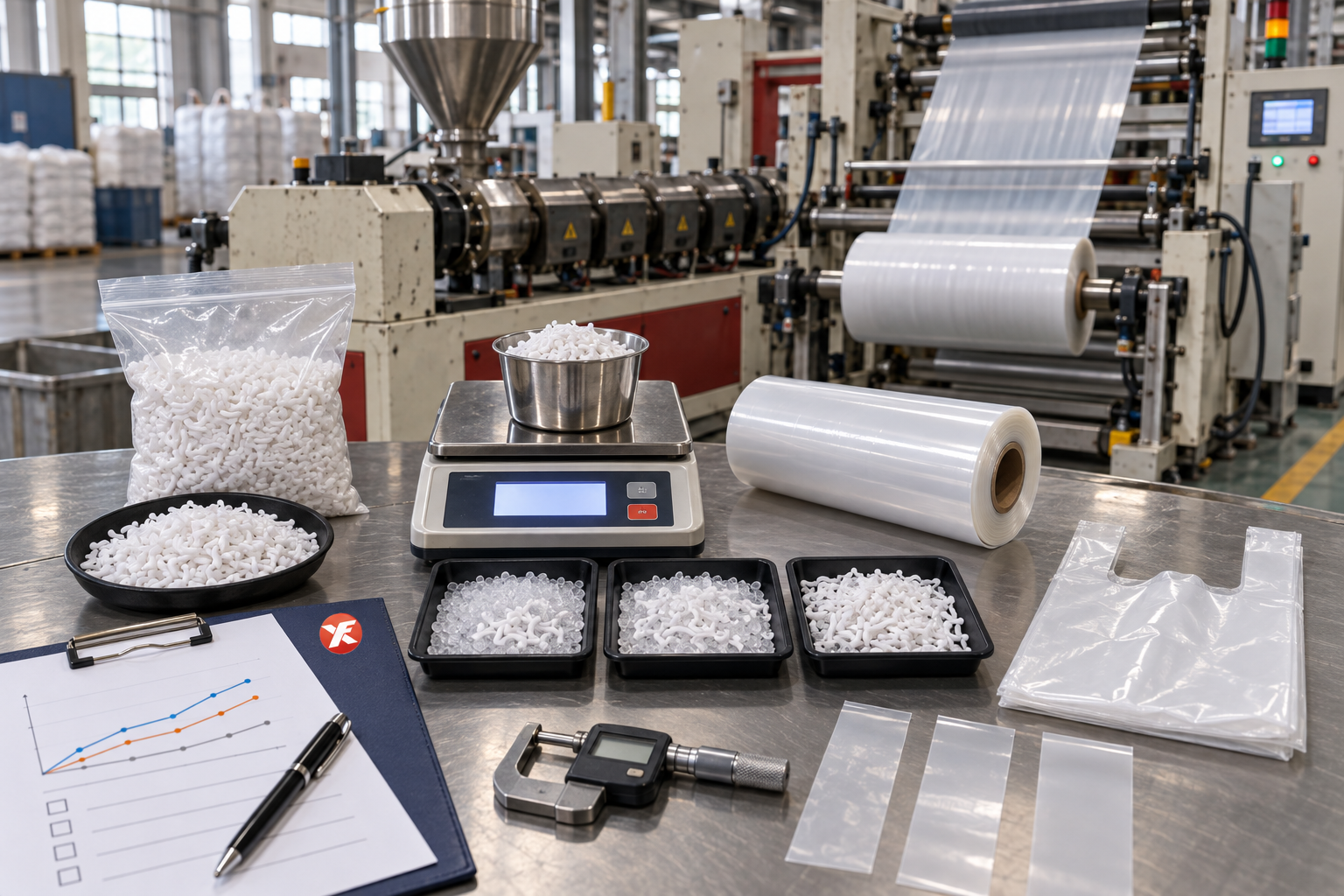
Before purchasing sodium sulfate filler masterbatch in large quantities, plastic manufacturers should conduct a controlled production trial.
A sample may appear suitable based on its colour and pellet shape, but its actual performance depends on the resin formulation, processing equipment, film thickness and finished-product requirements.
A structured test helps manufacturers determine whether the masterbatch can reduce production costs while maintaining acceptable product quality.
Why Is a Production Trial Necessary?
Different plastic factories use different raw materials and production settings. Even two manufacturers producing similar PE bags may obtain different results from the same masterbatch.
Performance can be affected by:
HDPE, LDPE or LLDPE resin grade
Virgin and recycled resin ratio
Melt flow rate
Film thickness
Extrusion temperature
Machine condition
Production speed
Required transparency
Mechanical-performance standards
For this reason, the recommended dosage should be treated as a starting point rather than a fixed formula.
Step 1: Define the Trial Objective
Before testing, determine what you want the sodium sulfate filler masterbatch to achieve.
Possible objectives include:
Reducing virgin-resin consumption
Lowering material cost per bag
Improving production economics
Maintaining acceptable transparency
Keeping stable film-bubble performance
Achieving the required product weight
Maintaining sealing and handle strength
A clear objective makes the trial results easier to evaluate.
If cost reduction is the only measurement, manufacturers may overlook increased rejection rates or weaker finished products.
Step 2: Record the Original Formulation
The existing formulation should be recorded before adding the masterbatch.
Important information includes:
Main resin type and supplier
Virgin-material percentage
Recycled-material percentage
Colour-masterbatch dosage
Other additives
Extrusion temperature
Machine speed
Finished-film thickness
Average product weight
Current rejection rate
This original formulation becomes the control group for the trial.
Without baseline data, it is difficult to determine whether any production change was caused by the filler masterbatch.
Step 3: Inspect the Masterbatch Sample
Before feeding the material into the machine, check the physical condition of the pellets.
A suitable sample should generally have:
Relatively uniform pellet size
Low surface dust
No obvious moisture
No serious clumping
Consistent colour
Smooth feeding behaviour
Sodium sulfate filler masterbatch must be stored in a dry environment. If the packaging has been open for an extended period, confirm whether drying is required before production.
Moisture can contribute to bubbles, pinholes and unstable extrusion.
Step 4: Begin with a Conservative Dosage
Avoid immediately testing the highest possible addition ratio.
Start with a conservative dosage and keep the remaining production conditions as close as possible to the original formulation. This helps isolate the effect of the masterbatch.
After the first trial is stable, increase the dosage gradually.
For every dosage level, record:
Feeding consistency
Extruder pressure
Motor load
Melt condition
Film-bubble stability
Production speed
Finished-film appearance
Rejection rate
The practical dosage limit is reached when further cost savings begin to cause unacceptable processing or quality problems.
Step 5: Ensure Uniform Mixing
Uniform premixing is essential for a reliable test.
If the masterbatch is not evenly distributed throughout the PE resin, the film may show inconsistent transparency, white spots or differences in thickness.
For small-scale trials:
Weigh all materials accurately.
Mix the resin and masterbatch thoroughly.
Avoid using an estimated dosage.
Keep each test batch clearly separated.
Label the trial samples after production.
Automatic dosing equipment should also be checked for calibration and feeding stability.
Step 6: Monitor the Blown-Film Process
During PE blown-film production, observe the machine continuously after adding the filler masterbatch.
Pay particular attention to:
Film-bubble stability
Die pressure
Extrusion output
Melt uniformity
Screen blockage
Film cooling
Thickness fluctuation
Surface appearance
If the film bubble becomes unstable, do not assume the masterbatch is the only possible cause. Moisture, mixing quality, extrusion temperature and the condition of the screen pack should also be checked.
Only adjust one major variable at a time. Changing several settings simultaneously makes it difficult to identify the actual cause of a problem.
Step 7: Inspect the Finished Film
Allow the machine to reach stable production before collecting samples.
The film should be evaluated for:
Transparency
Colour consistency
White spots
Surface smoothness
Film thickness
Tensile strength
Tear resistance
Flexibility
Odour
Printability, when required
Thin transparent film generally requires stricter control of filler dosage and dispersion than thick or opaque plastic bags.
The evaluation standard should always match the actual application.
Step 8: Test the Finished Bags
Film appearance alone is not enough. The converted bag must also meet its intended performance requirements.
For T-shirt bags and shopping bags, test:
Handle strength
Bottom-seal strength
Bag opening
Load-bearing performance
Tear behaviour
Product appearance
For garbage bags, check:
Puncture resistance
Bottom-seal reliability
Flexibility
Leakage risk
Performance under realistic waste loads
Testing should reproduce the conditions under which customers will use the finished product.
Step 9: Calculate the Real Production Cost
The final decision should be based on total production cost rather than only the purchase price of the masterbatch.
Include the following factors:
Virgin-resin savings
Masterbatch cost
Finished-product weight
Production output
Electricity consumption
Rejection rate
Screen-changing frequency
Machine-cleaning requirements
Customer complaints or quality risk
A formulation with a higher filler dosage is not necessarily more economical if it reduces production stability or increases rejected products.
Step 10: Keep Samples and Trial Records
Keep samples from every tested dosage and attach the relevant production data.
A useful trial record should include:
Test date
Masterbatch batch number
Formulation
Addition ratio
Machine settings
Film thickness
Product weight
Test results
Operator comments
These records make it easier to repeat successful formulations and communicate accurately with the masterbatch supplier.
Common Trial Problems
White Spots
Possible causes include insufficient mixing, poor dispersion, low processing temperature or excessive dosage.
Bubbles or Pinholes
Check masterbatch moisture, recycled-material moisture and extrusion conditions.
Reduced Transparency
Lower the filler dosage or adjust the formulation when high transparency is required.
Weak Heat Seals
Review the addition level, sealing temperature, sealing time and film thickness.
Brittle Film
The dosage may be too high for the required application. Resin formulation and processing temperature should also be checked.
Unstable Film Bubble
Inspect material moisture, mixing uniformity, extrusion pressure and temperature settings.
Work with a Manufacturer That Supports Sample Testing
A reliable masterbatch supplier should request information about the customer’s resin, equipment and finished product before recommending a grade.
Xinfeng manufactures sodium sulfate filler masterbatch for selected PE blown-film and PP processing applications. We can provide samples for production evaluation and discuss suitable starting formulations based on your application.
For a more useful recommendation, please provide:
Resin type
Finished-product application
Film thickness or product weight
Current formulation
Required transparency
Target dosage
Production equipment
Existing quality problems
Conclusion
Testing sodium sulfate filler masterbatch before bulk purchasing reduces formulation risk and helps manufacturers identify a practical balance between cost and performance.
Begin with a controlled dosage, keep accurate production records and evaluate both processing stability and finished-product quality. Bulk purchasing should only be considered after the formulation performs consistently under normal production conditions.
Send us a message now for quotation.
WhatsApp: https://wa.memessage/IRZROGA5F2RQO1
WhatsApp:+86 17835035161