


Sodium Sulfate Filler Masterbatch for PE Courier and Mailing Bags
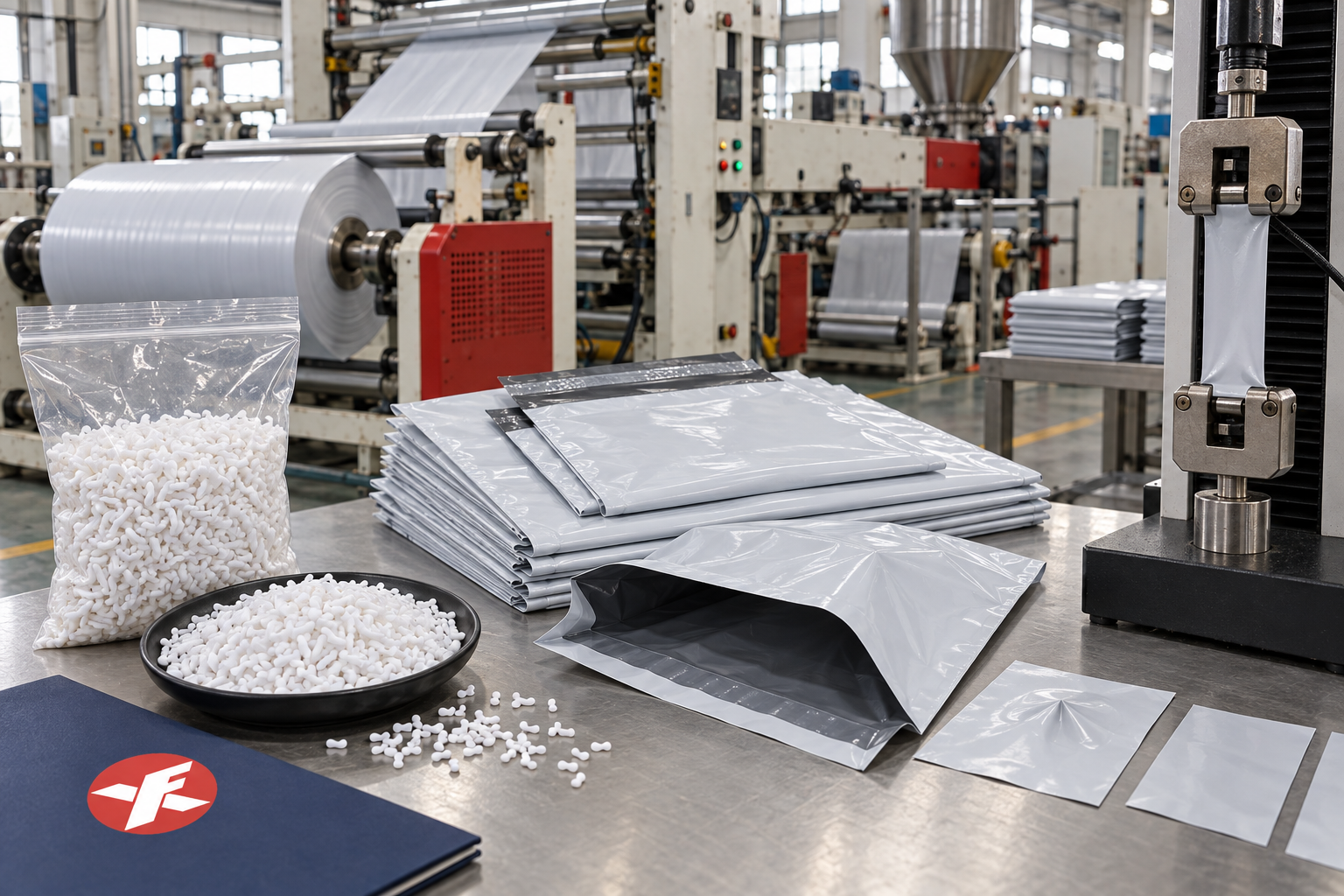
PE courier bags and poly mailers are widely used to package clothing, accessories, documents and e-commerce products. With increasing demand for delivery packaging, manufacturers must control raw-material costs while maintaining reliable sealing, puncture resistance and production stability.
Sodium sulfate filler masterbatch can be introduced into selected courier-bag formulations to replace part of the plastic resin and improve production economics.
However, the dosage must be carefully tested because courier bags require more than an acceptable surface appearance. The film must also withstand packing, sealing, transportation and handling.
What Is Sodium Sulfate Filler Masterbatch?
Sodium sulfate filler masterbatch is a functional plastic additive manufactured from treated sodium sulfate, a compatible polymer carrier and processing additives.
It is supplied as pellets, allowing it to be mixed with PE resin through conventional dosing and extrusion equipment.
Compared with feeding mineral powder directly, masterbatch offers several practical advantages:
Cleaner material handling
Easier dosage control
More uniform mixing
Reduced airborne powder
More stable feeding
Better filler dispersion
The actual performance depends on the formulation, carrier resin, pellet quality and production conditions.
Why Use Filler Masterbatch in Courier Bags?
The primary purpose is to reduce the amount of virgin resin required in each production batch.
When the formulation is suitable, sodium sulfate filler masterbatch may help manufacturers:
Reduce raw-material cost
Improve production cost control
Adjust film appearance
Increase film body
Maintain convenient pellet feeding
Use a repeatable formulation
The economic result should be calculated according to cost per acceptable finished bag rather than only the price per kilogram of raw material.
Suitable Courier-Bag Structures
Courier bags are manufactured in different structures and thicknesses. A masterbatch formulation that works in one type of bag may not be suitable for another.
Common structures include:
Single-layer PE mailing bags
Co-extruded courier bags
White exterior and dark interior films
Recycled-material courier bags
Tamper-evident mailing bags
Printed e-commerce packaging
Filler masterbatch is generally easier to introduce into opaque or thicker structures than into very thin films requiring high clarity.
For co-extruded products, the producer may test the filler masterbatch in a selected layer instead of adding it equally to every layer.
Resin Compatibility
Courier-bag films may contain combinations of HDPE, LDPE and LLDPE.
Each resin contributes different processing and performance characteristics:
HDPE can provide stiffness and support thin-film production.
LDPE generally supports processing and sealing performance.
LLDPE is often used to improve toughness and puncture resistance.
Introducing filler changes the balance of the formulation. The carrier resin of the masterbatch should therefore be compatible with the main PE system.
Manufacturers should test the masterbatch with the actual resin blend rather than relying only on a laboratory sample.
Start with a Conservative Addition Level
There is no universal addition ratio for every courier bag.
The practical dosage is influenced by:
Film thickness
Resin composition
Recycled-material content
Bag dimensions
Required load
Printing requirements
Sealing method
Production speed
Customer quality standards
Begin with a conservative addition level and increase it gradually. Keep other production variables stable during each stage of the trial.
This method helps determine when additional cost savings begin to cause unacceptable changes in film quality or bag strength.
Monitor Blown-Film Stability
During the trial, operators should observe the complete blown-film process.
Important indicators include:
Feeding consistency
Extruder pressure
Motor load
Melt uniformity
Film-bubble stability
Output rate
Thickness fluctuation
Film surface
Screen condition
Unstable processing may be related to excessive dosage, poor mixing, moisture or unsuitable temperature settings.
Only one major variable should be adjusted at a time so that the cause of a problem can be identified accurately.
Check Film Appearance and Dispersion
Good dispersion is important even when the courier bag is opaque.
Poor dispersion may cause:
Visible white spots
Agglomerated particles
Rough surfaces
Uneven colour
Weak points
Unstable printing results
Inspect film samples under both normal and backlit conditions. This makes small particles, pinholes and thickness irregularities easier to detect.
If white and dark masterbatches are also used, confirm that all additives disperse evenly together.
Evaluate Heat-Sealing Performance
The sealing area is one of the most important parts of a courier bag.
Excessive filler addition may influence heat transfer and seal strength. Existing sealing settings may need to be adjusted after the formulation changes.
Test the following areas:
Side seals
Bottom seals
Flap seals
Adhesive-strip area
Tamper-evident closure
Corners and folded sections
A finished bag should be filled with a realistic test load and handled repeatedly. A seal that looks acceptable may still fail during packing or transportation.
Test Puncture and Tear Resistance
Courier bags can be damaged by product corners, zippers, boxes and rough handling.
The trial should include realistic tests for:
Puncture resistance
Tear propagation
Impact resistance
Flexibility
Drop performance
Load-bearing ability
If the bag becomes too brittle, reduce the filler dosage or adjust the PE resin formulation. Increasing the proportion of a suitable tough resin may also be considered.
Confirm Printing and Surface Performance
Many courier bags carry logos, instructions, barcodes or brand graphics.
Before approving a formulation, test:
Ink adhesion
Printing clarity
Colour consistency
Surface treatment
Rubbing resistance
Lamination or coating compatibility
The film formulation may affect surface energy and printing behaviour. Corona-treatment settings should therefore be checked during production.
Control Moisture Carefully
Moisture can create bubbles, pinholes and unstable film surfaces.
Recommended handling practices include:
Store unopened bags in a dry area.
Keep masterbatch away from wet floors.
Reseal unused material promptly.
Avoid prolonged exposure to humid air.
Confirm drying requirements with the supplier.
Moisture from recycled PE resin should also be investigated when production defects occur.
Calculate the Real Saving per Bag
The lowest-cost formulation is not necessarily the one with the highest masterbatch dosage.
Calculate the total manufacturing cost by considering:
Virgin-resin reduction
Masterbatch cost
Finished-bag weight
Extrusion output
Electricity consumption
Rejection rate
Printing waste
Sealing failures
Customer quality requirements
A stable formulation that produces fewer rejected bags may be more economical than a cheaper formulation with inconsistent performance.
Information to Provide to the Supplier
For a more suitable product recommendation, provide the masterbatch manufacturer with:
HDPE, LDPE and LLDPE formulation
Virgin and recycled material ratio
Bag structure
Film thickness
Bag dimensions
Required colour
Printing method
Target dosage
Current production problems
Finished-bag samples and short production videos can also help the supplier understand the application.
Conclusion
Sodium sulfate filler masterbatch can support cost reduction in selected PE courier and mailing bag applications, but it must be evaluated through a controlled production trial.
Manufacturers should focus on dispersion, blown-film stability, puncture resistance, sealing strength and printing performance. The most suitable dosage is the one that lowers the real cost per finished bag without creating unacceptable production or quality problems.
Xinfeng manufactures sodium sulfate filler masterbatch for PE blown film and other plastic-processing applications. Contact us to discuss your formulation or request a sample for testing.
Send us a message now for quotation.
WhatsApp: https://wa.memessage/IRZROGA5F2RQO1
WhatsApp:+86 17835035161