


How Sodium Sulfate Filler Masterbatch Affects PE Film Heat Sealing
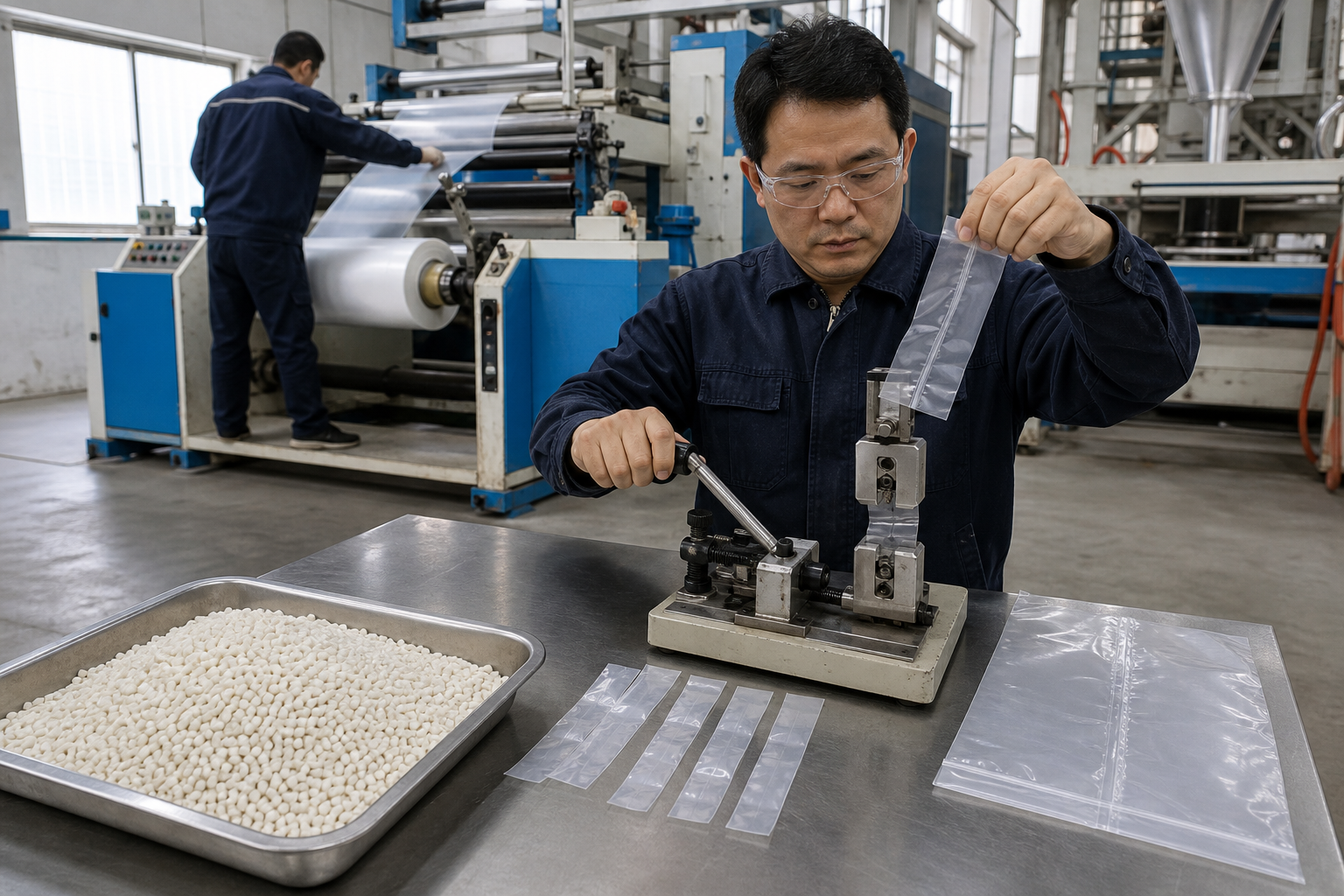
Stable film extrusion does not always guarantee successful bag production.
A PE film may appear smooth and run steadily on the blown-film machine but develop weak, brittle or inconsistent seals during bag making. This can happen after introducing sodium sulfate filler masterbatch or changing its addition ratio.
Sodium sulfate filler masterbatch can help reduce virgin resin consumption in suitable PE formulations. However, changing the formula may also change heat transfer, film thickness, mechanical behavior and the sealing window.
This article explains how to evaluate heat-sealing performance and troubleshoot common problems during a sodium sulfate filler masterbatch trial.
What Is Sodium Sulfate Filler Masterbatch?
Sodium sulfate filler masterbatch is a granular functional additive produced from finely processed sodium sulfate, a compatible carrier resin and selected processing additives.
It is also known as:
Na2SO4 filler masterbatch
Sodium sulfate filling masterbatch
Sodium sulfate transparent filler masterbatch
PE film cost-reduction masterbatch
Functional filler masterbatch
In suitable formulations, it can replace a controlled portion of virgin or recycled polyethylene.
The appropriate grade and dosage depend on the resin system, film thickness, bag application, equipment and required mechanical performance.
Why Is Heat Sealing Important?
Heat sealing joins layers of thermoplastic film by applying a controlled combination of:
Temperature
Pressure
Contact time
Cooling
A reliable seal should remain closed during filling, handling, transportation and normal use.
Depending on the product, weak seals may cause:
Bag-bottom failure
Side-seal opening
Leakage
Product loss
Customer complaints
Increased rejection rates
Reduced bag-making speed
Heat-sealing performance must therefore be included in every film-formulation trial.
Can Sodium Sulfate Filler Masterbatch Affect Heat Sealing?
It may.
Adding masterbatch changes the complete composition of the film. Depending on the dosage and formulation, this may influence:
Heat transfer through the film
Film thickness
Melt behavior at the seal
Seal initiation temperature
Seal strength
Seal appearance
Flexibility around the seal
Width of the usable sealing window
The result is not determined by the sodium sulfate masterbatch alone. The PE blend, recycled material, other additives and sealing-machine settings also matter.
What Is the Heat-Sealing Window?
The heat-sealing window is the range of temperatures and operating conditions that produce acceptable seals.
If the temperature is too low:
The layers may not bond completely
Seals may peel apart
Seal strength may vary
Production speed may become unstable
If the temperature is too high:
Film may shrink excessively
Seal areas may become brittle
The film may stick to the sealing bar
Holes or burn-through may appear
Material may be squeezed out of the seal area
A broad sealing window is generally easier to manage in continuous production. A narrow window requires more precise control of temperature, pressure and time.
Factor 1: Masterbatch Dosage
Dosage is one of the first factors to review when seal performance changes.
As the filler ratio increases, the amount and distribution of polymer within the seal area also change. An excessive dosage may make it more difficult to maintain the required seal strength in some thin-film applications.
Possible symptoms include:
Seals opening under load
Brittle seal lines
Incomplete bonding
Reduced seal flexibility
Increased variation between bags
Begin with a conservative trial ratio and test the finished bags before increasing the dosage.
The best ratio is not the highest possible addition level. It is the ratio that maintains acceptable sealing and bag performance while reducing total production cost.
Factor 2: Film Thickness
Film thickness strongly affects sealing behavior.
A thicker film may require more heat or contact time than a thinner film. Uneven thickness can cause part of the seal to bond correctly while another part remains weak.
When testing a new formulation, measure:
Average film thickness
Thickness across the film width
Thickness near the edges
Thickness in the actual sealing area
Do not rely only on machine settings or total roll weight.
If the film thickness changes after adding filler masterbatch, the original sealing parameters may no longer be suitable.
Factor 3: PE Resin Blend
Garbage bags, shopping bags and packaging film may use different combinations of:
LDPE
LLDPE
HDPE
Virgin PE
Recycled PE
Each resin contributes different processing and sealing behavior.
LDPE is commonly associated with useful processing and sealing characteristics. LLDPE can contribute strength and puncture resistance. HDPE may influence stiffness, feel and sealing behavior, depending on the grade and formulation.
When adding sodium sulfate filler masterbatch, keep the resin blend stable during the initial trial. This helps determine whether a sealing change is related to the filler ratio or another formulation adjustment.
Factor 4: Recycled PE Quality
Recycled PE may introduce significant variation in heat sealing.
Possible causes include:
Mixed polymers
Different melt-flow characteristics
Degraded resin
Contamination
Moisture
Residual inks
Unknown additives
Batch-to-batch variation
If an incompatible polymer is present in the seal area, the film layers may not fuse consistently.
When testing sodium sulfate filler masterbatch with recycled PE, use a stable recycled-material batch and record its source.
Do not change the recycled-resin supplier and masterbatch dosage during the same comparison trial.
Factor 5: Carrier-Resin Compatibility
The carrier resin of the masterbatch should be compatible with the base PE formulation.
Poor compatibility may cause:
Uneven dispersion
Weak interfaces
Visible particles
Inconsistent melt behavior
Localized seal weakness
Tell the supplier whether the application primarily uses LDPE, LLDPE, HDPE or a mixed PE system.
A masterbatch selected for a different polymer or processing method may not produce the same results.
Factor 6: Dispersion
Good dispersion helps distribute the filler and carrier more uniformly throughout the film.
Poor dispersion may create:
White spots
Rough seal lines
Thin weak areas
Small holes
Uneven bonding
Random bag failures
Check the mixing method, extrusion temperature, screw condition and screen pack.
If seal failures occur only in isolated points, inspect the failed area for visible particles, contamination or thickness variation.
Factor 7: Other Functional Additives
The formulation may also contain:
Color masterbatch
Antiblock masterbatch
Slip additive
Toughening additive
Desiccant masterbatch
Processing aid
These additives may influence the film surface or sealing behavior.
For example, surface-active additives can affect how film layers contact each other during sealing. High total additive levels may produce interactions that are not visible during a short extrusion test.
Evaluate the complete production formula rather than testing each material only in isolation.
Factor 8: Sealing Temperature
After changing the film formula, test a controlled range of sealing temperatures.
Do not increase the temperature immediately to an extreme level. Make gradual adjustments and record:
Temperature setting
Actual production speed
Seal appearance
Seal strength
Film shrinkage
Sticking
Burn-through
The temperature shown on the machine controller may not exactly equal the temperature at every point on the sealing bar.
Uneven heaters or worn components can cause inconsistent seals across the bag width.
Factor 9: Pressure and Contact Time
Temperature alone does not determine sealing quality.
Insufficient pressure may prevent the film layers from contacting evenly. Excessive pressure may squeeze hot polymer away from the seal area or create a thin, weak line.
Contact time is also important. At higher bag-making speeds, the sealing bar has less time to transfer heat.
When troubleshooting, review:
Sealing pressure
Dwell time
Machine speed
Cooling time
Sealing-bar alignment
Condition of the sealing surface
Adjust one main variable at a time.
Factor 10: Cooling After Sealing
A seal may appear complete while it is hot but deform or open before it has cooled sufficiently.
Check:
Cooling time
Cooling airflow
Film tension
Bag removal timing
Stacking temperature
If the seal is pulled or stretched while still hot, the final strength may be lower.
Cooling conditions become especially important when the formulation or bag-making speed changes.
Recommended Heat-Sealing Trial
Step 1: Record the Original Settings
Before changing the formula, record:
Resin formulation
Masterbatch dosages
Film thickness
Bag size
Bag weight
Sealing temperature
Pressure
Contact time
Machine speed
Cooling conditions
Current seal strength
Step 2: Produce a Controlled Film Trial
Introduce the recommended initial sodium sulfate filler masterbatch dosage.
Keep the resin blend and main production parameters stable where possible.
Step 3: Check the Film Before Bag Making
Evaluate:
Thickness uniformity
Surface appearance
Dispersion
Bubble stability
Tensile and tear performance
Do not continue to high-speed bag making if the film itself is already unstable.
Step 4: Create a Sealing Test Matrix
Produce samples at several controlled temperature settings while keeping pressure and time stable.
Then, if necessary, adjust pressure or contact time separately.
Step 5: Test Finished Bags
Test:
Bottom seal
Side seals
Handle area
Drawstring channel, where applicable
Load-bearing performance
Drop resistance
Leakage, where relevant
A visual inspection is not enough.
Step 6: Run Long Enough to Confirm Stability
The sealing result should remain consistent during normal production, not only during a few carefully prepared samples.
Record rejected bags and any required machine adjustments.
Simple Seal Tests
The appropriate test depends on the product and customer standard.
Useful factory checks may include:
Peel Test
Pull the film layers apart at the seal and compare how easily they separate.
Use consistent sample width and pulling conditions.
Load Test
Fill the bag with a controlled load and lift it repeatedly.
Observe whether failure occurs in the seal, film body or handle area.
Drop Test
Fill and close the bag as intended, then drop it from a controlled height under repeatable conditions.
Leak Test
For applicable bags, introduce a controlled quantity of water or another appropriate test medium and inspect the seal.
Do not use informal test results as substitutes for required industry or customer-specific standards.
Common Sealing Problems
Seal Peels Apart Easily
Possible causes:
Temperature too low
Contact time too short
Insufficient pressure
Incompatible resin
Excessive filler dosage
Surface contamination
Seal Becomes Brittle
Possible causes:
Excessive temperature
Excessive filler ratio
Film too thin
Insufficient polymer strength
Excessive pressure
Poor recycled-resin quality
Film Sticks to the Sealing Bar
Possible causes:
Temperature too high
Damaged sealing surface
Insufficient release material
Incorrect dwell time
Surface-additive imbalance
Seal Strength Varies Across the Width
Possible causes:
Uneven film thickness
Misaligned sealing bars
Uneven heater temperature
Poor pressure distribution
Inconsistent masterbatch feeding
Seals Pass Initially but Fail Later
Possible causes:
Insufficient cooling
Stress around the seal
Inconsistent production batches
Material aging
Packaging or storage conditions
Do Not Judge the Formula by Extrusion Alone
A sodium sulfate filler masterbatch may disperse well and produce a stable film bubble, but the completed bags still need to pass downstream tests.
The complete evaluation should include:
Film blowing
Printing, where applicable
Cutting
Sealing
Bag conversion
Packing
Actual-use testing
A formula should be approved only after the finished product meets the required standard.
Calculate the Real Cost
If a new formula requires lower bag-making speed, more rejects or a higher product weight, the apparent raw-material saving may disappear.
Calculate:
Total production cost ÷ number of qualified finished bags
Include:
Resin and masterbatch costs
Other additive costs
Finished-bag weight
Film and bag-making scrap
Production speed
Energy consumption
Downtime
Rejected bags
The correct filler dosage should reduce the cost per qualified bag without creating unacceptable seal failures.
Information to Send the Masterbatch Supplier
Provide:
PE resin types and grades
Virgin/recycled resin ratio
Complete formulation
Film thickness
Bag dimensions and weight
Sealing method
Sealing temperature
Machine speed
Required load performance
Current failure symptoms
Photos of failed seals
Film or bag samples
This information helps determine whether the issue is related to dosage, compatibility, dispersion, film thickness or bag-making settings.
Sodium Sulfate Filler Masterbatch from Xinfeng
Xinfeng manufactures sodium sulfate filler masterbatch for suitable PE blown-film and plastic bag applications.
Our functional additive range also includes:
High-transparency toughening additives
Color masterbatch
Antiblock masterbatch
Desiccant masterbatch
Other plastic functional additives
We recommend testing every formulation through film blowing and finished-bag conversion before mass production.
Send us your current formula, film specification and sealing problem to request a suitable grade and starting trial ratio.
Frequently Asked Questions
Does sodium sulfate filler masterbatch always reduce seal strength?
No. The result depends on dosage, resin formulation, film thickness, dispersion and sealing settings.
Should sealing temperature be increased after adding masterbatch?
Not automatically. Test a controlled temperature range and evaluate seal appearance and strength.
Why does the film run well but the bags fail?
Stable extrusion does not confirm heat-sealing performance. The sealing window, bag-making settings and finished-bag strength must be tested separately.
Can recycled PE cause weak seals?
Yes. Mixed polymers, degradation, contamination and batch variation may affect bonding consistency.
Can a toughening additive improve the seal?
It may help certain mechanical properties in a suitable formulation, but it does not replace correct sealing temperature, pressure and timing.
What dosage is best for heat-sealed bags?
There is no universal ratio. Begin with a controlled starting dosage and test the actual finished bags.
How should the economic result be calculated?
Calculate the total cost per qualified finished bag, including material cost, bag weight, rejected products and production speed.
Request a Heat-Sealing Trial Sample
Send Xinfeng your:
PE formulation
Film thickness
Bag type
Sealing method
Current sealing parameters
Required bag performance
Target cost reduction
We can recommend a suitable sodium sulfate filler masterbatch for your film and bag-making trial.
Send us a message now for quotation.
WhatsApp: https://wa.memessage/IRZROGA5F2RQO1
WhatsApp:+86 17835035161