


How PE Film Thickness Affects Sodium Sulfate Filler Masterbatch Dosage
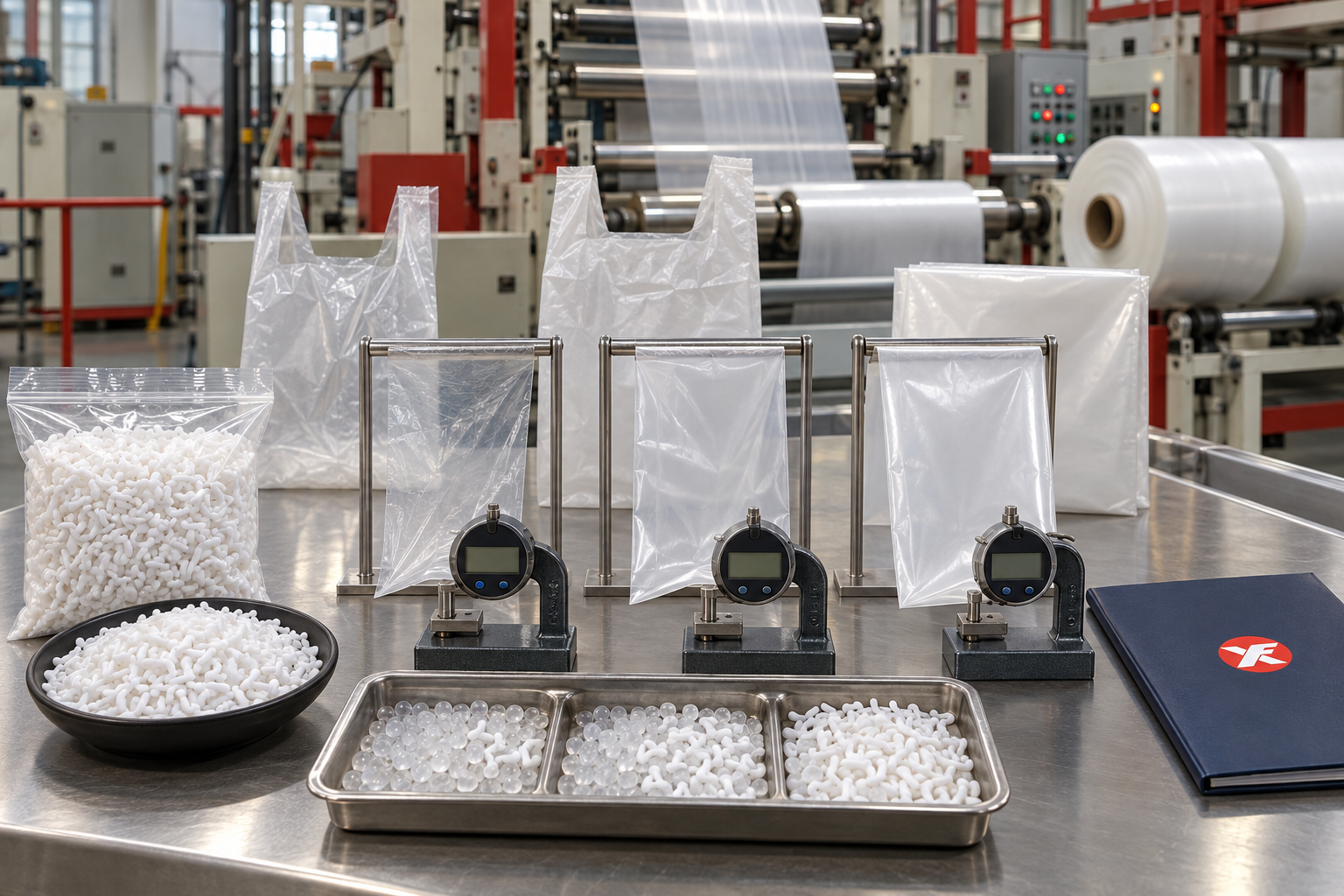
Film thickness is one of the most important factors when selecting a sodium sulfate filler masterbatch dosage.
A formulation that performs well in a thick garbage bag may create white spots, weak seals or unstable production in a thin shopping bag. Applying the same addition ratio to every PE film product can therefore lead to inconsistent results.
Manufacturers should evaluate thickness, resin formulation and finished-product performance together before approving a dosage.
Why Does Film Thickness Matter?
Thin film contains less material across its cross-section. Filler particles, agglomerates and small processing defects therefore have a greater influence on its appearance and strength.
In thicker film, the same particles may be less visible and have a smaller effect on the overall structure.
As film becomes thinner, manufacturers generally need tighter control over:
– Filler dispersion
– Masterbatch dosage
– Raw-material moisture
– Extrusion temperature
– Thickness uniformity
– Film-bubble stability
– Screen-pack condition
– Mechanical performance
Thin film also provides less tolerance for variations between different production batches.
Very Thin PE Film
Very thin film is often used for lightweight bags and cost-sensitive packaging.
These products can be challenging because small formulation changes may affect:
– Film-bubble stability
– Transparency
– White-spot visibility
– Tear resistance
– Handle strength
– Pinholes
– Thickness variation
When testing filler masterbatch in very thin film, begin with a conservative dosage.
Increase the addition level only after confirming that the film remains stable and meets the required mechanical properties.
High filler addition should not be the first trial objective. The initial goal should be to identify a stable starting formulation.
Standard Shopping and T-Shirt Bags
Shopping and T-shirt bags typically require a balance between cost, appearance, handle strength and bottom-seal performance.
The suitable dosage depends on:
– Bag dimensions
– Film thickness
– HDPE, LDPE and LLDPE ratio
– Virgin or recycled material
– Required transparency
– Handle design
– Expected carrying load
– Sealing conditions
Finished bags should be tested with a realistic load. A film sample may appear acceptable while the handle or bottom seal fails during actual use.
The dosage should be evaluated according to the finished bag rather than the film alone.
Garbage Bags
Garbage bags are often thicker or less dependent on high transparency, which may provide greater formulation flexibility.
However, they still require:
– Puncture resistance
– Tear resistance
– Flexible seals
– Reliable bottom closure
– Suitable load-bearing performance
– Consistent bag opening
Recycled material is also common in garbage-bag formulations. Variations in recycled resin may affect the practical filler dosage.
A formulation should therefore be tested with the actual recycled-material batch used in normal production.
Courier and Mailing Bags
Courier bags may use multi-layer or co-extruded film structures.
Instead of adding the same filler dosage to every layer, manufacturers may evaluate the masterbatch in selected layers according to their function.
For example:
– The outer layer may require good printability and surface quality.
– The inner layer may require opacity and toughness.
– The sealing layer must maintain reliable heat-sealing performance.
Film thickness should be evaluated by layer as well as by total structure.
Thick Industrial and Packaging Film
Thicker PE film may tolerate a higher filler level than thin transparent packaging, but the dosage should still be verified through production testing.
Important requirements may include:
– Tensile strength
– Puncture resistance
– Heat sealing
– Flexibility
– Folding endurance
– Printability
– Dimensional consistency
Thick film may hide some visual defects, but poor dispersion can still create weak points or processing problems.
Nominal Thickness Is Not Enough
The target thickness shown in the product specification does not always represent the entire roll.
Measure the film at multiple positions:
– Across the roll width
– Along the roll length
– Near the edges
– At folded sections
– Around handles and sealing areas
A film with an acceptable average thickness may contain thin areas that fail during use.
When filler masterbatch is added, thickness variation should be monitored carefully because changes in melt behaviour can affect bubble stability and gauge control.
Density Can Affect Finished-Product Weight
Sodium sulfate filler masterbatch may change the density of the material blend.
If the machine continues producing the same dimensions and nominal thickness, the finished bag may become heavier.
This affects the real cost calculation.
Manufacturers should record:
– Film thickness
– Bag dimensions
– Weight per bag
– Bags per kilogram
– Masterbatch dosage
– Rejection rate
A lower blended material price per kilogram does not automatically mean a lower cost per bag.
Dispersion Becomes More Visible in Thin Film
In thin or translucent film, poorly dispersed particles may appear as:
– White spots
– Rough areas
– Small raised points
– Pinholes
– Irregular transparency
– Localised weak areas
Inspect the film under normal and backlit conditions.
If defects increase with dosage, review:
– Masterbatch quality
– Premixing
– Processing temperature
– Screen-pack condition
– Moisture
– Carrier-resin compatibility
Reducing the dosage may help, but the root cause should still be identified.
Film Thickness and Heat Sealing
The sealing settings required for thick film may not be suitable for thin film.
After changing the formulation, evaluate:
– Sealing temperature
– Sealing time
– Pressure
– Cooling
– Production speed
– Seal width
Excessive filler addition may affect heat transfer and seal strength.
Test the finished bag after the seal has cooled fully. Inspect for brittle sealing lines, incomplete seals and whitening around the sealed area.
Film Thickness and Mechanical Performance
Mechanical properties should be tested at the actual finished thickness.
Relevant tests may include:
– Tensile strength
– Tear resistance
– Puncture resistance
– Drop testing
– Handle strength
– Bottom-seal strength
– Load-bearing performance
Comparing films with different thicknesses can produce misleading results. A thicker trial film may appear stronger even if the formulation itself is less suitable.
Maintain comparable thickness when evaluating different masterbatch dosages.
Use a Step-by-Step Trial
A practical testing sequence is:
1. Record the original resin formulation.
2. Measure the normal film-thickness range.
3. Record the original bag weight and output.
4. Add a conservative masterbatch dosage.
5. Keep the target thickness unchanged.
6. Allow production to stabilise.
7. Measure film thickness across the roll.
8. Inspect dispersion and appearance.
9. Convert the film into finished bags.
10. Test seals, handles and load performance.
11. Calculate the cost per acceptable bag.
12. Increase the dosage gradually if results remain acceptable.
Only one major variable should be changed at a time.
Compare Products Separately
Do not approve one dosage for the entire factory if multiple products are manufactured.
Create separate trial records for:
– Thin shopping bags
– Standard T-shirt bags
– Garbage bags
– Courier bags
– Printed packaging
– Thick industrial film
Each product may require a different resin formulation, filler dosage and processing setup.
Information to Give the Supplier
For a more suitable recommendation, provide:
– Film application
– Target thickness
– Thickness tolerance
– PE resin grades
– Virgin and recycled material ratio
– Bag dimensions
– Finished-bag weight
– Required transparency
– Sealing method
– Printing requirements
– Expected load
– Current production problems
A physical film or finished-bag sample can also help the supplier understand the required quality level.
Conclusion
PE film thickness directly affects how much sodium sulfate filler masterbatch a formulation can tolerate.
Thin film normally requires stricter control of dosage, dispersion and moisture. Thicker or opaque film may provide more flexibility, but mechanical performance and finished-product weight must still be checked.
The correct dosage is not the highest percentage that can pass through the extruder. It is the level that maintains stable production, acceptable product performance and a lower real cost per finished bag.
Xinfeng manufactures sodium sulfate filler masterbatch for selected PE blown-film and plastic-processing applications.
To request a sample or discuss your film formulation, visit Xinfeng Masterbatch.
Send us a message now for quotation.
WhatsApp: https://wa.memessage/IRZROGA5F2RQO1
WhatsApp:+86 17835035161