Sodium Sulfate Filler Masterbatch for PE Film and PP Injection Molding
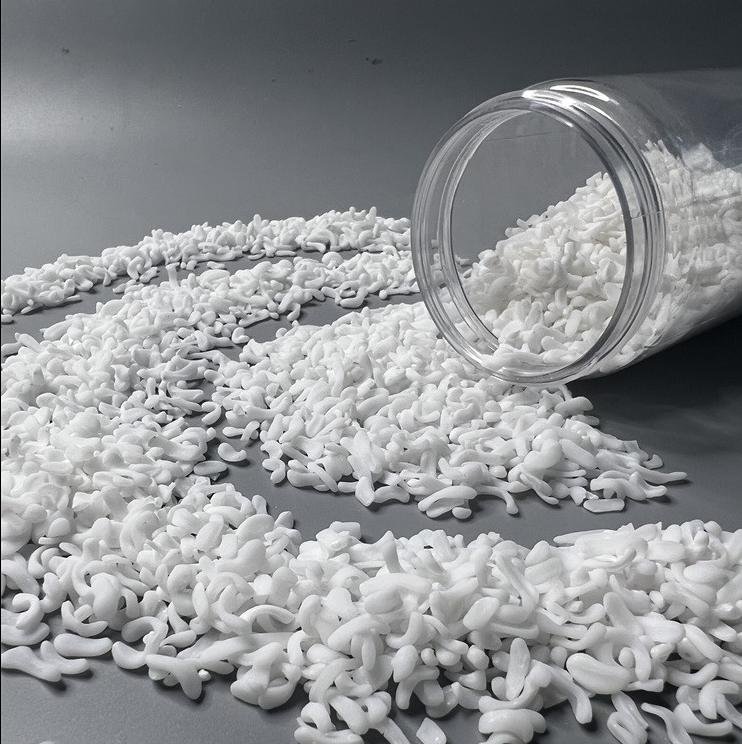
Plastic manufacturers are under constant pressure to control raw-material costs without sacrificing product quality or processing efficiency. Sodium sulfate filler masterbatch provides a practical solution for many polyethylene and polypropylene applications.
Also known as Na2SO4 filler masterbatch or transparent filler masterbatch, this functional additive can partially replace virgin plastic resin in suitable formulations. When correctly selected and tested, it may help manufacturers reduce material costs while maintaining acceptable transparency, appearance and mechanical performance.
What Is Sodium Sulfate Filler Masterbatch?
Sodium sulfate filler masterbatch is a concentrated compound made from finely processed sodium sulfate, a compatible carrier resin and selected processing additives.
Unlike conventional calcium carbonate filler masterbatch, a properly formulated sodium sulfate masterbatch is designed for applications where transparency and surface appearance are important. Its dispersion and compatibility allow it to be incorporated into PE or PP production using standard plastic-processing equipment.
The exact formulation should be selected according to:
Base resin
Production process
Required transparency
Mechanical-performance target
Product thickness
Processing temperature
Desired cost reduction
How Can It Reduce Plastic Production Costs?
Virgin PE and PP resin usually represent a major part of the total production cost. Sodium sulfate filler masterbatch can replace a controlled portion of the resin in suitable products.
Potential benefits include:
Reduced consumption of virgin resin
Lower formulation cost
Improved production consistency
Good dispersion during processing
Maintained surface smoothness in suitable applications
Better balance between cost and product appearance
The achievable saving depends on the masterbatch price, resin price and recommended dosage. A higher addition rate does not automatically produce a better economic result. Excessive filler may negatively affect strength, sealing performance or processing stability.
For this reason, manufacturers should determine the optimal dosage through production trials.
Applications in PE Blown Film
Sodium sulfate transparent filler masterbatch can be used in selected LDPE, LLDPE and HDPE film formulations. Typical applications may include:
Shopping bags
Garbage bags
Packaging film
Industrial liners
General-purpose blown film
Non-food plastic bags
For blown-film production, buyers should evaluate haze, transparency, tensile strength, elongation, sealing performance and film-bubble stability.
Film thickness is especially important. A formulation suitable for a thicker bag may not deliver the same results in very thin film. We therefore recommend testing the material under the customer’s actual production conditions.
Applications in PP Injection Molding
Na2SO4 filler masterbatch can also be considered for suitable polypropylene injection-molded products, including:
Household plastic products
Storage containers
General consumer products
Disposable plastic items
Non-critical industrial components
In PP injection molding, a properly selected functional masterbatch may support cost control and stable processing while maintaining an acceptable surface finish.
However, the recommended formulation depends on the part structure, wall thickness, impact-strength requirement and end-use conditions. Products subject to heavy loads or strict impact requirements require more careful testing.
Sodium Sulfate vs. Calcium Carbonate Filler Masterbatch
Both materials are used to reduce plastic formulation costs, but they are not identical.
Calcium carbonate filler masterbatch is widely used in applications where rigidity, opacity and economical filling are the main priorities. Sodium sulfate filler masterbatch is often considered when the manufacturer wants a better balance between filling and transparency.
The correct choice depends on the finished product. Buyers should compare:
Transparency and haze
Density
Surface gloss
Tensile and impact performance
Dispersion
Processing stability
Total formulation cost
A production trial is more reliable than choosing a filler based only on its price per ton.
How to Select a Suitable Grade
Before choosing a sodium sulfate filler masterbatch, provide the supplier with detailed application information.
Important information includes:
Base resin, such as LDPE, LLDPE, HDPE or PP
Processing method, such as blown film or injection molding
Finished-product thickness and dimensions
Current formulation
Required transparency and color
Mechanical-performance requirements
Target addition ratio
Processing temperature and equipment type
This information enables the supplier to recommend a more appropriate grade and trial dosage.
Why Dispersion and Compatibility Matter
A low-priced masterbatch does not necessarily result in lower production costs. Poor dispersion can cause visible particles, unstable film bubbles, uneven surfaces or frequent production interruptions.
A reliable filler masterbatch should provide:
Uniform granule quality
Good compatibility with the target polymer
Stable feeding
Consistent dispersion
Controlled moisture
Reliable batch-to-batch performance
Manufacturers should evaluate the total processing result instead of comparing only the purchase price.
Work With a Functional Masterbatch Manufacturer
Xinfeng supplies plastic functional additives for cost reduction, processing improvement and performance enhancement. Our product range includes sodium sulfate filler masterbatch, transparent toughening additives, color masterbatch, antiblock additives and desiccant masterbatch.
Our products are developed for plastic-processing applications such as PE blown film and PP injection molding. Grades and trial recommendations can be selected according to the customer’s resin system, equipment and finished-product requirements.
Contact us with your application, current formulation and performance target to discuss a suitable plastic additive solution.
Frequently Asked Questions
What is the recommended dosage of sodium sulfate filler masterbatch?
The suitable dosage depends on the polymer, product thickness, processing method and required performance. Begin with a controlled trial based on the supplier’s recommendation and adjust it according to the test results.
Can it be used in transparent PE film?
It can be considered for suitable transparent and translucent PE film applications. Final transparency depends on the formulation, film thickness, dispersion and addition ratio.
Is it suitable for both PE and PP?
Different grades may be formulated for PE and PP applications. Carrier-resin compatibility must be confirmed before production.
Will sodium sulfate filler masterbatch affect product strength?
Any filler may influence mechanical properties when the dosage changes. The effect should be evaluated through tensile, elongation, impact and sealing tests based on the finished product.
Can it completely replace virgin plastic resin?
No. It is normally used to replace a controlled portion of the resin in suitable applications. The optimal ratio must balance cost, processing stability and finished-product performance.
Send us a message now for quotation.
WhatsApp: https://wa.memessage/IRZROGA5F2RQO1
WhatsApp:+86 17835035161