


Sodium Sulfate Filler Masterbatch for PP Injection Molding Products
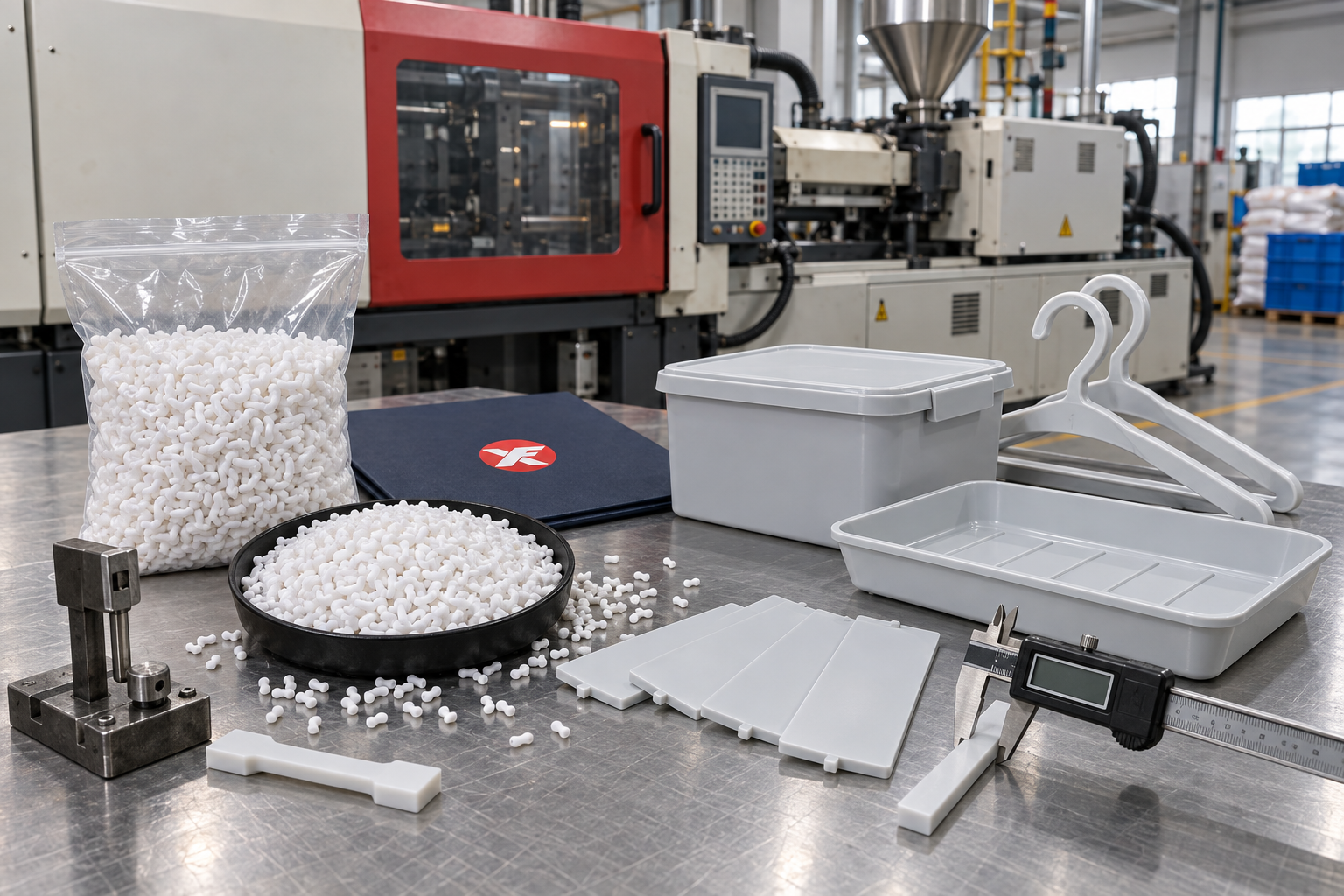
PP injection-moulded products are widely used in household goods, packaging, storage, furniture accessories and general consumer products.
For manufacturers producing high volumes of cost-sensitive items, raw-material expenses have a direct impact on profitability. Sodium sulfate filler masterbatch may be tested in selected PP injection-moulding applications to replace part of the plastic resin and improve production economics.
However, successful use depends on the product structure, resin formulation, mould design and performance requirements. The masterbatch should be evaluated through a controlled production trial before bulk purchasing.
What Is Sodium Sulfate Filler Masterbatch?
Sodium sulfate filler masterbatch is a functional plastic additive produced from treated sodium sulfate, a polymer carrier and suitable processing additives.
The material is supplied in pellet form and can be blended with PP resin before injection moulding.
Compared with feeding untreated powder directly, pelletised masterbatch provides:
Cleaner material handling
Easier weighing and dosing
More uniform mixing
Lower airborne dust
More stable feeding
Convenient use with existing equipment
The carrier resin must be compatible with the PP formulation to achieve suitable melting and dispersion.
Potential PP Injection-Moulding Applications
Sodium sulfate filler masterbatch may be evaluated in selected products such as:
Plastic hangers
Storage boxes
Waste bins
Household containers
Plastic basins
Trays
Flowerpots
General-purpose injection parts
Non-critical packaging components
Cost-sensitive consumer products
It may not be suitable for every application. Products requiring high impact strength, food-contact certification, extreme weather resistance or strict engineering performance require separate material evaluation.
The intended use should always be explained to the supplier before selecting a grade.
Why Do Manufacturers Use Filler Masterbatch?
The main objective is usually to reduce the amount of PP resin used in the formulation.
Depending on the product and processing conditions, an appropriate formulation may help manufacturers:
Lower material cost
Improve cost consistency
Adjust product stiffness
Control moulding economics
Maintain convenient pellet feeding
Increase formulation flexibility
The result should be evaluated according to the total cost per acceptable finished product rather than only the raw-material price per kilogram.
Check Carrier Compatibility
PP injection moulding requires a masterbatch carrier that can disperse effectively within the main resin.
Poor compatibility may lead to:
Surface marks
Uneven colour
Weak weld lines
Brittle sections
Poor dispersion
Irregular mould filling
Reduced mechanical strength
Before testing, provide the supplier with the PP grade, melt-flow information and any recycled-material content used in the formulation.
A masterbatch intended primarily for PE film should not automatically be assumed to perform well in PP injection moulding.
Start with a Small Production Trial
The safest approach is to start with a conservative dosage.
Keep the original PP formulation as the control group, then prepare several trial batches with gradually increasing masterbatch levels.
During each trial, record:
Material formulation
Injection temperature
Injection pressure
Screw speed
Back pressure
Cycle time
Mould-filling condition
Product weight
Surface appearance
Rejection rate
Only one major variable should be changed at a time. Changing the dosage, temperature and pressure simultaneously makes the results difficult to interpret.
Ensure Uniform Premixing
Uneven mixing may cause variations between products or between different sections of the same moulded part.
Before feeding the materials:
Weigh the PP resin and masterbatch accurately.
Mix them thoroughly.
Include colour masterbatch and other additives according to the trial formulation.
Avoid estimating the dosage by volume.
Keep each test batch separated and clearly recorded.
Automatic dosing systems should be calibrated before production testing.
Observe Material Feeding and Plasticisation
During moulding, monitor whether the material feeds smoothly from the hopper into the barrel.
Check for:
Pellet bridging
Clumping
Excessive dust
Irregular screw recovery
Unstable plasticisation
Changes in motor load
Unusual processing sounds
Melt inconsistency
The masterbatch should remain dry and flow freely. Moisture or pellet agglomeration may affect feeding and finished-product appearance.
Evaluate Mould Filling
Adding filler changes the composition of the melt and may affect flow behaviour.
Pay attention to:
Short shots
Incomplete corners
Thin sections
Ribs and reinforcing structures
Weld lines
Gates
Product edges
Multi-cavity filling balance
If mould filling becomes incomplete, review the dosage and processing settings. Do not simply increase injection pressure without checking whether the formulation is suitable.
Products with long flow paths or very thin walls usually require more careful testing.
Inspect Surface Quality
For visible household products, appearance may be as important as cost.
Inspect finished samples for:
White spots
Flow marks
Surface roughness
Colour differences
Uneven gloss
Visible particles
Silver streaks
Gate marks
Warpage
Compare samples from every dosage under the same lighting conditions.
If colour masterbatch is used, confirm that the filler does not create unacceptable shade differences or reduce colour consistency.
Measure Product Shrinkage and Dimensions
Changes in formulation may affect moulding shrinkage and finished-product dimensions.
Measure critical areas after the product has cooled fully. These may include:
Overall length and width
Wall thickness
Lid-fitting dimensions
Snap-fit components
Assembly points
Holes and slots
Flatness
Warpage
For products assembled from multiple components, even a small dimensional change may affect fitting performance.
Trial parts should therefore be checked using the same quality standards as normal production.
Test Impact and Drop Performance
Cost reduction should not make the product unsuitable for normal use.
Depending on the application, test:
Impact strength
Drop resistance
Bending performance
Load-bearing capacity
Snap-fit durability
Edge cracking
Hinge performance
Low-temperature behaviour
For example, a storage box may appear acceptable after moulding but crack when dropped with a load inside.
The test conditions should reflect how customers actually use the product.
Check Weld Lines and Stress Areas
Weld lines, corners, handles, hinges and screw holes are common weak points in injection-moulded products.
After introducing the masterbatch, inspect these areas carefully.
Potential warning signs include:
Whitening during bending
Cracks near screw holes
Weak handles
Brittle corners
Split weld lines
Damaged snap-fit parts
If these defects occur, reduce the filler dosage or adjust the resin formulation.
Evaluate Cycle Time and Production Output
Material savings should not be considered separately from production efficiency.
Record whether the new formulation changes:
Cooling time
Screw-recovery time
Injection time
Demoulding performance
Product sticking
Cycle stability
Daily output
Rejection rate
A low-cost formulation that increases cycle time or rejected products may not provide a real economic advantage.
Consider Mould and Screw Wear
Any filled formulation should be evaluated for its long-term effect on processing equipment.
Manufacturers should monitor:
Screw condition
Barrel condition
Check-ring performance
Nozzle deposits
Hot-runner stability
Mould vents
Gate condition
Cleaning frequency
Stable dispersion and correct processing conditions can help reduce avoidable production problems.
Calculate the Real Cost per Finished Product
The correct comparison is not simply PP resin price versus masterbatch price.
Include:
PP resin savings
Masterbatch cost
Finished-product weight
Cycle time
Energy consumption
Rejection rate
Labour requirements
Mould-cleaning frequency
Customer-quality risk
For example, a formulation that reduces material cost but increases rejected parts may be more expensive overall.
The best dosage is the one that delivers the required performance at the lowest total manufacturing cost.
Common Problems and Possible Causes
White Spots
Possible causes include poor premixing, insufficient dispersion, unsuitable temperature or excessive dosage.
Rough Surface
Review dispersion, processing temperature, moisture and mould condition.
Brittle Products
The addition level may be too high for the application. Impact-modification requirements should also be evaluated.
Incomplete Mould Filling
Check melt flow, dosage, temperature, injection settings and gate design.
Warpage
Review cooling conditions, shrinkage changes, product design and formulation balance.
Uneven Colour
Improve mixing and check compatibility between the filler masterbatch and colour masterbatch.
Information to Provide to the Supplier
For a more appropriate recommendation, share:
PP resin grade
Virgin and recycled material ratio
Product type
Product weight
Wall thickness
Number of mould cavities
Colour requirements
Required impact strength
Current production cycle
Target addition ratio
Photos or samples of the finished product
Detailed application information makes sample selection and technical communication more effective.
Conclusion
Sodium sulfate filler masterbatch may support cost reduction in selected PP injection-moulding products, but it must be tested according to the actual formulation, mould and finished-product requirements.
Manufacturers should evaluate material feeding, mould filling, surface quality, shrinkage, impact strength, cycle time and rejection rate. The highest possible addition ratio is not always the most economical choice.
Xinfeng manufactures sodium sulfate filler masterbatch and other functional additives for PE blown film and selected PP injection-moulding applications.
Send us a message now for quotation.
WhatsApp: https://wa.memessage/IRZROGA5F2RQO1
WhatsApp:+86 17835035161