


How PE Film Thickness Affects Sodium Sulfate Filler Masterbatch Use
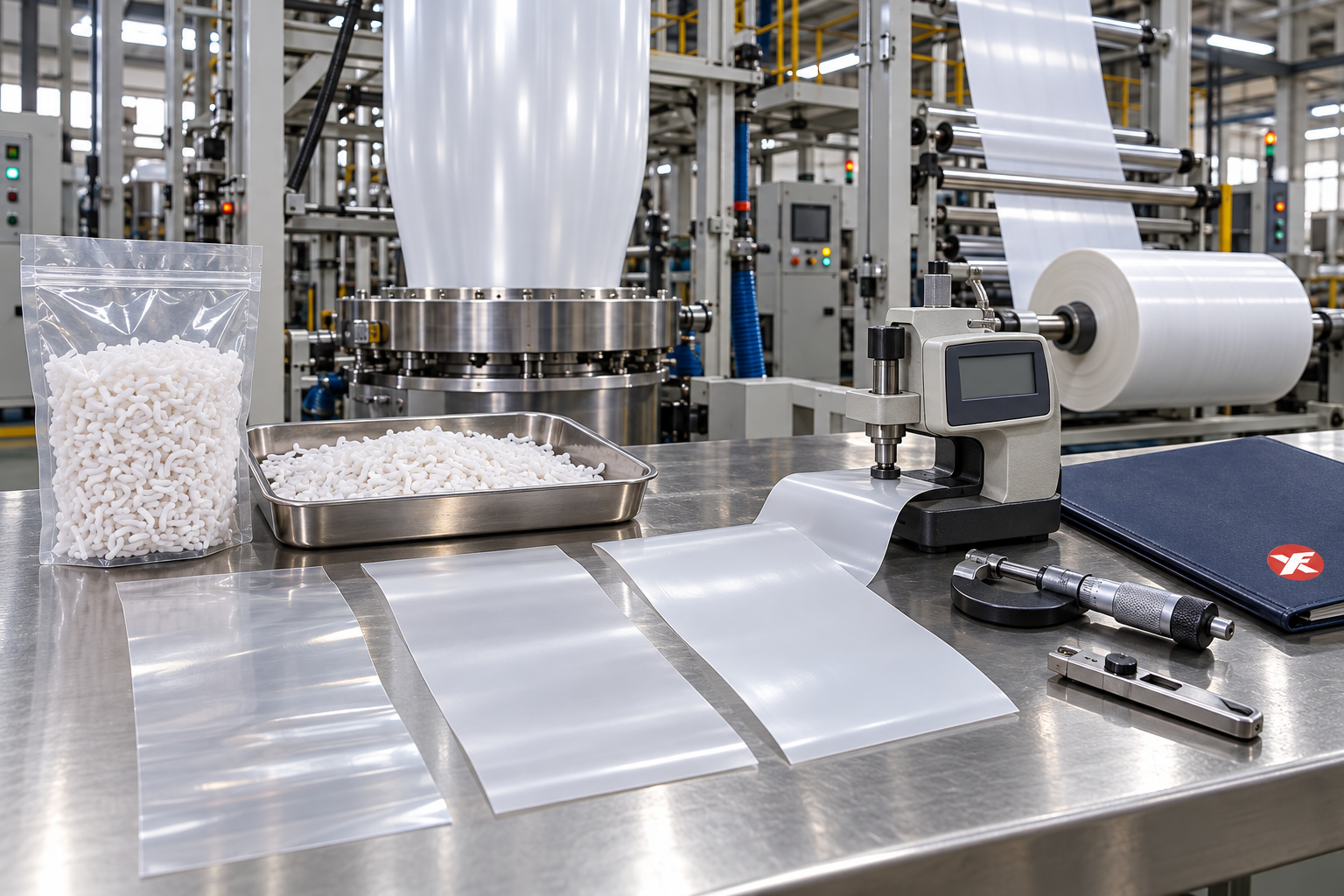
Sodium sulfate filler masterbatch can be used in selected PE blown-film applications to optimize formulation costs and production performance.
However, one formulation cannot be applied automatically to every film thickness.
A masterbatch formulation that performs successfully in a relatively thick refuse bag may not produce the same results in a thin shopping bag, packaging film or protective liner. As film thickness decreases, particle dispersion, contamination, thickness variation and localized weak points become increasingly important.
Manufacturers should therefore select and test the filler masterbatch according to the actual film thickness and finished-product requirements.
Why Is Film Thickness Important?
A thicker film contains more polymer material across its cross-section. It may therefore tolerate small formulation variations or minor defects more easily than a very thin film.
In thin film, a poorly dispersed particle, contaminant or excessively concentrated area may represent a larger proportion of the total thickness. This can contribute to:
– Pinholes
– Fish eyes
– White spots
– Uneven opacity
– Localized weak points
– Reduced elongation
– Film tearing
– Unstable bubbles
– Poor sealing performance
This does not mean that filler masterbatch cannot be used in thin film. It means that the product’s dispersion, carrier compatibility, dosing accuracy and processing control become more critical.
Thin Film Usually Requires More Careful Formulation
When PE film is drawn thinner, the bubble is subjected to significant stretching between the die and the nip rollers.
The final result depends on several connected factors:
– Polymer melt strength
– Resin molecular structure
– Blow-up ratio
– Draw-down ratio
– Frost-line height
– Cooling efficiency
– Extrusion output
– Film thickness
– Additive and filler dispersion
Research on polyethylene film blowing confirms that resin characteristics and processing parameters interact to determine film orientation and final properties. Film thickness cannot be considered separately from the resin and machine settings. Research on PE blown-film processing
As the target film becomes thinner, manufacturers should generally begin with a more conservative filler trial and increase the dosage only after the film passes the required tests.
Thicker Film May Offer a Wider Processing Window
Relatively thick PE film may provide a wider processing window for certain filler masterbatch applications.
Typical examples may include:
– Refuse bags
– Industrial liners
– Protective covers
– General-purpose packaging
– Non-critical shipping bags
– Construction film
– Thick shopping bags
However, thickness alone does not determine the correct dosage.
A thick film requiring high impact strength, puncture resistance or heavy-load performance may still need a conservative formulation. Meanwhile, a thicker film with moderate mechanical requirements may tolerate a different filler level.
The finished product—not only the micrometer reading—must guide the final decision.
Particle Dispersion Becomes More Visible in Thin Film
Uniform dispersion helps prevent concentrated filler areas and large agglomerates.
Research involving inorganic-filled polyethylene films shows that better filler dispersion can improve mechanical performance compared with poorly dispersed filler systems. Agglomerated particles may act as stress-concentration points, affecting tensile strength and elongation. Study of inorganic filler dispersion in PE
For thin-film applications, inspect samples against a controlled light source and look for:
– Concentrated white particles
– Uneven opacity
– Small holes
– Surface roughness
– Streaks
– Gels
– Unmelted material
– Thickness bands
A film that looks acceptable when folded into several layers should also be examined as a single layer.
Measure Actual Thickness Across the Film
The machine setting or target specification does not prove that the entire film has the same thickness.
Measurements should be taken across the web and along the production roll. Suggested sample positions include:
– Left side
– Left-center
– Center
– Right-center
– Right side
– Beginning of the roll
– Middle of the roll
– End of the roll
ASTM maintains guidance for determining the thickness of plastic-film test specimens, while other film standards cover thickness variability, tensile performance, impact, tear and related properties. ASTM plastic-film standards
Use a calibrated instrument and follow the relevant test method or customer specification.
Do Not Confuse Average Thickness with Uniformity
Two film rolls may have the same average thickness but very different thickness profiles.
For example, one roll may remain close to the target across its entire width. Another may contain alternating thick and thin bands that produce the same average value.
Thin areas can create:
– Lower bag strength
– Inconsistent sealing
– Puncture failure
– Uneven winding
– Wrinkles
– Customer complaints
When evaluating a filler masterbatch, record both average thickness and thickness variation.
Start from the Actual Commercial Film
A trial should reproduce the intended commercial product as closely as possible.
Testing a masterbatch only in a thick laboratory film may hide problems that appear when the film is drawn down to its final thickness.
The trial should use:
– The intended base resin
– The intended recycled-material content
– The normal film width
– The target commercial thickness
– The planned color masterbatch
– The actual production speed
– The usual blow-up ratio
– The normal bag-making process
If the formulation will be used for multiple film thicknesses, each important thickness range should be validated separately.
Adjust the Dosage Gradually
Avoid moving directly from a filler-free formulation to a high filler-masterbatch level.
A controlled trial can follow this sequence:
1. Produce a reference film without changing the established formula.
2. Confirm stable bubble formation.
3. Measure the reference film’s thickness profile.
4. Record extrusion pressure, motor load and output.
5. Add the filler masterbatch at a conservative starting level.
6. Keep other formulation variables unchanged.
7. Produce the film at the actual target thickness.
8. Inspect dispersion and surface quality.
9. Test mechanical and sealing properties.
10. Increase the dosage only after the previous stage passes.
This makes it easier to identify the point at which the formulation no longer meets the required performance.
Use Accurate Feeding and Mixing
Thin-film production can reveal small fluctuations in filler concentration.
If the dosing system feeds unevenly, sections of film may contain different amounts of filler. This can cause changes in opacity, thickness, strength and bubble stability.
Recommended controls include:
– Use gravimetric dosing where possible.
– Weigh each material separately.
– Avoid estimating dosage by volume.
– Maintain a consistent mixing time.
– Prevent pellet separation during conveying.
– Check for hopper bridging.
– Keep the feeder clean.
– Record the raw-material batch numbers.
The formulation should remain consistent throughout the production roll.
Monitor Extrusion Pressure and the Screen Pack
Increasing filler content can change melt behavior and filtration conditions. Contamination or poorly dispersed material may also increase screen pressure.
During every trial, record:
– Initial melt pressure
– Pressure after stable production
– Pressure trend over time
– Motor current
– Output rate
– Screen-changing frequency
– Die buildup
– Film-defect frequency
An unstable or rapidly increasing pressure should be investigated before increasing the filler dosage.
Test Mechanical Properties in Both Directions
Blown film is stretched differently in the machine direction and transverse direction. Its strength and tear behavior may therefore differ between the two directions.
Depending on the application, test:
– Tensile strength
– Elongation at break
– Tear resistance
– Dart-drop impact
– Puncture resistance
– Film stiffness
– Heat-seal strength
Thin films often have less material available to absorb impact or resist the growth of a tear. A small cut or pinhole may become a significant failure point.
Evaluate the Finished Bag
Film testing is only one part of the qualification process.
If the film will be converted into bags, test the finished product for:
– Bottom-seal strength
– Side-seal strength
– Handle-punch performance
– Opening behavior
– Drop resistance
– Leakage
– Static loading
– Repeated lifting
– Puncture resistance
A formulation may produce stable film but still fail during bag making or customer use.
Consider Color and Opacity
Film thickness affects how customers see color and opacity.
A dark film may appear lighter when it is made thinner. A white or pastel film may show greater shade variation when filler or pigment distribution is uneven.
When evaluating a new formulation:
– Compare samples at the same thickness.
– Use consistent lighting.
– Check a single film layer.
– Retain an approved reference sample.
– Measure color difference if required.
– Recheck printing and corona treatment.
Do not compare a thick reference sample directly with a thinner trial sample without considering the optical effect of thickness.
Calculate Cost by Film Area or Finished Bag
Comparing formulations only by price per kilogram can be misleading.
For film products, useful cost indicators include:
– Cost per square meter
– Cost per thousand bags
– Cost per qualified roll
– Cost per acceptable finished product
A formulation may have a lower cost per kilogram while producing a heavier film, lower output, more waste or a higher rejection rate.
Include:
– Resin consumption
– Filler and color masterbatch
– Production speed
– Energy use
– Screen replacement
– Film waste
– Bag-making waste
– Finished-product qualification rate
The optimum dosage is the one that produces the best total economic result while meeting the product specification.
Information to Provide to the Supplier
For a more appropriate recommendation, provide:
– Target film thickness
– Film-width range
– PE resin grades
– Virgin and recycled content
– Current formulation
– Color requirements
– Film-blowing equipment
– Blow-up ratio
– Production speed
– Finished-product application
– Required tensile, tear and impact properties
– Heat-sealing requirements
– Photographs of any current defects
This allows the masterbatch supplier to recommend a more suitable grade and trial method.
Conclusion
PE film thickness has an important influence on the successful use of sodium sulfate filler masterbatch.
Thin film generally requires more precise dosing, better dispersion, tighter thickness control and more conservative testing because localized particles and formulation variations can have a greater effect on the total film structure.
Thicker film may offer a wider operating window, but it must still meet the required strength, sealing and end-use performance.
Manufacturers should test the masterbatch at the actual production thickness, increase the dosage gradually and evaluate the finished product—not just the raw-material cost.
Xinfeng supplies sodium sulfate filler masterbatch for selected PE blown-film and plastic bag applications. Trial recommendations can be developed according to the customer’s film thickness, resin formulation, equipment and finished-product requirements.
For samples or technical consultation, visit Xinfeng Masterbatch.
Send us a message now for quotation.
WhatsApp: https://wa.memessage/IRZROGA5F2RQO1
WhatsApp:+86 17835035161