


Can Sodium Sulfate Filler Masterbatch Be Used in LDPE, LLDPE and HDPE?
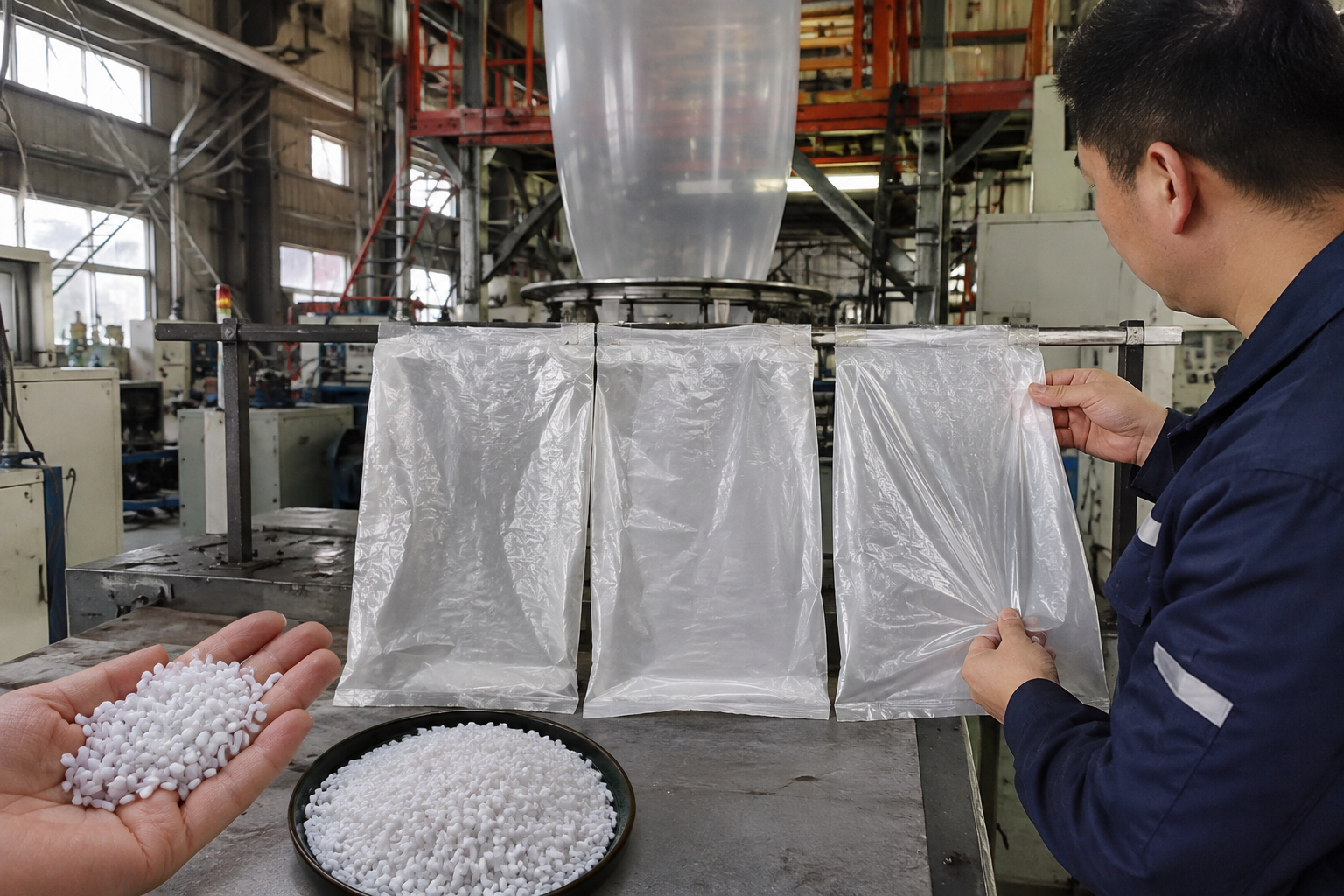
LDPE, LLDPE and HDPE all belong to the polyethylene family, but they do not provide identical processing or finished-product properties.
A sodium sulfate filler masterbatch that performs well in one PE formulation may require a different dosage or grade in another. The result depends on carrier compatibility, film thickness, resin blend, equipment and finished-product requirements.
Sodium sulfate filler masterbatch can be evaluated in suitable LDPE, LLDPE and HDPE applications. However, manufacturers should not assume that one grade and one dosage will work equally well in every polyethylene system.
This guide explains the main differences and how to conduct a reliable production trial.
What Is Sodium Sulfate Filler Masterbatch?
Sodium sulfate filler masterbatch is a granular functional additive manufactured from finely processed sodium sulfate, a compatible carrier resin and selected processing additives.
It is also known as:
Na2SO4 filler masterbatch
Sodium sulfate filling masterbatch
Sodium sulfate transparent filler masterbatch
PE film cost-reduction masterbatch
Functional filler masterbatch
In a suitable polyethylene formulation, it can replace a controlled portion of virgin or recycled resin to help reduce raw-material costs.
The product should be selected according to the customer’s base resin and processing method.
Understanding the Three Main PE Types
LDPE
Low-density polyethylene is commonly used in flexible film applications.
Depending on the grade, LDPE may offer:
Good processability
Useful melt strength
Film softness
Heat-sealing performance
Gloss
Flexibility
Typical applications include shopping bags, liners, packaging film and general plastic bags.
LLDPE
Linear low-density polyethylene is frequently blended with LDPE to improve selected mechanical properties.
Depending on the grade, LLDPE may contribute:
Tensile strength
Elongation
Puncture resistance
Tear performance
Toughness
It is widely used in garbage bags, stretch-type applications, industrial liners and packaging film.
HDPE
High-density polyethylene has a different molecular structure and generally provides greater stiffness than LDPE.
Depending on the grade and application, HDPE may contribute:
Stiffness
Thin-film capability
Characteristic film feel
Tensile performance
Lower natural clarity than some LDPE formulations
It is commonly used in T-shirt bags, produce bags, liners and other thin-film products.
Is One Sodium Sulfate Masterbatch Suitable for All Three?
Not automatically.
Although LDPE, LLDPE and HDPE are chemically related, differences in density, melt flow, crystallinity and processing behavior can affect masterbatch performance.
The supplier should consider:
Carrier-resin type
Base-resin melt flow
Film-blowing conditions
Required transparency
Mechanical requirements
Product thickness
Addition ratio
Some sodium sulfate masterbatch grades may be suitable for a range of PE formulations. Others may be optimized for a narrower application.
Always confirm the recommended polymer system before ordering.
Carrier Compatibility Is Important
The carrier resin helps introduce and disperse sodium sulfate throughout the plastic melt.
A suitable carrier should:
Melt within the processing conditions
Mix with the base PE
Support even filler distribution
Feed consistently
Avoid unnecessary surface defects
Poor compatibility may contribute to:
White spots
Rough film
Uneven haze
Weak areas
Film-bubble instability
Die deposits
Inconsistent mechanical properties
Tell the supplier whether your formulation is mainly LDPE, LLDPE, HDPE or a blend.
Sodium Sulfate Filler Masterbatch in LDPE
LDPE is widely used where film processability, softness and heat sealing are important.
Sodium sulfate filler masterbatch may be evaluated in LDPE applications such as:
Shopping bags
Garbage bags
General packaging film
Industrial liners
Inner packaging
Translucent bags
During testing, monitor:
Film-bubble stability
Transparency and haze
Film softness
Tensile strength
Elongation
Tear resistance
Heat-sealing strength
Surface appearance
The addition ratio should remain within the performance limits of the finished product.
Sodium Sulfate Filler Masterbatch in LLDPE
LLDPE is often used to improve the toughness of a PE film formulation.
A manufacturer may combine:
LDPE for processing
LLDPE for strength
Sodium sulfate filler masterbatch for cost control
The balance must be tested carefully.
As the filler dosage increases, evaluate whether the LLDPE content continues to provide sufficient:
Puncture resistance
Tear strength
Elongation
Load-bearing performance
Seal durability
LLDPE does not automatically prevent every mechanical-property change caused by a high filler ratio.
The complete formulation must pass finished-product testing.
Sodium Sulfate Filler Masterbatch in HDPE
HDPE film can be thin and relatively stiff. Small changes in dispersion or thickness may therefore become more noticeable.
Possible applications include:
T-shirt bags
Produce bags
Thin liners
General shopping bags
Selected packaging film
During an HDPE trial, check:
Bubble stability
Film thickness
White spots
Surface roughness
Tear behavior
Handle strength
Seal strength
Product weight
Very thin HDPE film generally requires conservative testing because visible defects and weak points can have a greater effect.
Using It in LDPE/LLDPE Blends
Many blown-film formulations use LDPE and LLDPE together.
The precise ratio depends on the machine, product and resin grades.
When introducing sodium sulfate filler masterbatch:
Record the current LDPE/LLDPE ratio.
Keep the resin blend stable during the first trial.
Add the recommended initial masterbatch dosage.
Record processing behavior.
Test the finished film and bags.
Increase the dosage only after the first formula passes.
Do not change the LDPE/LLDPE blend and filler dosage simultaneously unless the trial is specifically designed to evaluate both variables.
Using It in Mixed PE Formulations
Some manufacturers use LDPE, LLDPE and HDPE in the same formulation.
Mixed PE formulas may be developed to balance:
Processability
Stiffness
Toughness
Film feel
Cost
Sealing behavior
Adding sodium sulfate filler masterbatch introduces another variable.
For a meaningful trial, document every resin grade and percentage. The supplier cannot provide useful guidance if the formulation is described only as “PE.”
Virgin PE Versus Recycled PE
Sodium sulfate filler masterbatch may be tested with suitable virgin or recycled polyethylene.
Virgin PE usually provides more predictable:
Composition
Melt flow
Color
Mechanical properties
Moisture condition
Recycled PE may vary in:
Polymer composition
Contamination
Pigment content
Moisture
Degradation
Melt flow
Existing mineral content
When recycled PE is used, the masterbatch dosage should be evaluated using the actual commercial batch.
A formula that works with one recycled source may need adjustment when the source changes.
How Resin Melt Flow Affects the Trial
Melt flow is one factor influencing how the formulation processes and mixes.
If the viscosities of the base resin and masterbatch carrier are poorly matched, dispersion and processing may become less stable.
Possible symptoms include:
Uneven mixing
Pressure changes
Surface defects
Poor film uniformity
Inconsistent mechanical performance
Provide the resin grade or melt-flow information to the masterbatch manufacturer whenever available.
Melt flow should be considered together with temperature, screw design and production output.
Transparency Differences
LDPE, LLDPE and HDPE do not have identical natural optical properties.
Final transparency depends on:
PE type and grade
Filler dosage
Film thickness
Resin blend
Filler dispersion
Cooling conditions
Recycled-material content
Other additives
Sodium sulfate filler masterbatch may support an acceptable transparent or translucent appearance in suitable applications, but it will not be completely invisible under all conditions.
Compare samples at the same actual thickness.
Mechanical-Property Differences
Each PE type contributes differently to film performance.
When testing the masterbatch, measure properties relevant to the finished product:
Tensile strength
Elongation
Tear resistance
Puncture resistance
Impact performance
Handle strength
Load-bearing capacity
Heat-sealing strength
Do not evaluate strength based only on hand feeling.
A film may feel stiff or thick but still fail the required tear, puncture or sealing test.
Heat-Sealing Considerations
LDPE, LLDPE and HDPE blends can have different sealing windows.
After adding sodium sulfate filler masterbatch, check:
Seal initiation behavior
Sealing temperature
Pressure
Contact time
Cooling time
Bag-making speed
Seal strength
A formula that runs well on the blown-film machine may still require bag-making adjustments.
Test the completed bag rather than approving only the film roll.
Film Thickness and Product Weight
Changes in formulation may affect density, thickness control and finished-product weight.
Record:
Actual film thickness
Weight per meter
Bag weight
Roll weight
Qualified output per ton
For thin HDPE bags, small thickness changes may significantly affect strength and weight.
For LDPE and LLDPE film, thickness uniformity remains important for sealing and load performance.
Recommended Trial Procedure
Step 1: Identify the Resin System
Record each PE type, grade and percentage.
Step 2: Record the Original Production Data
Include:
Film thickness
Product weight
Temperature profile
Production speed
Scrap rate
Mechanical-test results
Step 3: Select a Compatible Masterbatch
Provide the resin and application information to the supplier.
Step 4: Start with a Controlled Dosage
Do not begin with the maximum possible ratio.
Step 5: Keep Major Variables Stable
Use the same resin batches and target thickness where possible.
Step 6: Observe Processing
Check feeding, pressure, dispersion, bubble stability, deposits and output.
Step 7: Test the Finished Product
Complete optical, mechanical, sealing and actual-use tests.
Step 8: Calculate Cost per Qualified Product
Include material cost, product weight, scrap and production efficiency.
Common Compatibility Problems
White Spots
Possible causes include poor dispersion, low temperature, incompatible carrier resin or contamination.
Unstable Film Bubble
Check moisture, mixing, temperature, filler dosage and resin compatibility.
Reduced Film Strength
Review the dosage, PE blend, recycled-material quality, thickness and dispersion.
Weak Seals
Check the resin blend, filler ratio, film thickness and bag-making parameters.
Excessive Haze
Review masterbatch dosage, film thickness, base resin and cooling conditions.
Die Deposits
Inspect the formulation, processing temperature, machine cleanliness and screen condition.
Which PE Is Best for Sodium Sulfate Filler Masterbatch?
There is no single PE type that is best for every application.
The correct system depends on:
Finished-product requirements
Resin availability
Equipment
Film thickness
Transparency
Required strength
Cost target
A masterbatch should be selected for the customer’s existing production needs rather than forcing every factory to use the same resin formula.
Information to Send the Supplier
Provide:
LDPE, LLDPE and HDPE percentages
Resin grades
Virgin/recycled ratio
Complete additive formula
Processing method
Film thickness
Finished-product application
Required transparency
Mechanical requirements
Processing temperature
Target dosage
Product samples or photographs
This information enables a more relevant masterbatch and trial recommendation.
Sodium Sulfate Filler Masterbatch from Xinfeng
Xinfeng manufactures sodium sulfate filler masterbatch for suitable LDPE, LLDPE, HDPE and mixed-PE processing applications.
Our functional additive range also includes:
High-transparency toughening additives
Color masterbatch
Antiblock masterbatch
Desiccant masterbatch
Other plastic functional additives
We recommend products according to the customer’s resin system, production equipment, finished-product requirements and target cost.
Send us your PE grades and current formulation to request a suitable sodium sulfate filler masterbatch sample.
Frequently Asked Questions
Can sodium sulfate filler masterbatch be used with LDPE?
A compatible grade may be evaluated in suitable LDPE film formulations. Dosage and performance must be confirmed through testing.
Can it be mixed with LLDPE?
Yes, suitable grades may be tested in LDPE/LLDPE or other LLDPE-containing formulations.
Is it suitable for thin HDPE bags?
It may be tested, but thin film requires careful control of dispersion, dosage, thickness and mechanical performance.
Can the same dosage be used in LDPE and HDPE?
Not automatically. The suitable dosage depends on the resin grade, film thickness, equipment and finished-product requirements.
Does recycled PE affect compatibility?
Yes. Recycled material may contain mixed polymers, moisture, contaminants and existing additives.
Will it affect heat sealing?
It may change sealing behavior depending on dosage and formula. Test the actual finished bag and adjust sealing parameters if necessary.
What information is most important before ordering a sample?
Provide the exact resin grades, formulation percentages, processing method, film thickness and required finished-product performance.
Request a PE Compatibility Trial
Send Xinfeng your:
LDPE, LLDPE and HDPE grades
Current mixing ratios
Recycled-material content
Film thickness
Finished-product application
Performance requirements
Target cost reduction
We can recommend a suitable sodium sulfate filler masterbatch grade and starting trial ratio.
Send us a message now for quotation.
WhatsApp: https://wa.memessage/IRZROGA5F2RQO1
WhatsApp:+86 17835035161