


How Sodium Sulfate Filler Masterbatch Affects PE Film Printing
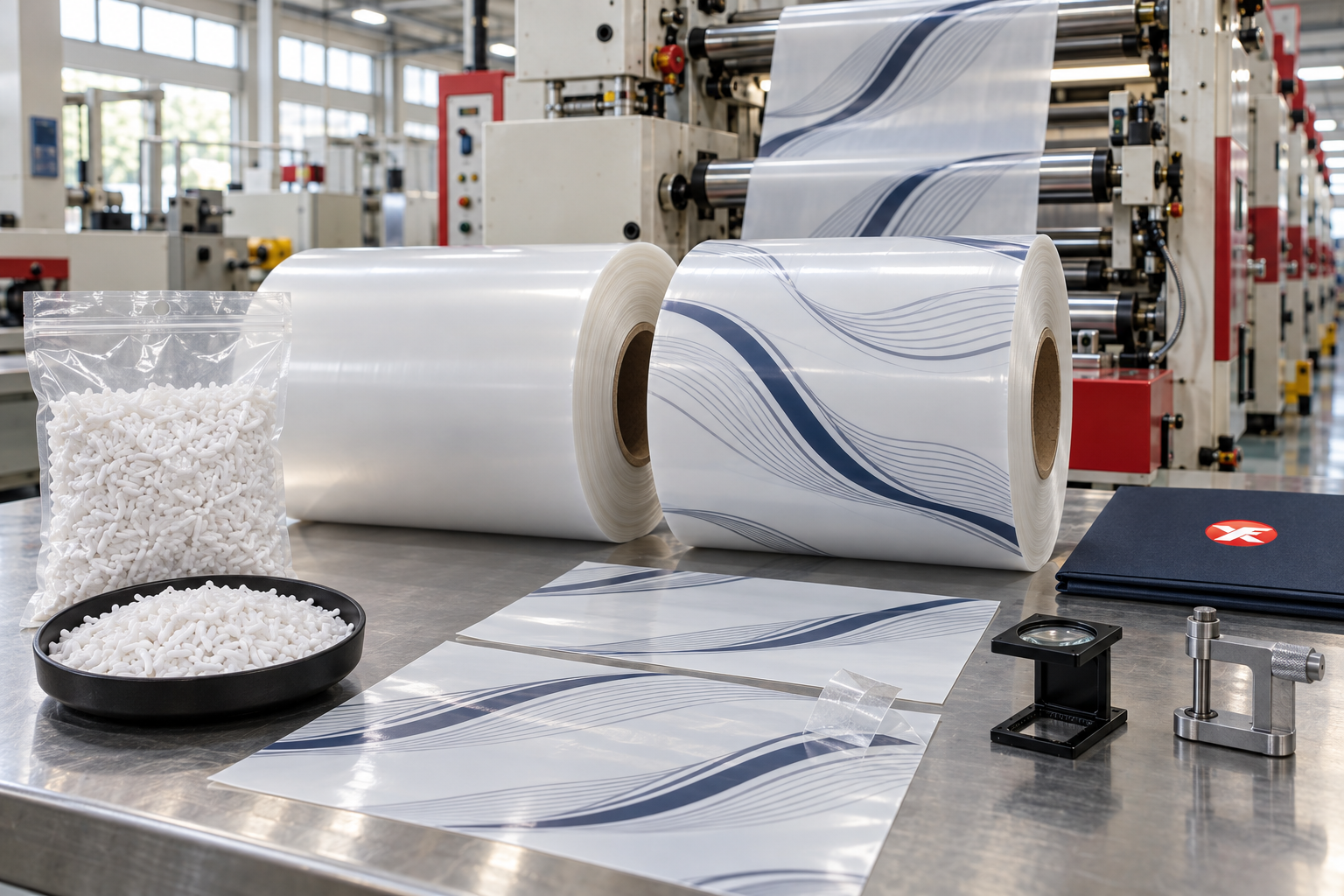
Printed PE film is widely used for shopping bags, courier bags, garbage bags and general packaging. Manufacturers must balance raw-material cost, extrusion stability, print quality and finished-bag performance.
Sodium sulfate filler masterbatch may help reduce resin consumption in selected PE film formulations. However, introducing filler can change the surface and mechanical behaviour of the film.
Before using the masterbatch in printed packaging, manufacturers should evaluate corona treatment, ink adhesion, colour consistency and sealing performance through a controlled production trial.
Why Is PE Film Difficult to Print?
Untreated polyethylene has relatively low surface energy. Printing ink may not wet or bond to the film effectively without surface treatment.
Corona treatment is commonly used to increase the surface energy of PE film before printing. When treatment is suitable, the ink spreads more evenly and forms a stronger bond with the film.
Printing performance can still vary according to:
– HDPE, LDPE and LLDPE formulation
– Virgin and recycled resin content
– Film thickness
– Slip and anti-block additives
– Filler-masterbatch dosage
– Corona-treatment level
– Ink system
– Printing speed
– Storage time before printing
Changing the film formulation may require the printing conditions to be reviewed.
Can Filler Masterbatch Affect Ink Adhesion?
Yes. Filler masterbatch may influence film-surface uniformity, additive migration and corona-treatment consistency.
If the dosage or dispersion is unsuitable, possible printing problems include:
– Weak ink adhesion
– Uneven ink coverage
– Pinholes in solid printed areas
– Colour differences
– Poor gloss
– White spots
– Ink rubbing or peeling
– Irregular treatment across the film
These problems do not always mean that the masterbatch is unsuitable. Extrusion settings, moisture, recycled resin and the ink system should also be checked.
Start with a Stable Film Formulation
Before testing filler masterbatch, record the original formulation and normal printing results.
Useful baseline information includes:
– Resin grades and ratios
– Recycled-material percentage
– Colour-masterbatch dosage
– Slip-agent dosage
– Anti-block additive
– Film thickness
– Extrusion temperature
– Corona settings
– Ink type
– Printing speed
– Current rejection rate
This control formulation allows the manufacturer to compare the effect of each masterbatch dosage more accurately.
Increase the Dosage Gradually
Do not begin the trial at the highest possible addition level.
Start conservatively and increase the dosage step by step. Keep the resin formulation, equipment settings and printing conditions as stable as possible during each test.
At every dosage level, inspect:
– Film-bubble stability
– Surface smoothness
– Filler dispersion
– Film thickness
– Corona-treatment uniformity
– Ink coverage
– Ink adhesion
– Colour consistency
– Seal strength
The practical addition limit is reached when further resin savings create unacceptable production or printing problems.
Dispersion Is Important for Printed Film
Poorly dispersed filler can create visible particles or irregularities in the film.
These defects may become more noticeable after printing, especially in dark or solid-colour areas.
Possible signs of poor dispersion include:
– White spots
– Rough printed areas
– Small unprinted points
– Uneven colour density
– Local film weakness
– Irregular ink transfer
Inspect both unprinted and printed film under consistent lighting. Backlighting can help reveal agglomerates, pinholes and thickness differences.
Check the Film Before Printing
Printing problems should not be diagnosed only at the printing machine.
First inspect the unprinted film for:
– Moisture bubbles
– Pinholes
– Surface contamination
– Excessive powder
– Uneven thickness
– Wrinkles
– Poor winding
– Visible agglomerates
If the base film already contains defects, printing adjustments alone will not solve the problem.
Correcting extrusion and material-handling issues first can prevent unnecessary printing waste.
Review Corona-Treatment Performance
A formulation change may affect the consistency of corona treatment.
During the trial, check whether treatment remains uniform across the full film width. The required level depends on the film, ink and printing process.
Manufacturers should measure surface energy using an appropriate test method rather than relying only on visual judgement.
Also consider the time between corona treatment and printing. Surface treatment may reduce during storage, particularly when the film contains additives that migrate to the surface.
For reliable results:
– Test newly treated film.
– Test again after the expected storage period.
– Keep rolls clean and protected.
– Record treatment conditions.
– Compare different positions across the roll.
Evaluate Ink Adhesion
Ink adhesion should be tested after the ink has dried or cured according to the ink supplier’s instructions.
Common evaluation methods include:
– Tape testing
– Rubbing tests
– Folding tests
– Scratch resistance
– Bag-conversion testing
– Product-contact simulation
The testing method should match the final application.
A shopping bag may require resistance to folding and rubbing, while a courier bag must withstand handling and friction during transportation.
Observe Colour and Print Density
Filler masterbatch can influence the visual background of the film, particularly when the packaging uses light colours, transparent sections or fine graphics.
Compare trial samples for:
– Colour shade
– Print density
– Gloss
– Opacity
– Fine-line definition
– Small-text clarity
– Registration stability
– Solid-area uniformity
Use the same ink batch and printing settings when comparing different formulations.
If the film’s background colour changes, the printing ink formulation may also require adjustment.
Consider White and Dark Courier Films
Co-extruded courier bags often use a light outer surface and a dark inner layer.
In these structures, filler masterbatch may be tested in selected layers rather than added equally throughout the film.
The outer printing layer should provide:
– Smooth appearance
– Uniform colour
– Suitable corona treatment
– Good ink adhesion
– Adequate seal performance
The inner layer may have different requirements for opacity, toughness and recycled-material use.
Layer-specific testing can provide more formulation flexibility than treating every layer identically.
Check Printing and Sealing Together
A film can print well but still fail during bag conversion.
After printing, test:
– Side seals
– Bottom seals
– Flap seals
– Handle areas
– Adhesive-strip zones
– Printed areas near seals
Ink, filler and sealing conditions may interact. Printed areas should not contaminate the sealing surface or reduce seal strength.
The finished bag should be tested with a realistic load rather than evaluated only as a flat film sample.
Control Moisture and Storage
Moisture may cause bubbles and pinholes that later appear as printing defects.
Recommended practices include:
– Store masterbatch in a dry warehouse.
– Keep unopened bags sealed.
– Place bags on raised pallets.
– Reseal unused material promptly.
– Check recycled resin for moisture.
– Keep mixers and conveying systems dry.
– Protect finished-film rolls from dust and humidity.
When printing defects appear, inspect every component of the formulation instead of assuming that the printing machine is the only cause.
Calculate the Real Cost of Printed Film
A lower extrusion-material cost does not automatically mean a lower total production cost.
The calculation should include:
– Virgin-resin savings
– Filler-masterbatch cost
– Printing-ink consumption
– Printing speed
– Rejected film
– Colour-adjustment waste
– Bag-conversion waste
– Sealing failures
– Customer-quality requirements
A stable formulation with a moderate filler dosage may be more economical than a higher dosage that increases printing waste.
Information to Provide to the Supplier
For a more useful recommendation, provide:
– PE resin formulation
– Virgin and recycled material ratio
– Film thickness
– Bag or packaging application
– Number of printed colours
– Printing method
– Ink type
– Corona-treatment process
– Required transparency or opacity
– Target addition ratio
– Photos of current defects
Printed and unprinted film samples can help the supplier distinguish between dispersion, moisture and surface-treatment problems.
Conclusion
Sodium sulfate filler masterbatch can be tested in selected printed PE film applications, but printing performance must be considered from the start of formulation development.
Manufacturers should evaluate dispersion, surface quality, corona treatment, ink adhesion, colour consistency and sealing strength. Increasing the dosage gradually and recording each trial provides a safer route to cost reduction.
Xinfeng manufactures sodium sulfate filler masterbatch for PE blown film and other selected plastic-processing applications.
To discuss your printed-film formulation or request a sample, visit Xinfeng Masterbatch.
Send us a message now for quotation.
WhatsApp: https://wa.memessage/IRZROGA5F2RQO1
WhatsApp:+86 17835035161