


How to Calculate the Real Cost Savings of Sodium Sulfate Filler Masterbatch
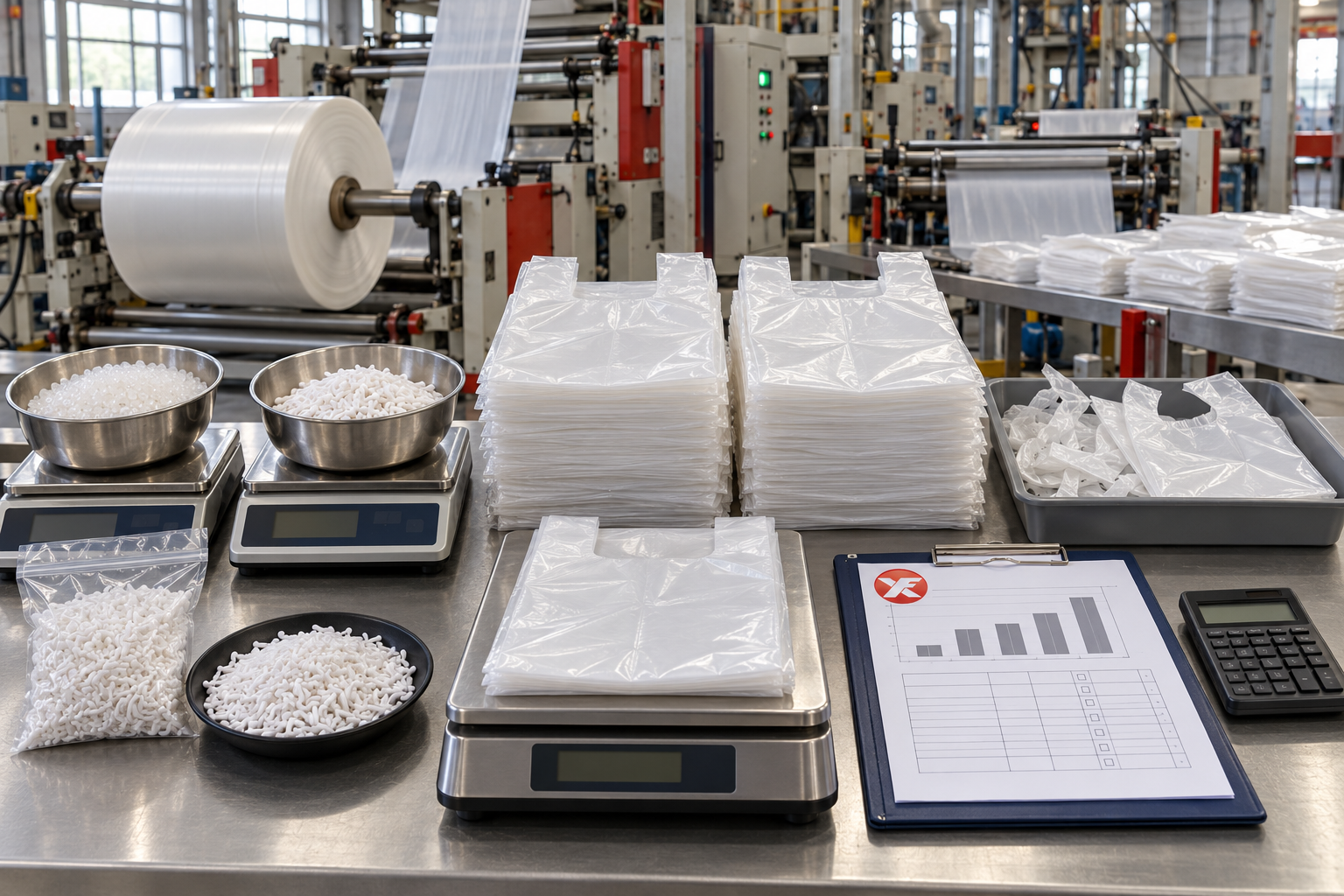
The main reason manufacturers use sodium sulfate filler masterbatch is to reduce plastic raw-material costs.
However, comparing the price of PE resin with the price of filler masterbatch does not show the complete result. Changes in bag weight, rejection rate, production output, sealing performance and downtime can significantly affect the actual savings.
The correct calculation should focus on the cost per acceptable finished product.
Why Price per Kilogram Is Not Enough
A filler masterbatch may cost less per kilogram than virgin PE resin, but several production factors can influence the final result.
These include:
– Masterbatch addition ratio
– Finished-bag weight
– Film thickness
– Production rejection rate
– Extrusion output
– Screen-changing frequency
– Electricity consumption
– Sealing failures
– Printing waste
– Customer-quality requirements
A formulation with a high filler dosage may appear inexpensive but become less economical if it increases rejected film or machine downtime.
Establish the Original Production Baseline
Before testing a new formulation, record the normal production data.
The baseline should include:
– PE resin price per kilogram
– Existing formulation
– Average bag weight
– Number of bags produced
– Raw-material consumption
– Rejection rate
– Machine output per hour
– Electricity consumption
– Screen-changing interval
– Normal production downtime
This information provides a control group for evaluating the masterbatch trial.
Step 1: Calculate the Original Material Cost
The basic material cost per bag is:
Bag weight × Original formulation cost per kilogram
If the finished bag weighs 20 grams, convert it to kilograms:
20 g ÷ 1,000 = 0.020 kg
If the original PE formulation costs USD 1.20 per kilogram:
0.020 kg × USD 1.20 = USD 0.024 per bag
For 1,000 bags:
USD 0.024 × 1,000 = USD 24.00
This is the theoretical material cost before considering rejected products and production losses.
All prices and values in this article are illustrative examples only. Manufacturers should use their current purchase and production data.
Step 2: Calculate the New Formulation Cost
Suppose a trial formulation contains:
– 85% PE resin
– 15% sodium sulfate filler masterbatch
Assume:
– PE resin costs USD 1.20/kg
– Masterbatch costs USD 0.65/kg
The blended material cost is:
(85% × USD 1.20) + (15% × USD 0.65)
USD 1.02 + USD 0.0975 = USD 1.1175/kg
If the bag remains at 20 grams:
0.020 kg × USD 1.1175 = USD 0.02235 per bag
For 1,000 bags:
USD 0.02235 × 1,000 = USD 22.35
The theoretical material saving is:
USD 24.00 − USD 22.35 = USD 1.65 per 1,000 bags
This calculation is only the first step.
Step 3: Measure the Actual Finished-Bag Weight
Adding filler may affect film density and finished-product weight.
If the machine continues operating at the same dimensions and thickness settings, the bag may become heavier. A lower material price per kilogram can therefore produce less saving than expected.
For example, if the new bag weighs 21 grams:
0.021 kg × USD 1.1175 = USD 0.02347 per bag
For 1,000 bags:
USD 0.02347 × 1,000 = USD 23.47
The saving compared with the original formulation becomes:
USD 24.00 − USD 23.47 = USD 0.53 per 1,000 bags
This is much lower than the theoretical USD 1.65 saving calculated at the original bag weight.
Always weigh finished samples instead of assuming the bag weight remains unchanged.
Step 4: Include the Rejection Rate
Rejected film and bags consume material but generate no saleable product.
Suppose the original rejection rate is 2%, while the new formulation produces a 4% rejection rate.
To deliver 1,000 acceptable bags:
– At a 2% rejection rate, approximately 1,021 bags must be produced.
– At a 4% rejection rate, approximately 1,042 bags must be produced.
The additional material required for rejected products reduces the real saving.
A useful formula is:
Required production = Acceptable quantity ÷ (1 − Rejection rate)
Calculate the raw-material cost using the total production quantity, not only the acceptable bags.
Step 5: Include Screen Changes and Downtime
If the new formulation causes more frequent screen blockage, the factory may lose production time.
Downtime costs can include:
– Lost machine output
– Operator labour
– Startup scrap
– Screen material
– Cleaning time
– Electricity during restart
– Delayed delivery
Calculate downtime cost as:
Downtime hours × Estimated machine cost per hour
Then divide the result by the number of acceptable bags produced during the measurement period.
A masterbatch formulation that requires frequent screen changes may not provide genuine savings.
Step 6: Measure Production Output
Compare the normal output with the trial output.
Record:
– Kilograms produced per hour
– Bags produced per hour
– Stable operating time
– Film-bubble interruptions
– Average machine speed
– Total acceptable output
If the filler formulation allows stable production at the normal speed, the material savings are easier to realise.
If production speed must be reduced substantially, the lower output may offset the raw-material benefit.
Step 7: Include Electricity Consumption
Electricity use may change when the formulation affects:
– Motor load
– Heating requirements
– Cooling requirements
– Production speed
– Restart frequency
– Total running time
The energy cost per 1,000 bags is:
Total electricity cost ÷ Acceptable bags produced × 1,000
Use data from a sufficiently long and stable production run. A short trial may not reflect normal factory operation.
Step 8: Include Printing and Bag-Conversion Waste
For printed bags, also calculate:
– Printing setup waste
– Ink-adhesion failures
– Colour-adjustment waste
– Registration problems
– Rejected printed rolls
For bag conversion, include:
– Weak bottom seals
– Side-seal failures
– Handle-cutting waste
– Adhesive-strip problems
– Incorrect bag dimensions
A film that passes extrusion inspection may still create losses during printing or bag conversion.
Step 9: Test Finished-Product Performance
Cost savings are only valid when the finished bag meets customer requirements.
Depending on the product, test:
– Tensile strength
– Tear resistance
– Puncture resistance
– Handle strength
– Bottom-seal strength
– Transparency or opacity
– Printing performance
– Load-bearing capacity
Customer complaints, returns and rejected deliveries can cost much more than the initial raw-material saving.
True Cost Formula
A practical calculation is:
True cost per 1,000 acceptable bags = Material cost + Rejection loss + Energy cost + Labour cost + Downtime cost + Printing and conversion loss
The true saving is:
Original total cost − Trial formulation total cost
This calculation provides a more realistic result than comparing resin and masterbatch prices alone.
Use a Controlled Production Trial
For an accurate comparison:
1. Record the original formulation and production data.
2. Test a conservative masterbatch dosage.
3. Keep bag dimensions and quality requirements unchanged.
4. Run the machine until production becomes stable.
5. Weigh finished bags.
6. Record all rejected material.
7. Measure output and downtime.
8. Test finished-bag performance.
9. Calculate cost per acceptable bag.
10. Increase the dosage only after reviewing the results.
Use the same resin grades and comparable production conditions whenever possible.
Information to Share with the Supplier
To receive a more suitable product recommendation, provide:
– PE resin formulation
– Resin prices
– Finished-bag type
– Bag dimensions
– Average bag weight
– Film thickness
– Existing rejection rate
– Target addition ratio
– Required mechanical performance
– Current production problems
The supplier can recommend a starting grade and trial dosage, but the final economic result must be verified on the customer’s equipment.
Conclusion
The real saving from sodium sulfate filler masterbatch depends on more than the difference between resin and masterbatch prices.
Bag weight, rejection rate, output, screen changes, electricity, printing waste and finished-product quality must all be included.
The best formulation is not necessarily the one with the highest filler dosage. It is the formulation that delivers the lowest cost per acceptable finished bag while maintaining stable production and customer requirements.
Xinfeng manufactures sodium sulfate filler masterbatch for selected PE blown-film and plastic-processing applications.
To request a sample or discuss your cost-reduction trial, visit Xinfeng Masterbatch.
Send us a message now for quotation.
WhatsApp: https://wa.memessage/IRZROGA5F2RQO1
WhatsApp:+86 17835035161