


Sodium Sulfate Filler Masterbatch vs Recycled PE: Which Reduces Cost Better?
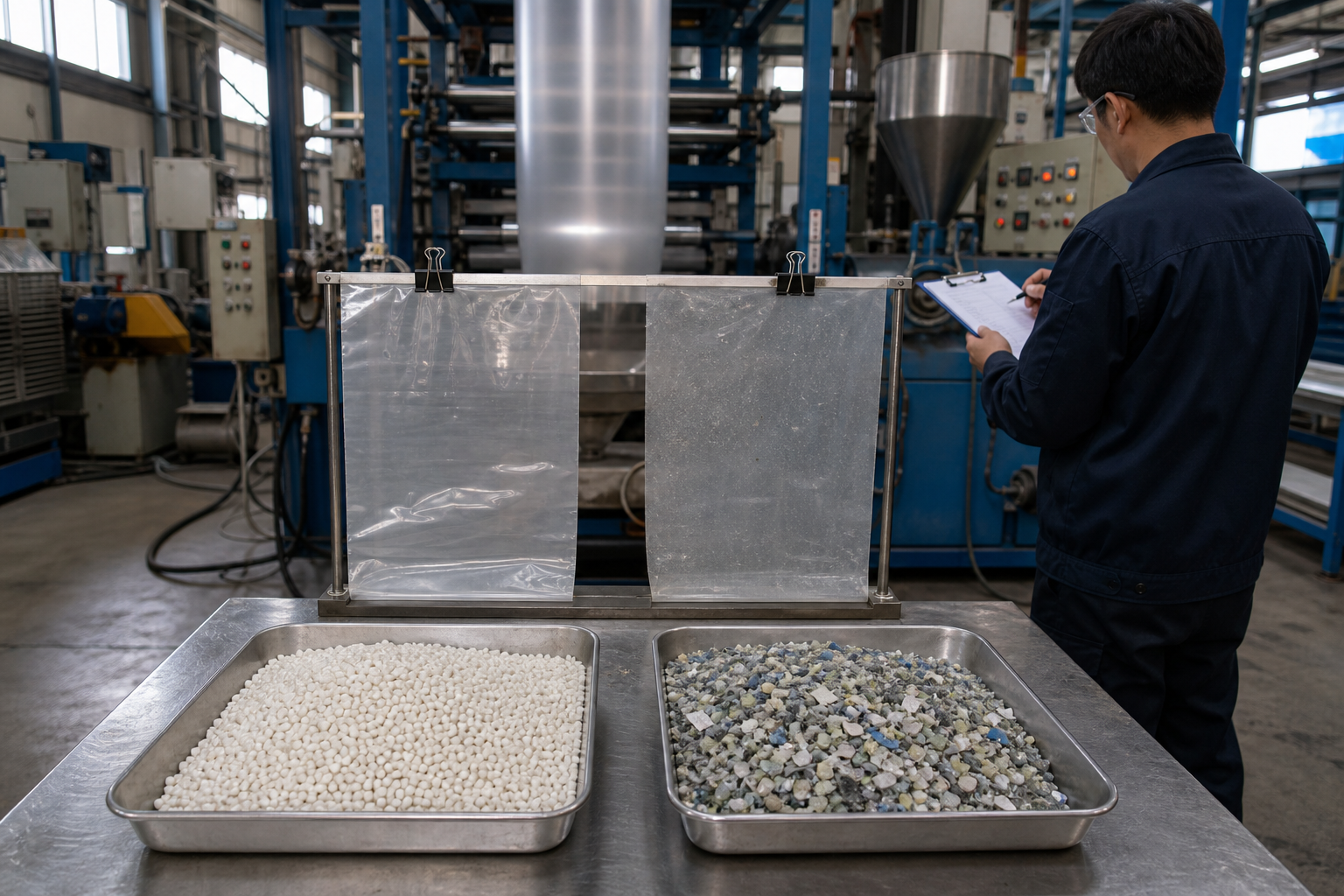
Plastic film and bag manufacturers commonly use two methods to reduce raw-material costs: increasing recycled polyethylene content or adding filler masterbatch.
Both approaches may reduce the consumption of virgin resin, but they affect the formulation differently.
Recycled PE is still polymer material recovered from previous plastic products. Sodium sulfate filler masterbatch is a functional additive containing processed sodium sulfate, a compatible carrier resin and selected processing additives.
Neither option is automatically better for every product. The correct choice depends on the required appearance, strength, processing stability, material availability and cost per qualified finished product.
This guide compares the two approaches for PE blown film and plastic bag production.
What Is Sodium Sulfate Filler Masterbatch?
Sodium sulfate filler masterbatch is a granular functional additive manufactured from finely processed sodium sulfate, a compatible carrier resin and processing additives.
It may also be called:
Na2SO4 filler masterbatch
Sodium sulfate filling masterbatch
Sodium sulfate transparent filler masterbatch
Transparent filling masterbatch
PE film cost-reduction masterbatch
In a suitable formulation, it can replace a controlled portion of PE or PP resin.
Its purpose is to help manufacturers reduce formulation costs while maintaining an acceptable balance of appearance, processability and finished-product performance.
What Is Recycled PE?
Recycled PE is polyethylene recovered from post-industrial or post-consumer plastic waste.
Depending on its source, it may contain:
LDPE
LLDPE
HDPE
Mixed polyethylene grades
Pigments
Additives
Small quantities of other polymers
Contamination or moisture
Post-industrial recycled material may provide greater consistency when its original source is known. Post-consumer material can offer cost advantages but may require more sorting, washing, filtering and quality control.
Recycled PE quality varies significantly between suppliers and batches.
The Main Difference
The most important difference is that recycled PE contributes polymer material, while sodium sulfate filler masterbatch introduces an inorganic filler through a polymer carrier.
This means they affect the formulation in different ways.
Recycled PE may contribute melt strength and mechanical properties, depending on its quality and processing history. However, degraded or contaminated recycled material can cause inconsistent performance.
Sodium sulfate filler masterbatch provides a controlled filling function but may affect density, transparency and mechanical properties as the dosage increases.
Manufacturers should not treat equal percentages of recycled PE and filler masterbatch as technically equivalent.
Cost per Kilogram
Both materials may cost less than virgin PE, depending on market prices and grade.
A simple formulation calculation is:
Formula cost per kg = Σ (material percentage × material price per kg)
This gives an initial comparison, but it does not show the complete economic result.
A lower formulation cost may be offset by:
Increased finished-product weight
Higher scrap
Reduced production speed
Additional machine cleaning
Weak seals
Product rejection
Customer complaints
The more meaningful figure is the cost per qualified finished bag or film roll.
Material Consistency
Sodium Sulfate Filler Masterbatch
A well-controlled masterbatch may offer relatively stable:
Filler content
Carrier-resin type
Granule size
Dispersion
Moisture level
Processing behavior
Consistency still depends on the manufacturer’s raw materials and quality controls.
Recycled PE
Recycled PE may vary in:
Polymer composition
Melt flow
Color
Odor
Moisture
Contamination
Mechanical strength
Degree of degradation
A stable recycled-resin supplier can reduce these variations, but incoming inspection remains important.
When formulation consistency is a priority, the variation of each commercial batch should be evaluated.
Transparency and Appearance
Sodium sulfate filler masterbatch is often selected when manufacturers want to reduce resin consumption while maintaining better transparency or translucency than may be possible with certain conventional mineral fillers.
However, it is not invisible. Transparency depends on:
Dosage
Film thickness
Base resin
Dispersion
Processing temperature
Cooling conditions
Recycled PE may introduce:
Gray or yellow tones
Pigment contamination
Black particles
Uneven haze
Surface defects
Odor
High-quality transparent post-industrial PE may retain acceptable appearance, while mixed post-consumer material is more likely to affect clarity and color.
The better option depends on the recycled material available and the finished-product standard.
Mechanical Properties
Recycled PE
Mechanical performance depends heavily on the source and degradation level.
Good-quality recycled PE may retain useful polymer properties. Lower-quality material may show:
Reduced elongation
Lower tensile strength
Poor puncture resistance
Inconsistent tear behavior
Weak sealing
Sodium Sulfate Filler Masterbatch
Any filler can affect mechanical properties as the dosage increases.
Possible changes include:
Reduced elongation
Modified rigidity
Changes in tear behavior
Changes in heat-sealing strength
Different puncture performance
Neither material should be approved based only on visual appearance. The finished film or bag must be tested according to its actual use.
Density and Finished-Product Weight
Sodium sulfate filler masterbatch changes the density of the formulation because it introduces inorganic material.
If film thickness and machine settings are not controlled, the weight of each finished bag may increase.
Recycled PE density may also vary according to its composition and contamination, but its effect is different because it remains primarily polymer material.
Manufacturers should measure:
Film thickness
Weight per meter
Bag weight
Roll weight
Qualified pieces per ton
A lower material price per kilogram does not guarantee a lower cost per bag.
Processing Stability
Potential Recycled PE Problems
Recycled resin may cause:
Changing extrusion pressure
Unstable film bubbles
Screen blockage
Die deposits
Surface defects
Odor
Variation between batches
These problems depend on sorting, filtration, moisture and polymer consistency.
Potential Filler Masterbatch Problems
An incompatible or poorly dispersed sodium sulfate filler masterbatch may cause:
White spots
Surface roughness
Bubble instability
Poor feeding
Deposits
Mechanical-property changes
A suitable carrier resin, controlled moisture and good dispersion are important for stable production.
Moisture Considerations
Recycled PE is frequently exposed to moisture during washing, transportation or outdoor storage.
Sodium sulfate filler masterbatch must also be protected from damaged packaging and humid storage conditions.
When moisture-related problems occur, inspect the entire formulation rather than blaming only one material.
Possible symptoms include:
Unstable extrusion
Surface marks
Small holes
Irregular feeding
Increased rejection rates
A suitable desiccant masterbatch may help in certain recycled-plastic formulations, but it should not replace proper drying and storage of severely wet materials.
Which Option Is Better for Transparent Film?
For film with meaningful transparency requirements, the first question is whether the available recycled PE is sufficiently clean and optically consistent.
A suitable sodium sulfate filler masterbatch may offer a more controlled formulation than low-grade mixed recycled resin. However, adding any filler can increase haze as the dosage rises.
For high-clarity film, both filler and recycled content should be evaluated conservatively.
Test:
Haze
Light transmission
Film thickness
Visible particles
Gloss
Mechanical performance
The final decision should be based on measured results rather than material descriptions.
Which Option Is Better for Black Garbage Bags?
Black garbage bags can often tolerate greater color and optical variation than transparent packaging film.
A formulation may use:
Recycled PE
Sodium sulfate filler masterbatch
Black masterbatch
Toughening additive
Desiccant masterbatch, where appropriate
This does not mean that unlimited quantities can be added.
Garbage bags still require acceptable:
Load-bearing performance
Tear resistance
Puncture resistance
Heat-sealing strength
Film-bubble stability
Bag weight
A controlled combined formulation may provide a useful cost-performance balance.
Can Recycled PE and Sodium Sulfate Filler Masterbatch Be Used Together?
Yes, they may be used together in suitable formulations.
They should be treated as different components with different functions.
When combining them:
Stabilize the recycled-resin source.
Record the existing formulation and production data.
Select a compatible sodium sulfate masterbatch grade.
Begin with a conservative filler dosage.
Keep the recycled PE percentage stable during the first test.
Evaluate processing and finished-product properties.
Increase the filler ratio gradually only after the first trial passes.
Changing the recycled resin, filler dosage and processing settings simultaneously makes troubleshooting difficult.
When to Consider More Recycled PE
Increasing recycled PE may be worth evaluating when:
A stable recycled source is available
Mechanical requirements can be maintained
Color or odor variation is acceptable
Filtration quality is adequate
The application allows recycled content
The customer accepts the resulting appearance
Regulated applications require additional confirmation of material suitability and applicable documentation.
When to Consider Sodium Sulfate Filler Masterbatch
Sodium sulfate filler masterbatch may be worth evaluating when:
A controlled cost-reduction additive is required
The resin carrier is compatible
Transparency or translucency matters
Material feeding should remain granular and convenient
The product can tolerate a controlled filler level
A stable production trial can be conducted
It should not be presented as a complete substitute for polymer resin in every application.
How to Run a Fair Comparison
Prepare at least three controlled formulations:
Existing production formula
Formula with adjusted recycled PE
Formula with sodium sulfate filler masterbatch
If a combined formulation is relevant, test it as a separate stage.
Keep these factors consistent:
Resin batch
Film thickness
Production equipment
Output target
Cooling conditions
Bag dimensions
Testing method
Record:
Formula cost per kilogram
Production output
Extrusion pressure
Film stability
Scrap rate
Bag weight
Mechanical-test results
Sealing performance
Cost per qualified product
Calculate the Real Saving
Use:
Cost per qualified product = total production cost ÷ qualified output
Include:
Virgin resin
Recycled resin
Sodium sulfate masterbatch
Color and other additives
Finished-product weight
Energy
Scrap
Machine downtime
Cleaning
Rejected products
The best solution is not necessarily the formula with the lowest price per kilogram. It is the formulation that provides the lowest repeatable cost while meeting the required product standard.
Common Decision-Making Mistakes
Comparing Only Material Prices
Price per ton does not account for product weight, output, scrap or quality.
Assuming All Recycled PE Is the Same
Recycled material can vary substantially in composition and performance.
Treating Filler and Recycled Resin as Direct Substitutes
They play different roles and affect the formulation differently.
Changing Multiple Variables During One Trial
This makes it difficult to determine the cause of any improvement or problem.
Ignoring Finished-Product Tests
Stable extrusion does not prove that the bag will pass loading, sealing or puncture tests.
Selecting the Highest Possible Filler Ratio
Maximum addition is less important than stable cost per qualified product.
Information to Send the Masterbatch Supplier
Provide:
Current PE formulation
Recycled PE source and percentage
Film thickness
Finished-product application
Bag or roll weight
Required transparency
Mechanical requirements
Processing temperature
Current production problem
Target cost reduction
Photos or physical samples
This helps the supplier recommend a suitable grade and practical starting dosage.
Work with Xinfeng
Xinfeng manufactures sodium sulfate filler masterbatch for suitable virgin and recycled PE blown-film formulations.
We also supply:
High-transparency toughening additives
Color masterbatch
Antiblock masterbatch
Desiccant masterbatch
Other plastic functional additives
We recommend evaluating the complete formulation according to its processing stability, finished-product performance and cost per qualified product.
Send us your current formula and product requirements to request a sodium sulfate filler masterbatch sample.
Frequently Asked Questions
Is sodium sulfate filler masterbatch the same as recycled PE?
No. Recycled PE is recovered polymer material, while sodium sulfate filler masterbatch introduces processed inorganic filler through a polymer carrier.
Which one reduces costs more?
The result depends on purchase prices, dosage, product weight, processing stability, scrap and finished-product requirements.
Can they be used together?
They may be combined in suitable applications. The recycled material should be stabilized and the filler dosage tested gradually.
Which is better for transparent film?
It depends on the quality of the recycled PE, filler dosage, film thickness and optical standard. Controlled sample testing is necessary.
Which is better for garbage bags?
Both may be used in suitable garbage bag formulations. Load, tear, puncture and sealing performance must still pass.
Does sodium sulfate filler masterbatch increase product weight?
It may change formulation density and finished-product weight. Measure the actual bag or film roll during testing.
How should the two options be compared?
Use the same equipment, thickness and quality standard, then compare the cost per qualified finished product.
Request a Formula Comparison
Send Xinfeng your:
Current resin formula
Recycled PE percentage
Film thickness
Finished-product specifications
Required performance
Current cost target
We can recommend a sodium sulfate filler masterbatch grade and starting trial plan for comparison.
Send us a message now for quotation.
WhatsApp: https://wa.memessage/IRZROGA5F2RQO1
WhatsApp:+86 17835035161