


How to Calculate the Real Cost Savings of Sodium Sulfate Filler Masterbatch
The main reason manufacturers use sodium sulfate filler masterbatch is to reduce plastic raw-material costs. However, comparing only the price per ton of masterbatch and virgin resin does not show the real saving.
A lower-cost formulation can become more expensive if the finished product gains weight, production speed decreases or the rejection rate increases.
The correct method is to calculate the total cost per qualified finished product.
This article explains how manufacturers can evaluate the actual economic benefits of sodium sulfate filler masterbatch in PE blown film and PP injection molding.
What Is Sodium Sulfate Filler Masterbatch?
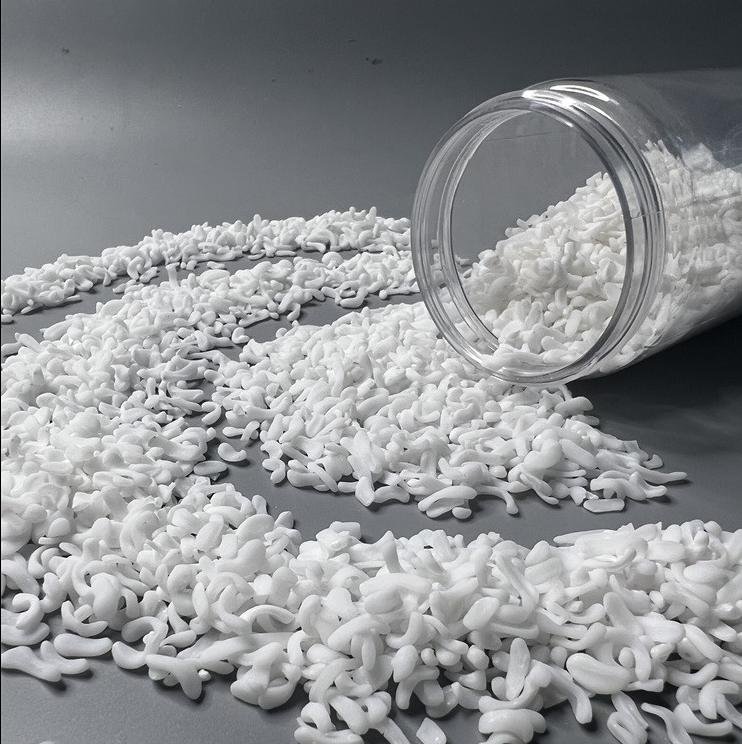
Sodium sulfate filler masterbatch is a granular functional additive made from finely processed sodium sulfate, a compatible carrier resin and selected processing additives.
It may also be called:
Na2SO4 filler masterbatch
Sodium sulfate filling masterbatch
Sodium sulfate transparent filler masterbatch
Plastic cost-reduction masterbatch
Functional filler masterbatch
In suitable PE and PP formulations, the product can replace a controlled portion of virgin resin. Its purpose is to help reduce formulation costs while maintaining acceptable processing, appearance and mechanical performance.
The real saving depends on the entire production result—not only the masterbatch quotation.
Why Price per Ton Is Not Enough
Suppose a filler masterbatch costs less per ton than virgin PE or PP. Adding it will normally reduce the calculated cost of the material mixture.
However, the new formula may also change:
Material density
Finished-product weight
Output by piece count
Film or part strength
Production speed
Energy consumption
Scrap rate
Machine-cleaning frequency
Customer acceptance rate
If these factors are ignored, the calculated saving may look better than the actual financial result.
Manufacturers should compare the original and trial formulas under the same production and quality standards.
Step 1: Calculate the Original Formulation Cost
First, record every material in the current formula.
The formula cost can be calculated as:
Formulation cost per kg = Σ (material percentage × material price per kg)
For example, a simplified original PE film formulation could contain:
70% LLDPE
20% LDPE
10% recycled PE
Multiply the percentage of each material by its price and add the results together.
Do not use estimated prices if accurate purchasing data is available. Include relevant color masterbatch and functional additives.
Step 2: Calculate the New Formulation Cost
Next, calculate the formulation after introducing sodium sulfate filler masterbatch.
A simplified trial formula might contain:
Base PE or PP resin
Recycled material, if applicable
Sodium sulfate filler masterbatch
Color masterbatch
Other functional additives
Use the same calculation:
New formulation cost per kg = Σ (new material percentage × material price per kg)
The difference between the original and new material costs is the preliminary saving per kilogram.
This figure is useful, but it is not yet the final saving.
Step 3: Measure the Finished-Product Weight
Adding inorganic filler may change the density of the formulation. If the machine settings remain unchanged, the weight of each bag or molded part may change.
For PE blown film, measure:
Film thickness
Film width
Roll weight
Weight per meter
Weight per finished bag
For PP injection molding, measure:
Weight of each molded part
Runner and sprue weight
Total shot weight
Number of qualified parts per kilogram
Use multiple samples rather than measuring only one product.
If the formulation becomes cheaper per kilogram but every product becomes significantly heavier, the saving per finished piece may be smaller than expected.
Step 4: Compare Output per Ton
The following calculation can be used:
Qualified pieces per ton = 1,000 kg ÷ weight of each qualified piece
For example, if each original product weighs 20 grams:
1,000 kg ÷ 0.020 kg = 50,000 pieces
If the new formulation increases the product weight to 21 grams:
1,000 kg ÷ 0.021 kg = approximately 47,619 pieces
This means one ton of the new formulation produces fewer pieces.
The manufacturer must determine whether the lower material cost compensates for the reduced output by piece count.
Step 5: Calculate Material Cost per Finished Product
Use the following formula:
Material cost per piece = formulation cost per kg × product weight in kg
This calculation should be completed for both the original product and the trial product.
For film rolls, calculate:
Material cost per roll = formulation cost per kg × roll weight
For products sold by weight rather than by piece, density and performance still matter, but the sales model should be considered separately.
Step 6: Include Scrap and Rejected Products
Only qualified products generate revenue.
If the new formulation causes more:
Film breaks
Bubble collapses
Weak seals
Surface defects
Brittle molded parts
Warpage
Color variation
Customer rejections
the real cost can increase quickly.
A useful calculation is:
Effective material cost = total material consumed ÷ qualified production output
Record the scrap rate for both formulas under comparable production conditions.
A slightly more expensive but stable masterbatch may deliver better savings than a cheaper grade that creates frequent production problems.
Step 7: Measure Production Efficiency
The filler masterbatch may influence processing behavior.
For PE blown film, record:
Extrusion output per hour
Film-bubble stability
Number of line stops
Screen-changing frequency
Die-cleaning frequency
Bag-making speed
For PP injection molding, record:
Molding-cycle time
Filling pressure
Cooling time
Mold-release behavior
Number of machine interruptions
Cleaning requirements
If the new formulation reduces output or increases downtime, include the lost production time in the cost comparison.
Step 8: Include Energy and Labor Costs
Material cost usually represents the largest part of plastic production, but energy and labor should not be ignored.
Compare:
Electricity consumption per production batch
Machine operating time
Labor required for mixing
Additional cleaning time
Rework
Quality-inspection time
Packaging changes
These costs may be small during a short trial but significant in continuous mass production.
Step 9: Confirm Finished-Product Performance
A product is not economical if it fails to meet customer requirements.
For PE blown film, test:
Transparency and haze
Tensile strength
Elongation
Tear resistance
Puncture resistance
Heat-sealing strength
Load-bearing performance
Printing quality
For PP injection-molded products, test:
Surface appearance
Dimensions
Shrinkage
Warpage
Impact strength
Flexibility
Drop resistance
Assembly performance
The formula must pass the same quality standard used for the original product.
A Practical Cost-Comparison Table
Use a table like this during production trials:
Cost factor Original formula Trial formula
Material cost per kg Record actual value Record actual value
Product weight Record actual value Record actual value
Qualified output per ton Calculate Calculate
Production speed Record Record
Scrap rate Record Record
Energy consumption Record Record
Cleaning downtime Record Record
Cost per qualified product Calculate Calculate
The final decision should be based on the last row, supported by acceptable product performance.
Common Cost-Calculation Mistakes
Comparing Only Raw-Material Prices
A lower price per ton does not automatically mean a lower finished-product cost.
Ignoring Density and Product Weight
Changes in product weight affect output per ton and cost per piece.
Using an Unstable Recycled-Material Batch
Variations in recycled plastic can distort the trial results and make it difficult to evaluate the masterbatch accurately.
Testing Several Changes at the Same Time
If the resin grade, masterbatch dosage and machine settings are all changed together, the result cannot be attributed to one variable.
Ignoring Rejected Products
Scrap and customer rejections must be included in the total cost.
Selecting the Highest Possible Dosage
The most profitable ratio is not necessarily the highest addition ratio. It is the ratio that provides the lowest cost while consistently meeting the quality standard.
How to Run a Reliable Comparison Trial
For a meaningful result:
Record the original formula and production data.
Use the same resin batch where possible.
Select a compatible sodium sulfate filler masterbatch.
Begin with a controlled trial dosage.
Keep the main processing settings stable.
Produce enough material for representative testing.
Measure finished-product weight and performance.
Record production speed, scrap and downtime.
Calculate the cost per qualified finished product.
Increase the dosage gradually only after the first trial passes.
A short visual test is not sufficient for a commercial purchasing decision.
Information to Send the Masterbatch Supplier
To receive a useful cost-reduction recommendation, provide:
Base resin and grade
Current formulation
Current raw-material prices
Processing method
Film thickness or part dimensions
Weight of the finished product
Required mechanical properties
Current scrap rate
Current production speed
Target cost reduction
Product photos or samples
Sensitive pricing information does not need to be made public. It can be used internally to compare the original and trial formulas.
Work with Xinfeng
Xinfeng manufactures sodium sulfate filler masterbatch for PE blown film, PP injection molding and other suitable plastic-processing applications.
Our functional additive range also includes high-transparency toughening additives, color masterbatch, antiblock masterbatch and desiccant masterbatch.
We recommend evaluating each formula by its cost per qualified finished product. Our team can review your resin system, current formulation, product requirements and cost target before recommending a grade and starting trial ratio.
Send us your application information to request a sodium sulfate filler masterbatch sample.
Frequently Asked Questions
How much money can sodium sulfate filler masterbatch save?
The saving depends on resin prices, masterbatch price, dosage, product weight, scrap and production efficiency. It must be calculated for the specific application.
Is formulation cost per kilogram the most important figure?
No. The more useful figure is the cost per qualified finished bag, film roll or molded part.
Why can product weight increase after adding filler?
Adding inorganic material changes the formulation density. Machine settings and dimensional control may also influence the final weight.
Should scrap be included in the calculation?
Yes. Material used to produce rejected products is part of the real production cost.
Does a higher addition ratio always save more?
No. Excessive filler may increase product weight, reduce strength or raise the rejection rate.
How long should a production trial run?
It should run long enough to evaluate stable processing, finished-product quality, scrap and cleaning requirements. A few visually acceptable samples are not sufficient.
How should two masterbatch suppliers be compared?
Use the same resin, equipment, dosage and quality standard. Compare production stability and cost per qualified product.
Request a Cost-Reduction Trial
Send Xinfeng your:
Base resin
Current formulation
Processing method
Finished-product specifications
Current product weight
Required performance
Target cost reduction
We can recommend a suitable sodium sulfate filler masterbatch grade for your production trial.
Send us a message now for quotation.
WhatsApp: https://wa.memessage/IRZROGA5F2RQO1
WhatsApp:+86 17835035161