


How to Reduce Film Breakage When Using Sodium Sulfate Filler Masterbatch
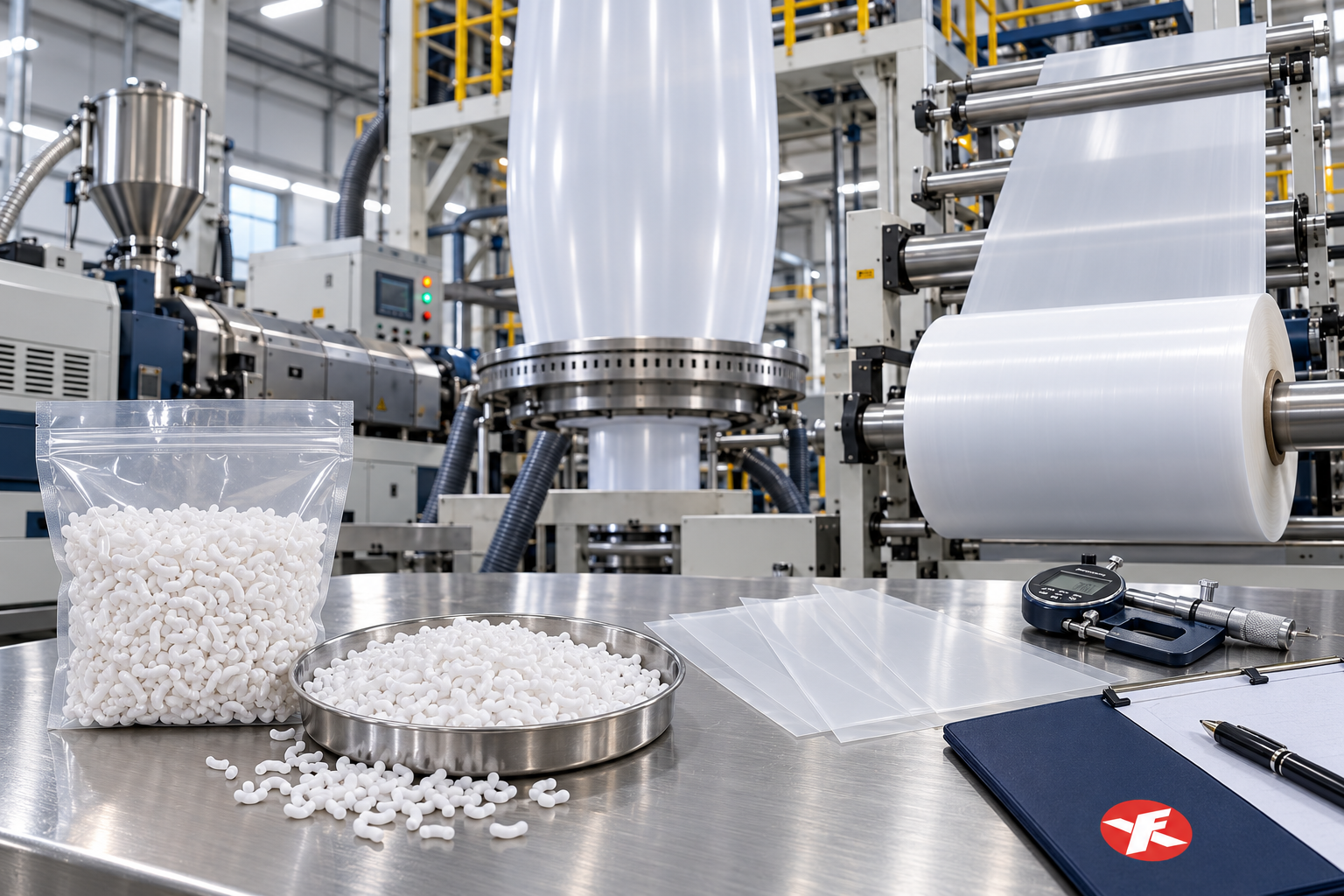
Sodium sulfate filler masterbatch can help PE film manufacturers optimize formulation costs and improve production efficiency. However, when a new filler masterbatch is introduced or its dosage is increased too quickly, some factories may experience film breakage, unstable bubbles, uneven thickness or reduced film toughness.
These problems do not necessarily mean that the filler masterbatch is unsuitable. In many cases, they are related to formulation balance, material compatibility, dispersion or processing conditions.
By carrying out controlled trials and adjusting one variable at a time, manufacturers can identify the cause and establish a stable production formula.
Why Does Film Breakage Occur?
A PE blown-film bubble depends on the melt strength of the polymer and the balance between extrusion output, cooling, blow-up ratio, draw-down ratio and film thickness.
The addition of an inorganic filler changes the composition of the polymer system. If the filler content is higher than the film structure can tolerate, or if the particles are not uniformly dispersed, localized stress points may form in the film.
Research on inorganic-filled polyethylene shows that particle dispersion and interfacial compatibility can significantly affect tensile strength and elongation. Poorly dispersed particles or agglomerates may act as stress-concentration points, while improved dispersion can produce better mechanical performance. Research on inorganic filler dispersion in PE
Film breakage may therefore be associated with several factors rather than a single cause.
1. The Filler Dosage Was Increased Too Quickly
One of the most common causes is increasing the filler masterbatch dosage directly from zero to a relatively high level.
Every film formulation has a different tolerance. A thick refuse bag made from an LDPE/LLDPE blend may accept a different formulation from a thin packaging film or a bag requiring high puncture resistance.
A safer approach is to begin with a conservative trial level and increase the dosage gradually. At each stage, record:
– Bubble stability
– Extrusion pressure
– Motor load
– Film thickness
– Tensile strength
– Elongation
– Tear resistance
– Dart impact
– Heat-sealing performance
There is no universal dosage suitable for every PE film. The correct level depends on the base resin, film thickness, equipment and finished-product requirements.
2. The Base Resin Does Not Provide Enough Melt Strength
The polymer resin remains the main structural component of the blown film. If the original resin blend already has limited melt strength, adding filler may make bubble instability more noticeable.
Operators should check whether the formulation contains an appropriate balance of LDPE, LLDPE and HDPE for the intended product.
The molecular structure of polyethylene and the film-blowing conditions interact strongly to determine mechanical, optical and processing performance. Important variables include melt temperature, output rate, blow-up ratio, draw-down ratio and frost-line height. Polyethylene blown-film processing research
If the bubble becomes unstable after adding filler masterbatch, reducing filler alone may not be the only solution. The base resin blend may also require optimization.
3. The Masterbatch Carrier Is Not Compatible
The carrier resin of the sodium sulfate filler masterbatch should be compatible with the PE resin being processed.
Poor carrier compatibility may cause:
– Uneven melting
– Poor filler distribution
– White spots
– Surface roughness
– Unstable extrusion pressure
– Weak areas in the film
Before ordering, manufacturers should provide the supplier with information about the base resin and processing application.
For PE blown film, tell the supplier whether the formulation uses LDPE, LLDPE, HDPE, recycled PE or a combination of these materials.
4. Raw Materials Are Not Mixed Uniformly
Uneven dry blending can create areas with different filler concentrations. A portion of the mixture containing too much filler may produce a weak section in the film bubble.
Accurate weighing and sufficient mixing are therefore essential.
Recommended controls include:
– Use gravimetric dosing where possible.
– Avoid estimating dosage by volume.
– Keep mixing time consistent.
– Check whether materials separate during transportation to the hopper.
– Confirm that the feeder operates continuously.
– Avoid overfilling the mixer.
– Keep different masterbatch grades clearly identified.
The pellets should appear evenly distributed before entering the extruder.
5. Moisture or Contamination Is Present
Moisture and foreign contamination can create bubbles, pinholes and weak points in the film.
Although the visible defect may appear after filler masterbatch is introduced, the actual source can be:
– Open packaging
– Poor warehouse conditions
– Condensation
– Wet recycled material
– Dust inside the mixer
– Contaminated regrind
– Residue from a previous production formula
Raw materials should be stored in a clean and dry area. Open bags should be resealed, and the hopper, mixer and conveying system should be inspected before the trial.
If drying is required for a particular formulation, follow the material supplier’s recommendations.
6. The Processing Temperature Is Not Suitable
A temperature setting that works for the original resin formula may not be ideal after filler masterbatch is added.
If the melt temperature is too low, the carrier resin may not melt and distribute properly. This can cause poor dispersion, unmelted particles and uneven film appearance.
If the temperature is too high, excessive thermal exposure may reduce polymer stability or create processing problems.
Adjust the temperature gradually while observing:
– Melt uniformity
– Extrusion pressure
– Motor current
– Bubble stability
– Film surface
– Die buildup
– Odor or discoloration
Avoid making large temperature changes across all heating zones simultaneously. Small, recorded adjustments make troubleshooting more reliable.
7. The Film Is Being Drawn Too Thin
A formulation may run successfully at one film thickness but break when the film is drawn thinner.
As the film thickness decreases, localized defects become more critical. Agglomerates, contamination and variations in filler concentration have a greater chance of creating weak points.
When evaluating a filler masterbatch, conduct the trial at the actual production thickness. A successful trial on a thick sample does not automatically prove that the same formulation will work for a thinner commercial product.
The trial should also reproduce the intended production speed and blow-up ratio.
8. Screen Pressure Is Increasing
An abnormal increase in screen pressure may indicate contamination, poor dispersion, unsuitable filtration or material buildup.
Operators should record the initial pressure and monitor changes during production. Also inspect the screen pack and die after the trial.
Pay attention to:
– Rapid pressure increases
– Unstable pressure readings
– Frequent screen replacement
– Die deposits
– Black spots
– White particles
– Gels in the film
If pressure rises continuously, continuing production without investigation may create additional waste and increase the risk of film breakage.
9. The Film Properties Are Not Balanced in Both Directions
Blown film has different orientation characteristics in the machine direction and transverse direction. A film that appears strong in one direction may still tear easily in another.
Samples should therefore be tested in both directions when possible.
Important evaluations include:
– Tensile strength
– Elongation at break
– Tear strength
– Dart-drop impact
– Puncture resistance
– Seal strength
– Finished-bag load test
The influence of filler depends on particle type, dispersion, concentration and polymer structure. Inorganic fillers may increase stiffness while also changing elongation and impact behavior, so the complete performance balance must be checked rather than relying on only one test result.
A Practical Troubleshooting Procedure
When film breakage occurs after adding sodium sulfate filler masterbatch, use the following sequence:
1. Return to the last stable formulation.
2. Confirm that the raw materials are dry and uncontaminated.
3. Check the weighing and mixing accuracy.
4. Inspect the feeder, screen pack and die.
5. Introduce the filler masterbatch at a lower trial level.
6. Keep film thickness and production speed stable.
7. Record temperature, pressure and motor load.
8. Inspect filler dispersion and film appearance.
9. Increase the dosage in controlled steps.
10. Test the finished film and bag before approving production.
Only one major variable should be changed at a time. Otherwise, it becomes difficult to determine which adjustment improved or worsened the result.
Information to Send to the Masterbatch Supplier
For a more accurate recommendation, provide:
– PE resin grades and blend ratio
– Virgin and recycled material content
– Current film thickness
– Bag or film application
– Existing additive formulation
– Target filler dosage
– Extruder type and screw diameter
– Processing temperatures
– Blow-up ratio
– Description or photographs of the defect
– Required tensile, tear and sealing performance
A qualified supplier should evaluate the application instead of recommending one fixed formulation for every customer.
Conclusion
Stable use of sodium sulfate filler masterbatch in PE blown film depends on more than the filler dosage.
Base-resin melt strength, carrier compatibility, material dispersion, moisture control, temperature, film thickness and machine settings all influence bubble stability and finished-film performance.
The most reliable approach is to begin with a controlled trial, increase the dosage gradually and test the actual finished product. This allows manufacturers to optimize production costs while maintaining the required film strength, sealing performance and processing stability.
Xinfeng supplies sodium sulfate filler masterbatch for selected PE blown-film and plastic bag applications. Product selection and trial recommendations can be provided according to the customer’s resin formulation, equipment and finished-product requirements.
For samples or technical consultation, visit Xinfeng Masterbatch.
Send us a message now for quotation.
WhatsApp: https://wa.memessage/IRZROGA5F2RQO1
WhatsApp:+86 17835035161