


How to Scale Up a Sodium Sulfate Filler Masterbatch Trial
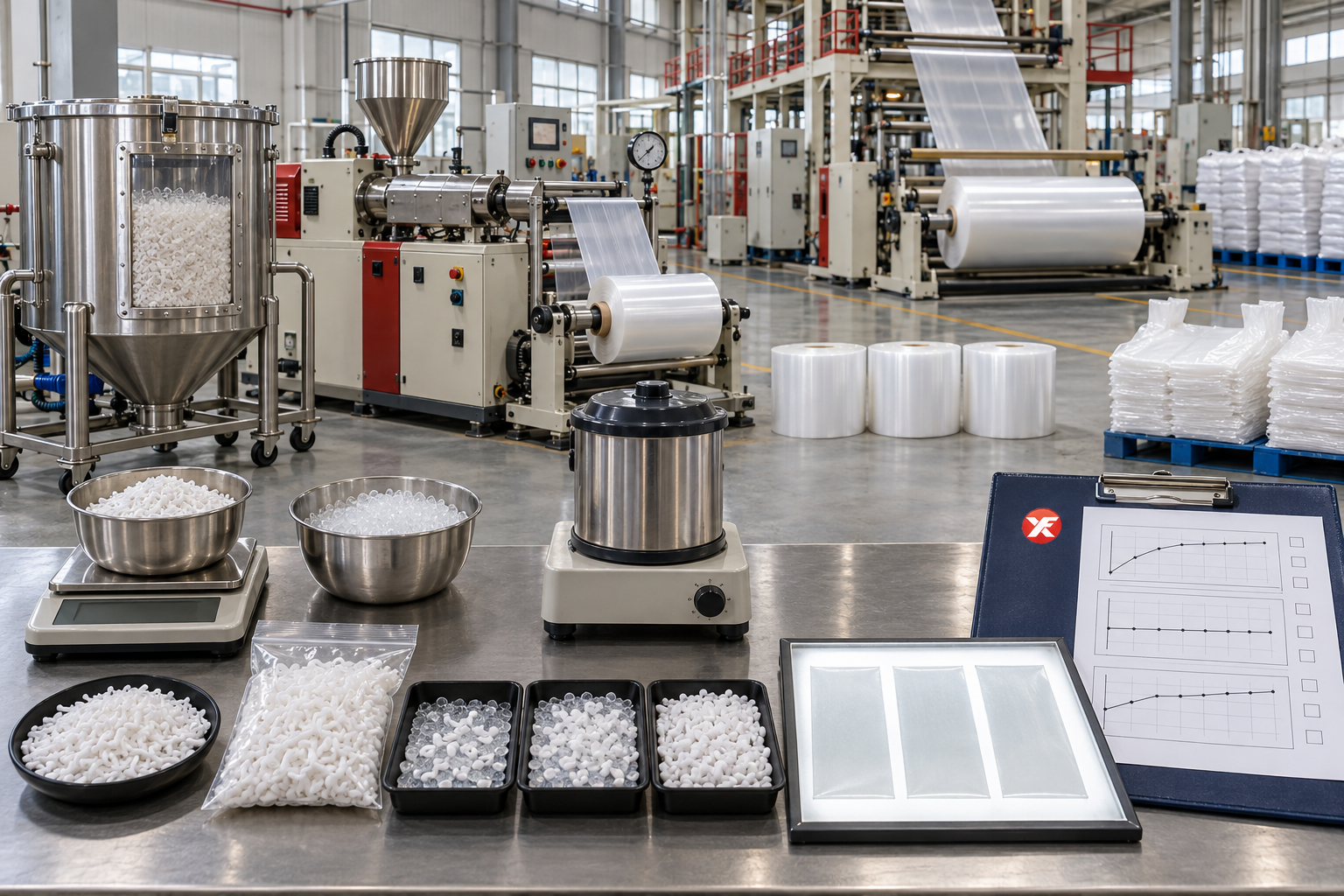
A successful small trial does not automatically guarantee stable mass production.
During a short test, the machine may process only a limited amount of material. Screen pressure, raw-material variation, moisture and finished-product consistency may change during a longer production run.
Manufacturers should therefore move from sample testing to full-scale production in controlled stages.
Why Can Scale-Up Produce Different Results?
A small trial may not reveal problems that develop gradually.
During continuous production, manufacturers may experience:
– Increasing extrusion pressure
– Material separation in the hopper
– Moisture from opened bags
– Screen blockage
– Die buildup
– Film-thickness variation
– Changes between resin batches
– Higher rejection rates
– Sealing or printing problems
A scale-up plan provides enough time and production volume to evaluate these risks before the formulation becomes a standard recipe.
Stage 1: Establish the Original Baseline
Before adding the filler masterbatch, record the performance of the existing formulation.
The baseline should include:
– Resin grades and ratios
– Recycled-material percentage
– Additive dosage
– Film thickness
– Finished-product weight
– Extrusion temperature
– Production speed
– Starting pressure
– Pressure increase over time
– Rejection rate
– Screen-changing interval
– Energy consumption
Without baseline data, it is difficult to determine whether a change was caused by the masterbatch or by normal production variation.
Stage 2: Conduct a Small Controlled Trial
The first trial should use a conservative masterbatch dosage.
Keep the other variables as stable as possible, including:
– Main resin
– Recycled-resin batch
– Machine
– Screen pack
– Processing temperature
– Film thickness
– Production speed
– Cooling conditions
Allow the machine to reach stable operation before collecting samples.
Record the formulation accurately rather than estimating the dosage by volume.
Stage 3: Test the Finished Product
Do not approve the formulation based only on smooth extrusion.
For PE film and plastic bags, evaluate:
– Dispersion
– White spots
– Film-bubble stability
– Thickness
– Transparency or opacity
– Tensile strength
– Tear resistance
– Puncture resistance
– Heat-seal strength
– Handle strength
– Finished-bag weight
For PP injection-moulded products, check:
– Feeding
– Mould filling
– Surface appearance
– Shrinkage
– Warpage
– Product weight
– Impact strength
– Cycle time
The test method should reflect how the customer will use the finished product.
Stage 4: Lock the Trial Formulation
Once a trial passes, record the exact formula.
Include:
– Material supplier
– Product grade
– Batch number
– Mixing ratio
– Masterbatch dosage
– Colour-masterbatch dosage
– Other additives
– Recycled-material content
– Machine settings
– Finished-product specification
Do not change several materials when moving to the next scale.
If the resin, recycled material and masterbatch dosage all change simultaneously, the cause of any problem becomes difficult to identify.
Stage 5: Increase the Batch Size Gradually
Move to a medium-length production run before full-scale manufacturing.
The longer run should be sufficient to observe:
– Feeding stability
– Hopper separation
– Pressure development
– Motor load
– Output rate
– Screen condition
– Die deposits
– Roll consistency
– Rejection rate
Compare data from the beginning, middle and end of the run.
A formulation that performs well for the first hour but becomes unstable later requires further investigation.
Control Premixing at Larger Scale
Mixing methods that work for a small bucket may not provide the same uniformity in a large production batch.
During scale-up, check:
– Mixer capacity
– Mixing time
– Loading sequence
– Dosing accuracy
– Material separation
– Hopper feeding
– Conveying distance
Avoid overloading the mixer.
Automatic dosing equipment should be calibrated for the masterbatch pellet shape and bulk behaviour.
Monitor Extrusion Pressure Over Time
Pressure should be recorded throughout the production run.
Useful measurements include:
– Starting pressure
– Stable operating pressure
– Pressure after several hours
– Rate of pressure increase
– Time before screen replacement
– Output at each stage
A rapid pressure increase may indicate contamination, poor dispersion, recycled-material variation or an unsuitable dosage.
Do not evaluate the formulation using only one pressure reading.
Verify Moisture Control
More bags are opened during mass production than during a small trial. This increases exposure to warehouse and factory humidity.
Good handling practices include:
– Opening bags only when required
– Resealing unused material
– Storing material on raised pallets
– Keeping bags away from wet areas
– Checking recycled resin
– Keeping mixers and conveying systems dry
If drying is required, confirm the conditions with the supplier and record them as part of the production process.
Check Multiple Finished Rolls or Batches
Do not inspect only the first roll.
Collect samples from:
– The start of production
– The middle of the run
– The end of production
– Different positions across the roll
– Multiple finished bags or mould cavities
This reveals whether product quality remains stable throughout the batch.
Include Printing and Conversion
For printed or converted film, the scale-up is incomplete until the material passes later production stages.
Evaluate:
– Corona treatment
– Ink adhesion
– Colour consistency
– Registration
– Bottom sealing
– Side sealing
– Handle cutting
– Bag opening
– Adhesive-strip performance
A film may appear acceptable at the extrusion line but create waste during printing or bag making.
Compare Rejection Rates
Record all rejected material during the scale-up run.
Possible waste includes:
– Startup film
– Unstable film bubbles
– Thickness variation
– White spots
– Pinholes
– Printing defects
– Weak seals
– Incorrect bag dimensions
– Film breaks
The real cost calculation should use acceptable finished products rather than total material output.
Approve a Production Range, Not One Perfect Setting
Factory conditions change slightly from day to day.
A practical production standard should define an acceptable range for:
– Masterbatch dosage
– Film thickness
– Finished-product weight
– Extrusion pressure
– Temperature
– Output
– Rejection rate
This is more useful than approving one test result produced under ideal conditions.
Retain Samples from the Approved Run
Keep representative samples of:
– Masterbatch
– Resin
– Recycled material
– Extruded film
– Printed film
– Finished bags or moulded parts
Record the batch numbers and production date.
These samples provide a physical reference when future deliveries or production results are compared.
Train Operators
Operators should understand:
– The approved formulation
– Correct material-loading sequence
– Dosing requirements
– Moisture precautions
– Normal pressure range
– Warning signs
– Sample-collection procedure
– When to stop and report a problem
A technically suitable formulation may still fail if each shift uses a different mixing or feeding method.
Calculate the True Mass-Production Cost
The economic evaluation should include:
– Blended material cost
– Finished-product weight
– Production output
– Rejection rate
– Electricity consumption
– Screen-changing downtime
– Cleaning time
– Printing waste
– Sealing waste
– Customer-quality risk
A small trial may show theoretical savings, but only a stable extended run can confirm the real manufacturing benefit.
A Practical Scale-Up Checklist
Before approving mass production, confirm:
– The formulation is recorded.
– Raw-material batches are traceable.
– Dosing equipment is calibrated.
– Premixing is uniform.
– Moisture is controlled.
– Pressure remains stable.
– Output meets the target.
– Multiple samples pass inspection.
– Printing and sealing are acceptable.
– Rejection remains within the factory’s limit.
– Finished-product cost has been calculated.
– Reference samples are retained.
If one critical item fails, repeat the controlled trial before full production.
Information to Share with the Supplier
When requesting scale-up support, provide:
– Trial formulation
– Machine type
– Film thickness or part weight
– Production duration
– Starting and ending pressure
– Output rate
– Rejection rate
– Photos of defects
– Finished-product test results
– Masterbatch and resin batch numbers
Detailed information allows the supplier to provide more useful recommendations.
Conclusion
Moving from a sodium sulfate filler masterbatch sample trial to mass production requires a controlled scale-up process.
Manufacturers should lock the formulation, increase production volume gradually and monitor pressure, moisture, output and finished-product quality throughout the run.
The formulation should be approved only after it performs consistently during extrusion, printing, sealing or moulding and delivers a lower cost per acceptable finished product.
Xinfeng manufactures sodium sulfate filler masterbatch for selected PE blown-film and PP processing applications.
To request a sample or discuss a production scale-up, visit Xinfeng Masterbatch.
Send us a message now for quotation.
WhatsApp: https://wa.memessage/IRZROGA5F2RQO1
WhatsApp:+86 17835035161