


Using Sodium Sulfate Filler Masterbatch in Black PE Garbage Bags
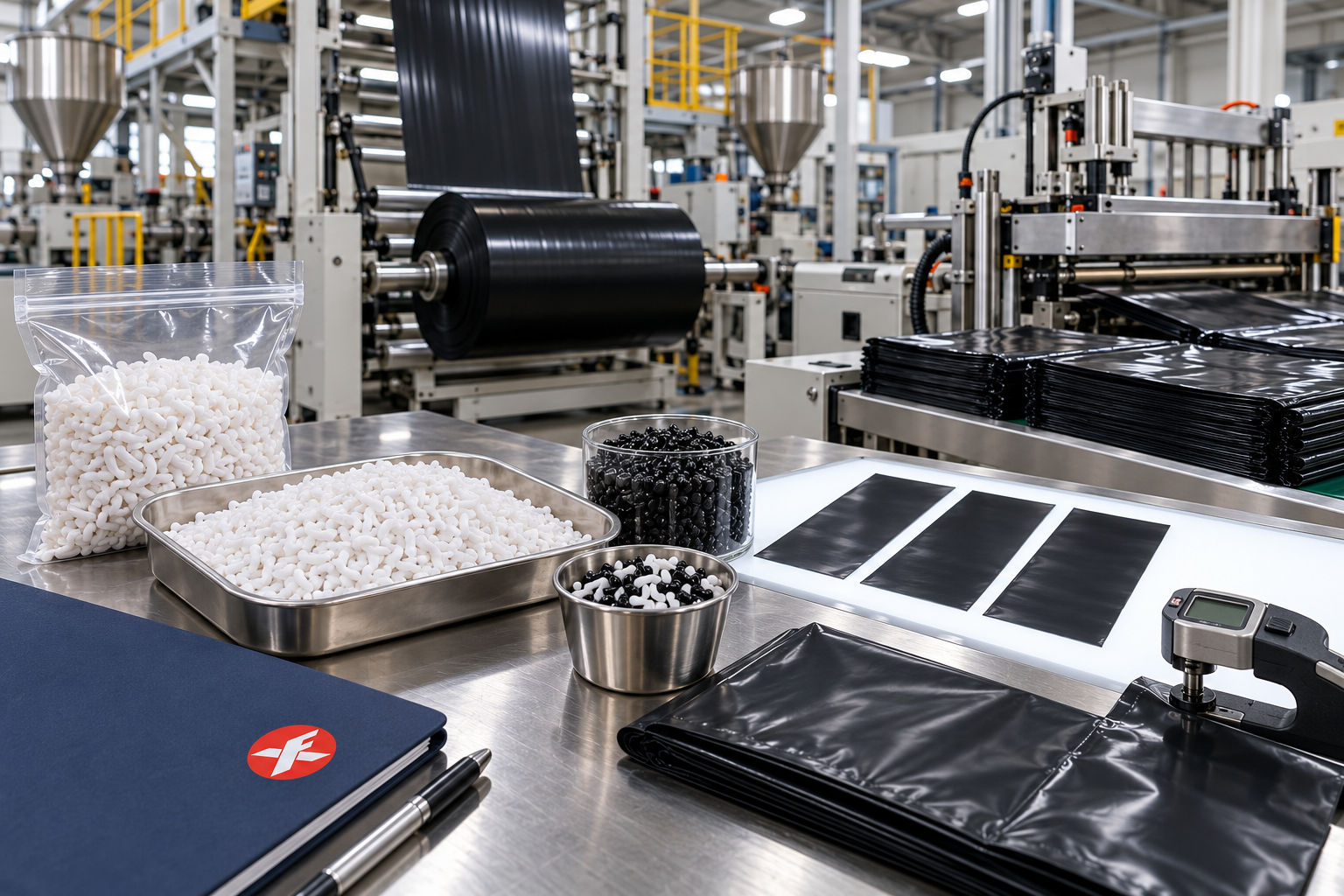
Black PE garbage bags are an important application for recycled polyethylene, black color masterbatch and functional filler masterbatch.
Because the finished film is opaque and dark, some manufacturers assume that a filler formulation only needs to achieve an acceptable black appearance. In practice, color is only one part of the evaluation.
A qualified black garbage bag must also provide:
– Stable film blowing
– Uniform thickness
– Adequate tensile and tear strength
– Sufficient puncture resistance
– Reliable heat sealing
– Consistent bag opening
– Acceptable load capacity
– Competitive production cost
Sodium sulfate filler masterbatch can be used in selected black PE bag formulations, but it must be balanced with the base resin, recycled material and black masterbatch through controlled production trials.
What Does Each Material Do?
A typical black PE garbage-bag formulation may contain several components.
Base PE Resin
LDPE, LLDPE and HDPE provide the main polymer structure. Each resin contributes different processing and mechanical characteristics.
LDPE can support melt strength and processing stability. LLDPE is often used to improve toughness, puncture resistance and elongation. HDPE may contribute stiffness and thin-film performance, depending on the product design.
Recycled PE
Recycled PE helps reduce material cost but may introduce variations in melt flow, color, odor, contamination and mechanical properties.
Black Masterbatch
Black masterbatch supplies the pigment needed to produce the required black color and opacity. Its carrier should be compatible with the PE formulation.
Sodium Sulfate Filler Masterbatch
Sodium sulfate filler masterbatch introduces a functional inorganic component through a polymer carrier. In suitable formulations, it can help optimize material cost and adjust processing or handling characteristics.
Each component affects the complete formulation. They should not be evaluated independently.
A Black Appearance Does Not Prove Good Dispersion
A film may look sufficiently black while still containing poorly dispersed pigment or filler.
Possible signs of uneven dispersion include:
– Dark and light streaks
– Cloudy areas
– White specks
– Concentrated black spots
– Surface roughness
– Uneven gloss
– Weak points
– Pinholes
– Inconsistent opacity
Carbon-black distribution is important because aggregates or unevenly pigmented regions may act as stress-concentration areas. Research on carbon-black-filled polyethylene shows that dispersion and distribution can influence mechanical performance even when the total pigment concentration is similar. Research on carbon-black distribution in PE
For this reason, blackness should be assessed together with dispersion and mechanical testing.
Keep White and Black Masterbatch Dosing Accurate
Sodium sulfate filler masterbatch and black masterbatch normally have different pellet shapes, densities and recommended addition levels.
Estimating the quantities with the same scoop can produce dosing errors.
Recommended practices include:
– Weigh each material separately.
– Use gravimetric dosing where possible.
– Maintain consistent mixing time.
– Avoid overfilling the mixer.
– Check for material separation during conveying.
– Keep the hopper feed stable.
– Record the batch numbers of all materials.
– Retain an approved reference sample.
An uneven feed can cause visible color changes along the production roll.
Check Carrier Compatibility
Both the filler masterbatch and black masterbatch should use carriers compatible with the PE resin being processed.
An unsuitable carrier may contribute to:
– Uneven melting
– Poor pigment dispersion
– Poor filler distribution
– Surface defects
– Unstable extrusion pressure
– Reduced mechanical performance
– Weak heat sealing
Before ordering masterbatch, provide the supplier with information about the base resin, recycled content, film thickness and intended application.
A formulation for a thick industrial refuse bag may be different from one used for a thin household garbage bag.
The Black Masterbatch Dosage May Need Adjustment
Adding filler masterbatch changes the total composition of the film. The same quantity of black masterbatch is then distributed across a different formulation.
Depending on filler dosage, film thickness and opacity, the finished film may appear:
– Lighter
– Grayer
– Less saturated
– More opaque
– Less glossy
– Different under strong backlighting
The solution is not automatically to add a large amount of additional black masterbatch.
First confirm:
1. The actual film thickness
2. Filler dosage accuracy
3. Pigment dispersion
4. Base resin color
5. Recycled-material color
6. Mixing uniformity
7. Processing temperature
After these factors are stable, the black masterbatch dosage can be adjusted in controlled steps.
Evaluate the Film Under More Than One Lighting Condition
Black film should be inspected under reflected light and transmitted light.
Reflected light helps reveal:
– Gloss variation
– Surface roughness
– Streaks
– Color consistency
A backlit inspection helps reveal:
– Thin areas
– Pinholes
– White specks
– Uneven pigment distribution
– Localized opacity differences
A film that appears uniformly black when folded may show significant variation as a single layer.
Film Thickness Still Matters
A thicker black film may hide small color variations more easily than a very thin black film. However, it also uses more material per bag.
A thinner film can reduce bag weight, but it generally requires tighter control over:
– Resin quality
– Filler dosage
– Pigment dispersion
– Thickness uniformity
– Bubble stability
– Sealing conditions
Measure film thickness across the width and along the production roll. Do not rely only on the machine’s target setting.
Thickness variation can affect both blackness and bag strength.
Test Tensile and Elongation Performance
The bag must stretch and carry its intended load without premature failure.
Test film specimens in both the machine direction and transverse direction where applicable.
Important properties include:
– Tensile strength
– Elongation at break
– Tear resistance
– Dart-drop impact
– Puncture resistance
– Stiffness
– Seal strength
ASTM lists standardized methods covering tensile, tear, impact, thickness and other properties of plastic films. The appropriate method should be selected according to the customer specification and product application. ASTM plastic-film standards
A visually black film should not be approved if it fails the required mechanical tests.
Check Puncture and Tear Resistance
Garbage bags frequently contain objects with corners or irregular shapes. A small puncture can grow into a large tear during lifting.
The formulation should therefore be evaluated with realistic contents or a suitable puncture test.
Pay particular attention to:
– Thin sections of the film
– Fold lines
– Bag corners
– Handle holes
– Bottom seals
– Surface defects
– Pigment or filler agglomerates
If a bag begins tearing from a white speck or concentrated black particle, dispersion and raw-material cleanliness should be investigated.
Verify Heat-Sealing Performance
The bottom seal is often the most critical area of a garbage bag.
After changing the filler or black masterbatch dosage, test:
– Seal initiation
– Seal temperature window
– Seal width
– Seal appearance
– Seal strength
– Leakage
– Tearing beside the seal
– Performance at normal bag-making speed
A bag may have strong film but still fail if the seal is incomplete or overheated.
Test the finished bag under load rather than inspecting only an empty sample.
Consider Recycled PE Variation
Many black garbage bags use recycled PE. Black pigment can hide some visual variation, but it cannot remove contamination or restore degraded polymer.
Different recycled-material batches may contain:
– Different PE grades
– PP contamination
– Existing mineral filler
– Residual pigment
– Paper or metal particles
– Moisture
– Odor
– Different melt-flow characteristics
When a recycled-material batch changes, confirm the formulation again before maintaining the same filler dosage.
Monitor Extrusion Pressure
Record extrusion pressure during the trial.
A rapid pressure increase may indicate:
– Contamination
– Poorly dispersed material
– Excessive screen blockage
– Incompatible polymers
– Degraded material
– Incorrect temperature settings
Also monitor:
– Motor current
– Output rate
– Screen-changing frequency
– Die buildup
– Film defects
– Bubble stability
Do not increase the filler dosage while the base process remains unstable.
Use a Controlled Trial Procedure
A practical development sequence is:
1. Produce a reference black film using the current approved formulation.
2. Measure its thickness, color and mechanical properties.
3. Record the black masterbatch dosage.
4. Add sodium sulfate filler masterbatch at a conservative trial level.
5. Keep other major variables unchanged.
6. Inspect the film under reflected and transmitted light.
7. Measure extrusion pressure and bubble stability.
8. Test tensile, tear, puncture and impact performance.
9. Produce finished bags.
10. Test heat seals and load capacity.
11. Adjust the black masterbatch only after the formulation is stable.
12. Increase the filler dosage only when the previous stage passes.
This process helps separate color adjustments from mechanical and processing changes.
Test the Actual Finished Garbage Bag
Finished-bag testing may include:
– Static loading
– Repeated lifting
– Drop testing
– Puncture testing
– Leakage testing
– Bottom-seal testing
– Handle testing
– Bag opening
– Roll perforation testing
– Storage evaluation
Use a test load representative of the intended market. A light household liner and a heavy industrial refuse bag should not use the same qualification criteria.
Calculate the True Cost
The lowest formulation cost per kilogram does not necessarily deliver the lowest cost per qualified bag.
Include:
– Base resin cost
– Recycled PE cost
– Filler masterbatch
– Black masterbatch
– Film weight per bag
– Production speed
– Energy consumption
– Screen replacement
– Scrap rate
– Bag-making waste
– Customer complaints or rejection risk
If additional filler requires much more black masterbatch, causes more waste or forces the bag to be made thicker, part of the expected saving may disappear.
Calculate the cost per thousand qualified bags rather than comparing raw-material prices alone.
Information to Provide to the Supplier
For a more suitable recommendation, provide:
– Bag dimensions
– Target film thickness
– Bag weight
– Required load capacity
– Virgin and recycled PE content
– Current black masterbatch dosage
– Current filler content
– Existing ash content, if known
– Extruder specifications
– Bag-making speed
– Seal type
– Photographs of defects
– Mechanical test results
This information helps the supplier recommend an appropriate masterbatch grade and trial procedure.
Conclusion
Sodium sulfate filler masterbatch can be used in selected black PE garbage-bag formulations, but a uniform black appearance is not sufficient to approve the product.
Manufacturers should evaluate pigment and filler dispersion, film thickness, tensile strength, puncture resistance, heat sealing and finished-bag load performance.
The filler and black masterbatch dosages should be adjusted through controlled trials rather than by visual judgment alone.
Xinfeng supplies sodium sulfate filler masterbatch for selected PE blown-film and plastic bag applications. Trial recommendations can be developed according to the customer’s resin formulation, recycled content, film thickness, equipment and finished-product requirements.
For samples or technical consultation, visit Xinfeng Masterbatch.
Send us a message now for quotation.
WhatsApp: https://wa.memessage/IRZROGA5F2RQO1
WhatsApp:+86 17835035161