


Sodium Sulfate Filler Masterbatch for PE Construction Film
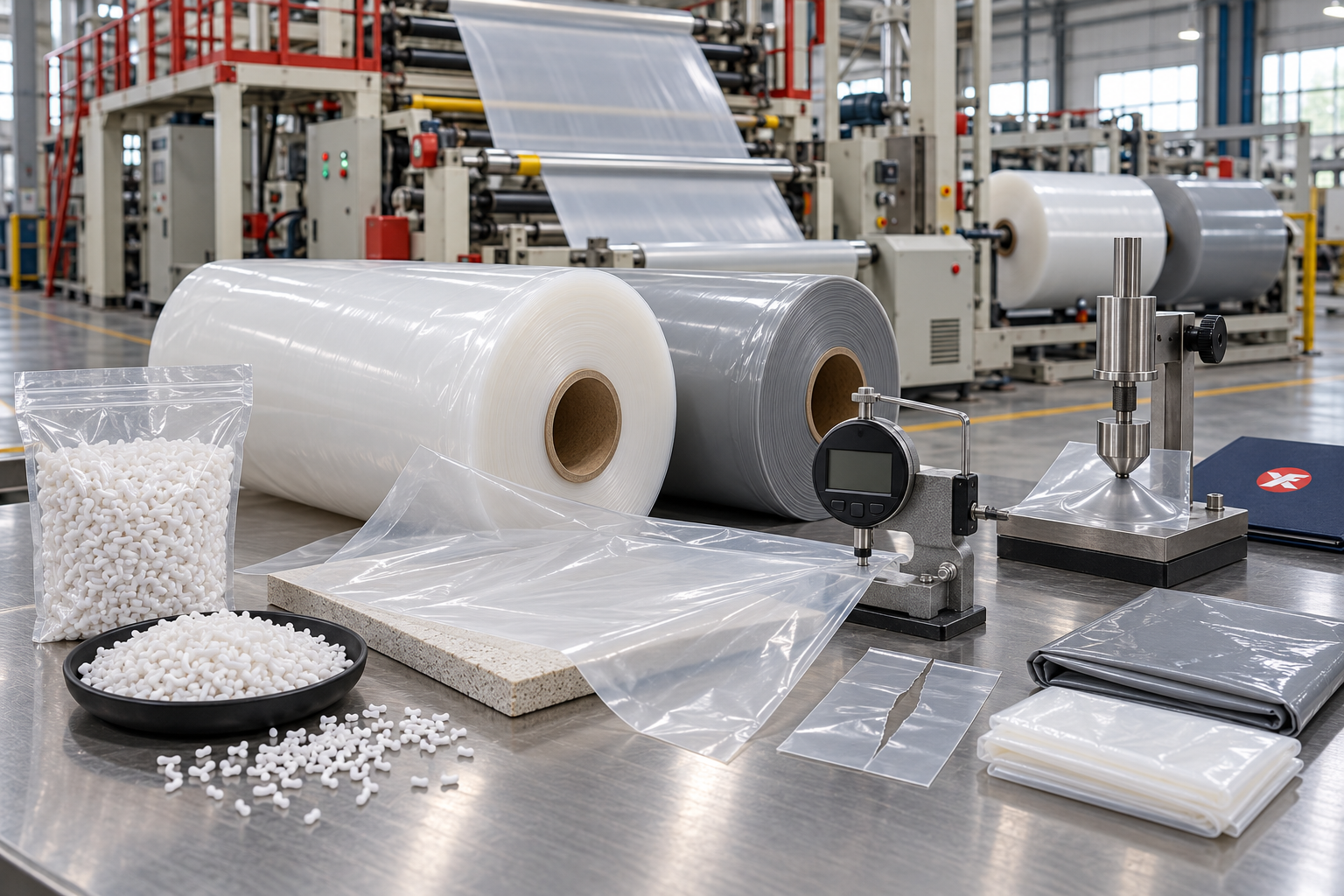
PE construction film is commonly used to protect floors, walls, furniture, machinery and building materials from dust, paint, moisture and dirt.
These products are often large in size and sensitive to raw-material costs. Sodium sulfate filler masterbatch may be tested in selected construction and protective-film formulations to reduce PE resin consumption.
However, the lowest material price is not the only objective. The finished film must remain flexible, easy to unfold and strong enough for handling at a construction site.
Common Construction-Film Applications
PE protective film may be used as:
– Floor-protection sheeting
– Painting dust sheets
– Furniture covers
– Temporary wall protection
– Building-material covers
– Equipment covers
– General-purpose waterproof sheets
– Packaging liners
– Industrial protective film
Each application has different requirements for thickness, transparency, toughness and outdoor exposure.
A formulation suitable for an indoor dust cover may not be appropriate for heavy-duty outdoor sheeting.
Why Use Sodium Sulfate Filler Masterbatch?
Sodium sulfate filler masterbatch is supplied in pellet form and can be mixed with PE resin during extrusion.
Depending on the formulation and application, it may help manufacturers:
– Reduce virgin-resin consumption
– Lower raw-material cost
– Improve cost consistency
– Adjust film body and feel
– Maintain convenient pellet feeding
– Produce cost-sensitive protective film
The economic result should be calculated according to the cost per acceptable roll or sheet rather than only the blended material price per kilogram.
Match the Masterbatch to the PE Formulation
Construction film may contain HDPE, LDPE, LLDPE, recycled PE or a combination of these materials.
Each resin provides different properties:
– LDPE generally supports processing and flexibility.
– LLDPE can improve toughness and puncture resistance.
– HDPE may provide stiffness and support thinner structures.
– Recycled PE can reduce costs but may vary between batches.
The carrier resin of the masterbatch should be compatible with the main formulation.
Poor compatibility may lead to rough film, unstable extrusion, weak areas or visible filler particles.
Film Thickness Determines the Trial Strategy
Construction film is available in lightweight, standard and heavy-duty grades.
Lightweight dust sheets normally require more careful dosage control because small particles and thickness variations can create pinholes or weak areas.
Thicker protective sheets may provide greater formulation flexibility, but their strength and roll weight must still be checked.
For each product, record:
– Target thickness
– Actual thickness range
– Sheet dimensions
– Roll length
– Roll weight
– Masterbatch dosage
– Resin formulation
– Rejection rate
Do not use one masterbatch ratio for every film thickness.
Begin with a Conservative Dosage
Start the production trial at a conservative addition level.
After the film bubble becomes stable, collect samples and evaluate:
– Film appearance
– Thickness consistency
– Filler dispersion
– Flexibility
– Tear resistance
– Puncture resistance
– Folding performance
– Finished-roll weight
Increase the dosage gradually only when the previous formulation remains acceptable.
This helps identify the practical addition limit without creating unnecessary production waste.
Check Dispersion and Surface Quality
Construction film may not require the same clarity as premium packaging, but poor dispersion can still affect performance.
Possible signs of insufficient dispersion include:
– White spots
– Rough surfaces
– Raised particles
– Pinholes
– Weak points
– Uneven opacity
– Film-bubble instability
Inspect samples under normal and backlit conditions.
Backlighting helps reveal small holes, agglomerates and thickness irregularities that may be difficult to see on a folded sheet.
Test Tear Resistance
Construction film is frequently pulled, folded and walked over during installation.
A small cut or puncture should not cause the sheet to tear too easily.
Test the film:
– In the machine direction
– Across the film width
– Near folded edges
– Around perforations
– After repeated folding
– At different points across the roll
If tearing becomes easier as the filler dosage increases, reduce the addition level or adjust the PE resin blend.
Evaluate Puncture Resistance
Sharp corners, tools, building materials and furniture legs can puncture protective film.
A realistic test may include controlled contact with:
– Rounded furniture corners
– Building-material edges
– Packaging components
– Standard puncture-test fixtures
– Weighted objects with defined contact areas
Avoid relying only on a visual inspection. A sheet that appears thick may still puncture easily if the formulation is too brittle.
Check Flexibility and Unfolding
Protective sheets must be easy to unfold and spread across a surface.
Excessive stiffness may cause:
– Difficult installation
– Poor surface coverage
– Cracking around folds
– Unwanted spring-back
– Customer complaints
Evaluate the sheet after it has been folded or stored in a roll. Test whether it opens smoothly without splitting along crease lines.
Cold-temperature conditions may also affect flexibility when the film is used outdoors or stored during winter.
Control Moisture
Moisture can cause bubbles, pinholes and unstable extrusion.
Possible moisture sources include:
– Open masterbatch bags
– Recycled PE resin
– Damaged packaging
– Humid storage
– Wet mixing equipment
– Material-conveying systems
Keep raw materials sealed, dry and stored on raised pallets.
When moisture is suspected, inspect every component of the formulation instead of assuming that the filler masterbatch is the only cause.
Consider Recycled-Material Variation
Recycled resin is common in cost-sensitive protective film, but its quality may change between deliveries.
Variations may involve:
– Melt flow
– Moisture
– Colour
– Contamination
– Polymer type
– Mechanical strength
– Odour
A masterbatch dosage that works with one recycled-resin batch may perform differently with another.
Establish incoming-material checks and keep retained samples of important batches.
Monitor Screen Pressure
Contamination from recycled resin or poorly dispersed material can increase screen pressure and shorten production runs.
Record:
– Starting pressure
– Pressure increase over time
– Screen-changing interval
– Production output
– Masterbatch dosage
– Recycled-resin batch
– Film defects
Frequent screen changes increase downtime and reduce the real economic benefit of a low-cost formulation.
Calculate Cost per Finished Roll
Construction film is often sold by roll, sheet area or total weight.
Calculate the real production cost using:
– Blended raw-material cost
– Film thickness
– Film width
– Roll length
– Finished-roll weight
– Rejection rate
– Machine output
– Electricity consumption
– Screen-changing downtime
– Packaging cost
A denser formulation may increase roll weight even when the material price per kilogram is lower.
Always compare products with the same dimensions and required performance.
Outdoor Applications Need Additional Testing
Construction film used outdoors may be exposed to:
– Sunlight
– Heat
– Rain
– Wind
– Temperature changes
– Extended storage
Sodium sulfate filler masterbatch alone does not provide UV protection.
If outdoor service life is required, the complete formulation should be evaluated with suitable stabilisers and tested according to the expected exposure conditions.
Do not describe an indoor protective film as suitable for long-term outdoor use without verification.
Information to Provide to the Supplier
For a suitable recommendation, provide:
– Film application
– Indoor or outdoor use
– Target thickness
– Film width
– Roll length
– Resin formulation
– Recycled-material percentage
– Required colour or opacity
– Puncture requirements
– Tear requirements
– Target addition ratio
– Current production problems
Finished-film and recycled-resin samples can make technical communication more effective.
Conclusion
Sodium sulfate filler masterbatch may support cost reduction in selected PE construction-film and protective-sheet applications.
The dosage should be evaluated according to film thickness, resin formulation, puncture resistance, tear strength, flexibility and finished-roll weight.
The most economical formulation is not necessarily the one containing the most filler. It is the formulation that produces stable, acceptable rolls at the lowest total manufacturing cost.
Xinfeng manufactures sodium sulfate filler masterbatch for selected PE blown-film and plastic-processing applications.
To discuss your construction-film formulation or request a sample, visit Xinfeng Masterbatch.
Send us a message now for quotation.
WhatsApp: https://wa.memessage/IRZROGA5F2RQO1
WhatsApp:+86 17835035161