


Sodium Sulfate vs Calcium Carbonate Filler Masterbatch for PE Film
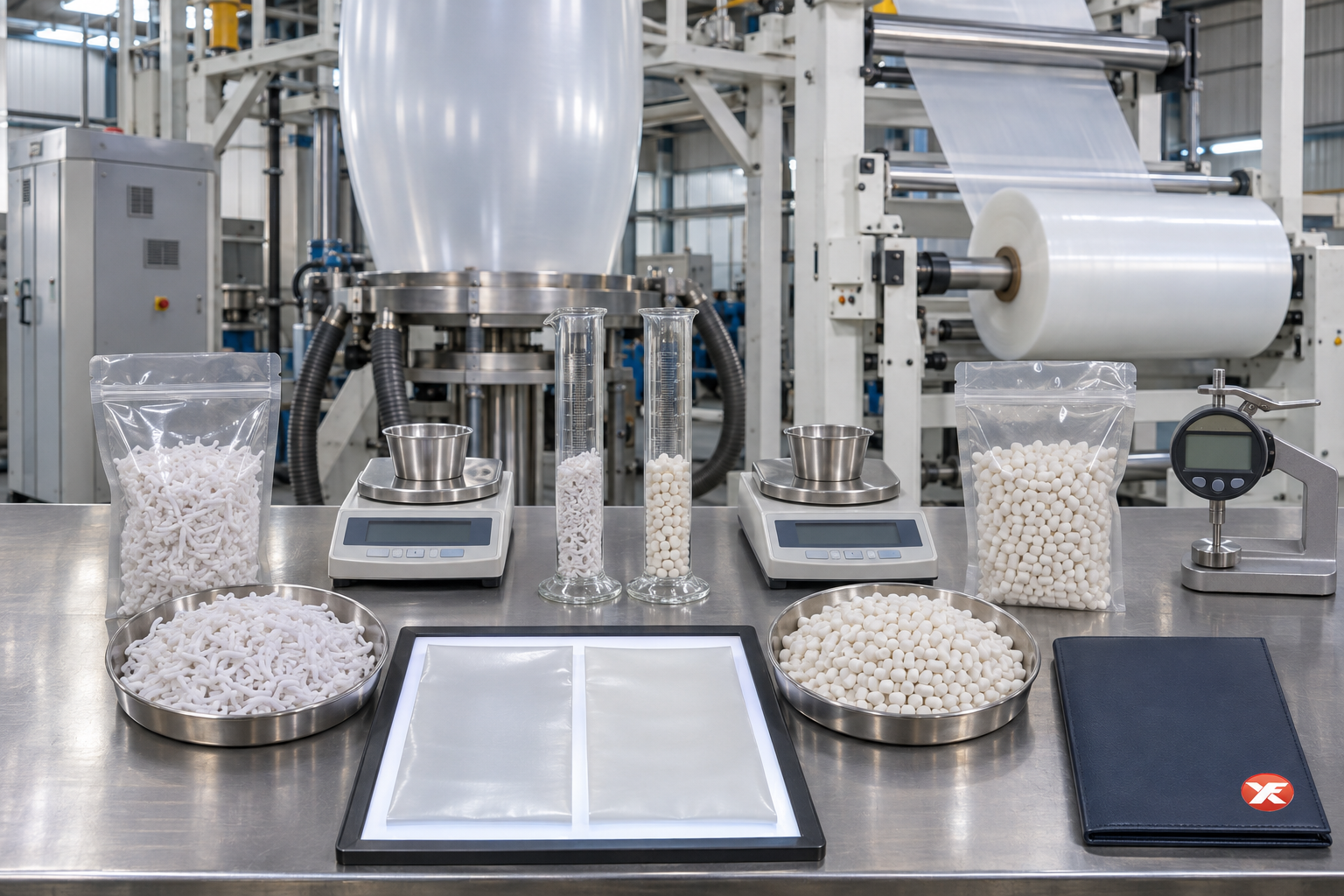
Sodium sulfate and calcium carbonate are both used in functional filler masterbatch systems for plastic processing.
Customers comparing these products frequently ask which filler masterbatch is better for PE blown film.
There is no universal answer.
The result depends on the complete masterbatch formulation, filler concentration, carrier resin, particle characteristics, dispersion quality, film thickness, production equipment and finished-product requirements.
A useful comparison should therefore examine actual masterbatch products under the same production conditions rather than comparing only the names or prices of the two mineral components.
What Is Sodium Sulfate Filler Masterbatch?
Sodium sulfate filler masterbatch incorporates a sodium sulfate-based functional component into a polymer carrier.
It is supplied as pellets so that customers can feed, mix and process the material more conveniently than adding loose inorganic powder directly to the extruder.
In suitable PE film formulations, sodium sulfate filler masterbatch may help manufacturers:
– Optimize formulation cost
– Improve feeding convenience
– Adjust film opacity and handling
– Reduce direct powder handling
– Maintain more controlled dosing
– Develop application-specific cost-performance balances
The final properties depend on the masterbatch grade and how it is used.
What Is Calcium Carbonate Filler Masterbatch?
Calcium carbonate filler masterbatch contains calcium carbonate dispersed in a polymer carrier.
Calcium carbonate is one of the most established fillers used in polyolefin compounds. Different commercial products can vary considerably in:
– Mineral source
– Particle size
– Particle-size distribution
– Surface treatment
– Mineral concentration
– Carrier resin
– Lubricant system
– Pellet quality
– Dispersion performance
Therefore, two calcium carbonate masterbatches may also behave differently from each other.
Both Products Are More Than Their Mineral Names
A masterbatch is a formulated product—not simply a bag of mineral powder.
Its production performance depends on:
– Mineral quality
– Filler loading
– Polymer carrier
– Surface treatment
– Dispersing system
– Lubricants
– Pellet dimensions
– Pellet uniformity
– Moisture control
– Manufacturing process
The carrier resin must melt and distribute the filler throughout the customer’s PE formulation.
A well-designed masterbatch with controlled dispersion can perform differently from a lower-quality product containing the same type of mineral.
Chemical Properties Are Different
Sodium sulfate and calcium carbonate are different inorganic compounds.
Sodium sulfate is a sulfate salt, while calcium carbonate is a carbonate mineral. Calcium carbonate is described as practically insoluble in water, whereas sodium sulfate has different solubility behavior. Calcium carbonate information from PubChem, sodium sulfate information from PubChem
These chemical differences can influence product formulation, manufacturing and storage requirements.
However, customers receive a polymer-based masterbatch rather than the pure laboratory chemical. The behavior of the commercial pellets must be evaluated using the supplier’s technical information and actual production trials.
Do Not Assume a Large Density Difference
Some buyers assume that one filler masterbatch must always produce a much lighter plastic product because its mineral name is different.
This conclusion should not be made without measuring the actual products.
Published reference values show that the densities of pure sodium sulfate and calcium carbonate are within a broadly comparable mineral-density range. However, the density of a finished masterbatch also depends on:
– Mineral concentration
– Polymer-carrier density
– Other formulation components
– Pellet porosity
– Manufacturing process
– Test method
The buyer should request the actual masterbatch density or measure it using an agreed method.
More importantly, calculate the weight and cost of the finished film—not only the density of the raw mineral.
Compare Cost per Square Meter or Finished Bag
Price per tonne is not sufficient for evaluating filler masterbatch.
A more useful calculation includes:
– Masterbatch price
– Recommended and acceptable dosage
– Finished-film density
– Actual film thickness
– Weight per square meter
– Weight per finished bag
– Production speed
– Energy consumption
– Screen-changing frequency
– Scrap rate
– Mechanical performance
– Customer rejection risk
A product with a lower price per tonne may not provide the lowest cost per qualified bag.
The comparison must use film produced at the same dimensions and acceptable performance level.
Film Appearance May Be Different
Sodium sulfate and calcium carbonate masterbatches may produce different optical effects depending on their formulation and dosage.
Evaluate:
– Opacity
– Haze
– Whiteness
– Gloss
– Surface smoothness
– Color undertone
– Light transmission
– Visibility of particles
– Printing appearance
Do not compare one film that is thicker than the other. Even a small thickness difference can affect opacity and apparent color.
Film samples should be measured before making a visual judgment.
Particle Size and Dispersion Matter
The chemical identity of a filler does not fully predict dispersion.
Particle size, agglomeration, surface properties, carrier compatibility and compounding quality all influence how a filler distributes within PE.
Poor dispersion can contribute to:
– White specks
– Rough surfaces
– Pinholes
– Weak points
– Film breaks
– Unstable pressure
– Die deposits
– Reduced elongation
– Uneven opacity
Research on calcium-carbonate-filled PE films shows that filler concentration and dispersion can affect tensile, elongation, joint and surface properties. The results also demonstrate why one test formulation should not be generalized to every film application. Research on calcium-carbonate-filled PE film
A sodium sulfate masterbatch should be evaluated using the same controlled approach.
Carrier Resin Compatibility Is Essential
Both filler masterbatch types need a carrier compatible with the customer’s base polymer.
For PE blown film, tell the supplier whether the formulation contains:
– LDPE
– LLDPE
– HDPE
– Virgin PE
– Recycled PE
– PE blends
– Color masterbatch
– Slip or antiblock additives
Incompatible carriers may cause poor melting, uneven dispersion or unstable film properties.
The mineral component alone cannot compensate for an unsuitable carrier.
Compare Pellet Quality
Commercial pellet characteristics affect feeding and mixing.
Inspect:
– Pellet shape
– Pellet size
– Pellet-size uniformity
– Dust
– Broken pellets
– Clumping
– Surface appearance
– Foreign contamination
– Packaging condition
If two products have very different bulk densities or pellet shapes, volume-based feeding can produce inaccurate dosage comparisons.
Use gravimetric weighing whenever possible.
Test Processing Stability
Run both masterbatches using the same base formulation and controlled conditions.
Record:
– Hopper feeding
– Mixing uniformity
– Extrusion pressure
– Pressure fluctuation
– Motor current
– Output
– Screen pressure
– Screen-changing frequency
– Die buildup
– Bubble stability
– Film breaks
– Start-up waste
A short demonstration may not reveal gradual screen blockage or die buildup. The trial should run long enough to observe process trends.
Test the Same Film Thickness
Comparisons are only meaningful when the finished films have equivalent dimensions.
Measure:
– Film width
– Average thickness
– Minimum and maximum thickness
– Thickness variation
– Film weight per unit area
– Bag weight
If one formulation produces a thicker film, it may appear stronger but consume more material.
The objective should be to compare qualified products with the same intended dimensions.
Compare Mechanical Performance
Depending on the final application, test:
– Tensile strength
– Elongation at break
– Tear resistance
– Dart-drop impact
– Puncture resistance
– Film stiffness
– Heat-seal strength
– Finished-bag load capacity
Test in the machine and transverse directions where applicable.
A filler formulation may increase stiffness while reducing elongation. Whether this is acceptable depends on the product.
For example, a rigid industrial liner and a flexible household bag may have different performance priorities.
Check Heat Sealing
Both filler systems can change the overall film composition, so sealing performance should be verified.
Evaluate:
– Seal initiation
– Sealing-temperature window
– Seal strength
– Seal appearance
– Film thinning beside the seal
– Leakage
– Bottom-seal load performance
– Bag-making speed
An acceptable blown-film trial is not complete until the finished bag passes its sealing requirements.
Check Color Masterbatch Consumption
If the finished product is black, blue or another color, the filler masterbatch may influence apparent shade and opacity.
Record whether either formulation requires a change in color masterbatch dosage.
An apparent saving in filler cost may be reduced if significantly more pigment is required to achieve the approved color.
Compare color under consistent lighting and at the same film thickness.
Consider Storage and Moisture Management
The two masterbatch formulations may have different storage recommendations.
Follow the supplier’s instructions concerning:
– Original packaging
– Dry storage
– Shelf life
– Opened-bag management
– Drying, if required
– Temperature
– Condensation prevention
Do not apply drying settings from one masterbatch automatically to another.
The complete pellet formulation—including carrier and additives—determines appropriate handling.
Do Not Compare Ash Results Without an Agreed Method
Ash content is sometimes used to estimate inorganic content, but the result depends on:
– Test temperature
– Test time
– Sample preparation
– Mineral chemistry
– Other inorganic additives
– Decomposition or transformation during testing
A percentage reported by one supplier may not be directly comparable with a result produced by another method.
Agree on the analytical method and interpretation before using ash content as a purchasing criterion.
Suggested Comparison Trial
A controlled comparison can follow these steps:
1. Produce a reference film using the current approved formulation.
2. Record all raw materials and machine settings.
3. Test sodium sulfate filler masterbatch at a conservative starting level.
4. Return the machine to stable reference conditions.
5. Test calcium carbonate filler masterbatch under comparable conditions.
6. Keep base resin, film thickness and production speed unchanged.
7. Measure thickness and film weight.
8. Record extrusion pressure and output.
9. Inspect film dispersion and appearance.
10. Test mechanical and sealing performance.
11. Produce finished bags.
12. Calculate cost per qualified finished product.
13. Retain labeled samples from both trials.
If processing conditions must be changed for one product, record the changes and include their economic effect.
Which Masterbatch Should a Customer Choose?
Sodium sulfate filler masterbatch may be selected when its specific formulation provides a suitable combination of processing, finished-film performance and total production cost for the customer’s application.
Calcium carbonate masterbatch may be selected where an established calcium-carbonate formulation meets the required stiffness, appearance, processing and performance targets.
The correct choice depends on actual results—not a universal statement that one mineral is always better.
Important questions include:
– Which product disperses more consistently?
– Which product provides the required film appearance?
– Which formulation maintains elongation and impact performance?
– Which product runs more stably on the customer’s equipment?
– Which formulation seals reliably?
– Which product produces the lowest cost per qualified bag?
– Which supplier provides consistent batches and technical support?
Information to Give the Supplier
For a useful recommendation, provide:
– PE resin grades
– Virgin and recycled content
– Film thickness
– Film width
– Finished-product application
– Current filler type and dosage
– Current formulation cost
– Required mechanical properties
– Color requirements
– Printing requirements
– Extruder information
– Current production problems
This allows the supplier to recommend a grade and trial plan based on the real application.
Conclusion
Sodium sulfate and calcium carbonate filler masterbatch are different formulation systems, but neither should be selected by mineral name or price per tonne alone.
The buyer should compare actual commercial masterbatches under equivalent processing conditions and at the same finished-film thickness.
Dispersion, carrier compatibility, film appearance, mechanical properties, heat sealing, production stability and total cost per qualified product should all be considered.
Xinfeng supplies sodium sulfate filler masterbatch for selected PE blown-film and plastic bag applications. Sample trials can be developed according to the customer’s resin formulation, film thickness, equipment and finished-product requirements.
For samples or technical consultation, visit Xinfeng Masterbatch.
Send us a message now for quotation.
WhatsApp: https://wa.memessage/IRZROGA5F2RQO1
WhatsApp:+86 17835035161