


Can Sodium Sulfate Filler Masterbatch Be Used with Color Masterbatch?
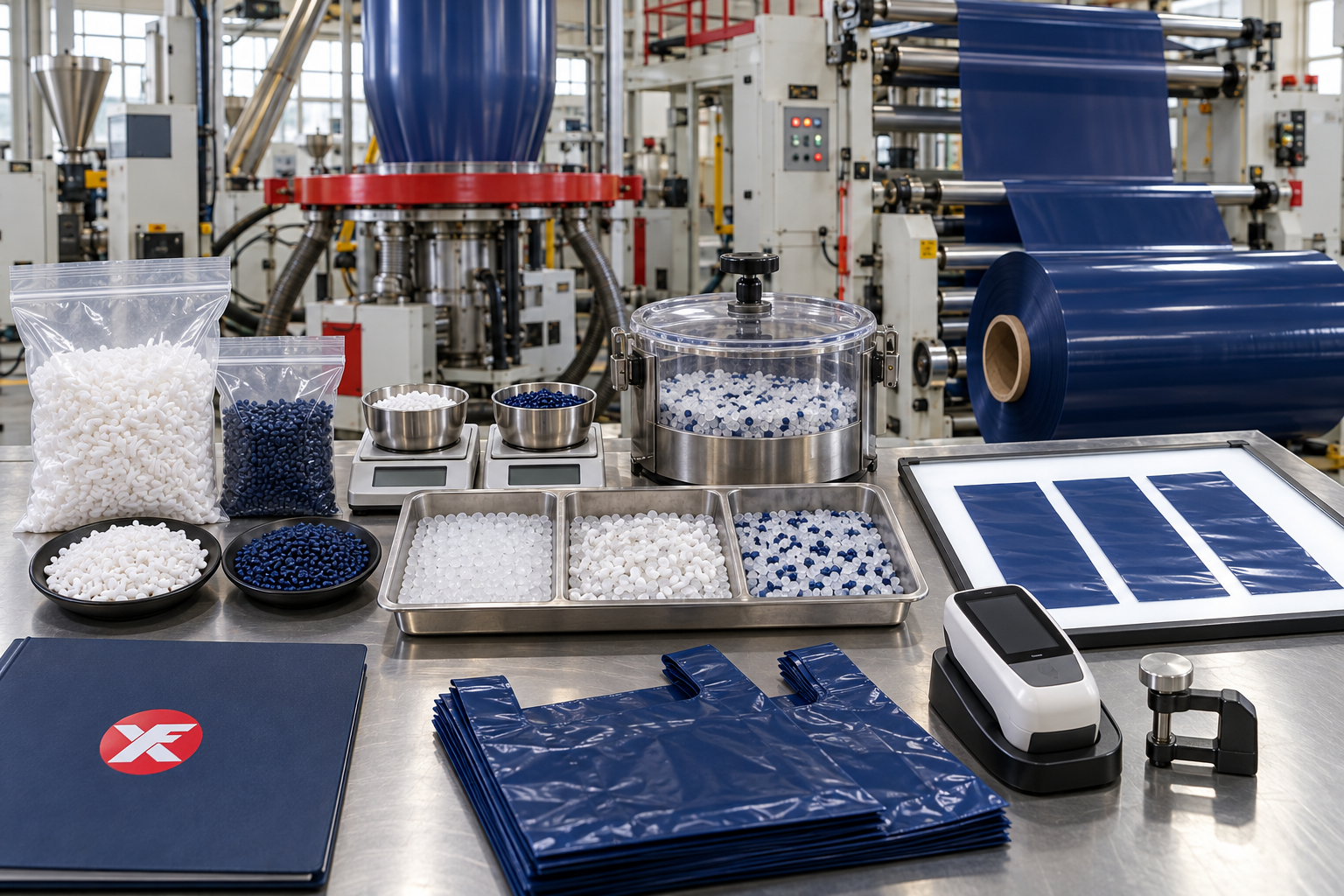
Manufacturers of colored PE film and plastic bags often use several functional additives in the same formulation. A common question is whether sodium sulfate filler masterbatch can be used together with color masterbatch.
The short answer is yes.
When the carrier resin, processing conditions and final product requirements are compatible, sodium sulfate filler masterbatch and color masterbatch can be incorporated into the same PE formulation. However, adding filler masterbatch may influence apparent color, opacity, gloss and processing behavior. Therefore, the complete formulation should be evaluated through a controlled production trial rather than judging each additive separately.
What Does Each Masterbatch Do?
Sodium sulfate filler masterbatch is designed to introduce a functional inorganic component into plastic products through a polymer carrier.
In suitable PE film applications, it can help manufacturers:
– Optimize raw material costs
– Improve material processing efficiency
– Adjust stiffness and handling characteristics
– Improve the balance between formulation cost and finished-product performance
– Maintain more convenient feeding and dispersion than directly adding inorganic powder
Color masterbatch performs a different function. It introduces pigments or dyes into the polymer to create the required shade, opacity and visual appearance.
When these two materials are used together, the objective is not simply to add their individual dosages. The compounder must ensure that the entire formulation remains stable throughout mixing, extrusion, film blowing, printing and bag making.
Why Can the Filler Affect the Final Color?
Even when sodium sulfate filler masterbatch is white, it does not necessarily behave like a neutral ingredient in every colored formulation.
Changing the filler dosage can influence:
– Film opacity
– Light transmission
– Surface gloss
– Pigment concentration per unit weight
– Perceived color depth
– Color uniformity across the film
– The visual effect of the substrate behind the film
For example, a dark blue film may appear slightly lighter or less saturated after the filler dosage is increased. A white or pastel film may show a more noticeable change in brightness, opacity or undertone.
This does not automatically indicate a quality problem. It means the color masterbatch dosage may need to be adjusted after the filler masterbatch is introduced.
Check Carrier Resin Compatibility First
Carrier compatibility is one of the first factors to confirm.
For PE blown-film production, both the filler masterbatch and color masterbatch should preferably use carriers that are compatible with the base polyethylene resin and the intended processing temperature.
An incompatible carrier may contribute to:
– Uneven dispersion
– Surface defects
– Poor film appearance
– Unstable extrusion pressure
– Weak mechanical performance
– Pigment streaks or color spots
Before production, manufacturers should tell the masterbatch supplier whether the base material is LDPE, LLDPE, HDPE, recycled PE or a blend. Film thickness, end use and processing temperature should also be provided.
Use Accurate Gravimetric Dosing
Filler masterbatch and color masterbatch should be weighed accurately and separately.
Volume-based scoops can create inconsistent results because different pellets may have different bulk densities and pellet shapes. Gravimetric dosing is preferable when repeatable color and formulation control are important.
A practical mixing sequence may be:
1. Prepare the base PE resin.
2. Add the measured sodium sulfate filler masterbatch.
3. Add the measured color masterbatch.
4. Add other approved functional additives.
5. Mix until the pellets are evenly distributed.
6. Feed the blend consistently into the extruder.
The optimum sequence can vary according to the mixer, feeding system and formulation. The machine supplier’s operating guidance and the masterbatch supplier’s recommendations should be considered.
Pigment Dispersion Still Matters
Uniform pigment dispersion is essential for stable film color. Research on polyethylene color masterbatch shows that formulation and processing conditions can materially influence pigment dispersion and the resulting color performance. Inorganic particles also require effective distribution within the polymer matrix to avoid localized defects. Wiley research on pigment dispersion, polyethylene color masterbatch study
During a trial, operators should inspect the film for:
– Dark or light streaks
– Concentrated pigment spots
– White specks
– Uneven opacity
– Surface roughness
– Die lines
– Excessive screen pressure
– Material buildup around the die
A satisfactory formulation should remain visually consistent at the beginning, middle and end of the production roll.
Dark and Light Colors Require Different Attention
Dark-colored films, including black, navy blue and dark green bags, may visually tolerate moderate changes in opacity better than light-colored or transparent products.
However, dark color does not remove the need to test mechanical properties and heat sealing.
White, beige, yellow and pastel-colored films are usually more sensitive to small formulation changes. In these applications, even a minor variation in filler or pigment dosage can produce a visible shade difference.
For demanding color specifications, samples should be compared under consistent lighting. A spectrophotometer can provide more objective color-difference data than visual judgment alone.
Test Printing and Surface Treatment
If the finished film will be printed, the evaluation should include printing performance.
Check:
– Corona treatment level
– Ink adhesion
– Print density
– Dot and line definition
– Color appearance beneath printed areas
– Rub resistance
– Surface cleanliness
A formulation that performs well during film blowing may still require adjustment if it affects surface treatment or ink adhesion.
For printed shopping bags, courier bags and industrial packaging, both the film color and the printed graphics should be assessed before approving mass production.
Do Not Ignore Heat Sealing
Heat sealing is especially important in bag-making applications.
After changing the filler or color masterbatch dosage, test:
– Sealing temperature window
– Seal strength
– Seal appearance
– Bag-bottom strength
– Handle-punching performance
– Drop resistance under load
An acceptable color result is not enough if the bag becomes difficult to seal or fails during use.
The formulation must be evaluated as a complete system.
Control Moisture and Storage Conditions
All raw materials should be stored in a clean, dry environment. Open packaging should be properly resealed to prevent moisture absorption and contamination.
If moisture enters the production system, it may contribute to bubbles, unstable extrusion or surface defects. This can make it difficult to determine whether a problem comes from the filler masterbatch, color masterbatch or storage conditions.
Keeping materials clearly labeled also prevents accidental mixing between different grades or batches.
Recommended Trial Procedure
A controlled trial helps identify the most suitable formulation while reducing production risk.
A practical procedure is:
1. Record the current approved PE formulation.
2. Produce a reference sample without changing other variables.
3. Add the selected sodium sulfate filler masterbatch at the planned starting level.
4. Keep the processing temperature and machine speed stable.
5. Compare film color, opacity, thickness and appearance.
6. Adjust the color masterbatch only when necessary.
7. Test tensile performance, sealing and bag strength.
8. Evaluate printing performance if applicable.
9. Calculate the actual production cost per acceptable finished product.
10. Approve the formulation only after consistent results are obtained.
Only one major variable should be changed at a time. Changing filler dosage, color dosage, temperature and film thickness simultaneously makes it difficult to identify the real cause of any difference.
Evaluate the True Production Cost
The lowest resin cost does not always produce the lowest finished-product cost.
When comparing formulations, manufacturers should consider:
– Base resin consumption
– Filler masterbatch dosage
– Color masterbatch consumption
– Production speed
– Energy consumption
– Filter-changing frequency
– Scrap rate
– Printing and bag-making performance
– Finished-film qualification rate
If a filler dosage requires substantially more color masterbatch or creates additional production waste, the apparent saving may be reduced. The best formulation is the one that delivers stable quality and a competitive total production cost.
Information to Provide to Your Supplier
To receive a more suitable recommendation, provide the following details:
– Base resin type
– Virgin or recycled material content
– Film color
– Film thickness
– Current color masterbatch dosage
– Intended filler dosage
– Printing requirements
– Bag type and final application
– Film-blowing equipment information
– Required mechanical properties
A formulation for a dark refuse bag may be different from one intended for a printed shopping bag or thin colored packaging film.
Conclusion
Sodium sulfate filler masterbatch can be used together with color masterbatch in many PE colored-film applications. Successful use depends on carrier compatibility, accurate dosing, uniform dispersion and proper evaluation of the finished product.
Because filler masterbatch can change opacity and perceived shade, the color formulation may require fine adjustment. Manufacturers should conduct a controlled trial and verify color consistency, film strength, printing and heat-sealing performance before full-scale production.
Xinfeng supplies sodium sulfate filler masterbatch for selected PE film and PP processing applications. Formulation recommendations can be developed according to the customer’s resin type, product structure, equipment and performance requirements.
For samples or technical consultation, visit Xinfeng Masterbatch.
Send us a message now for quotation.
WhatsApp: https://wa.memessage/IRZROGA5F2RQO1
WhatsApp:+86 17835035161