


How Does Sodium Sulfate Filler Masterbatch Affect PE Film Heat Sealing?
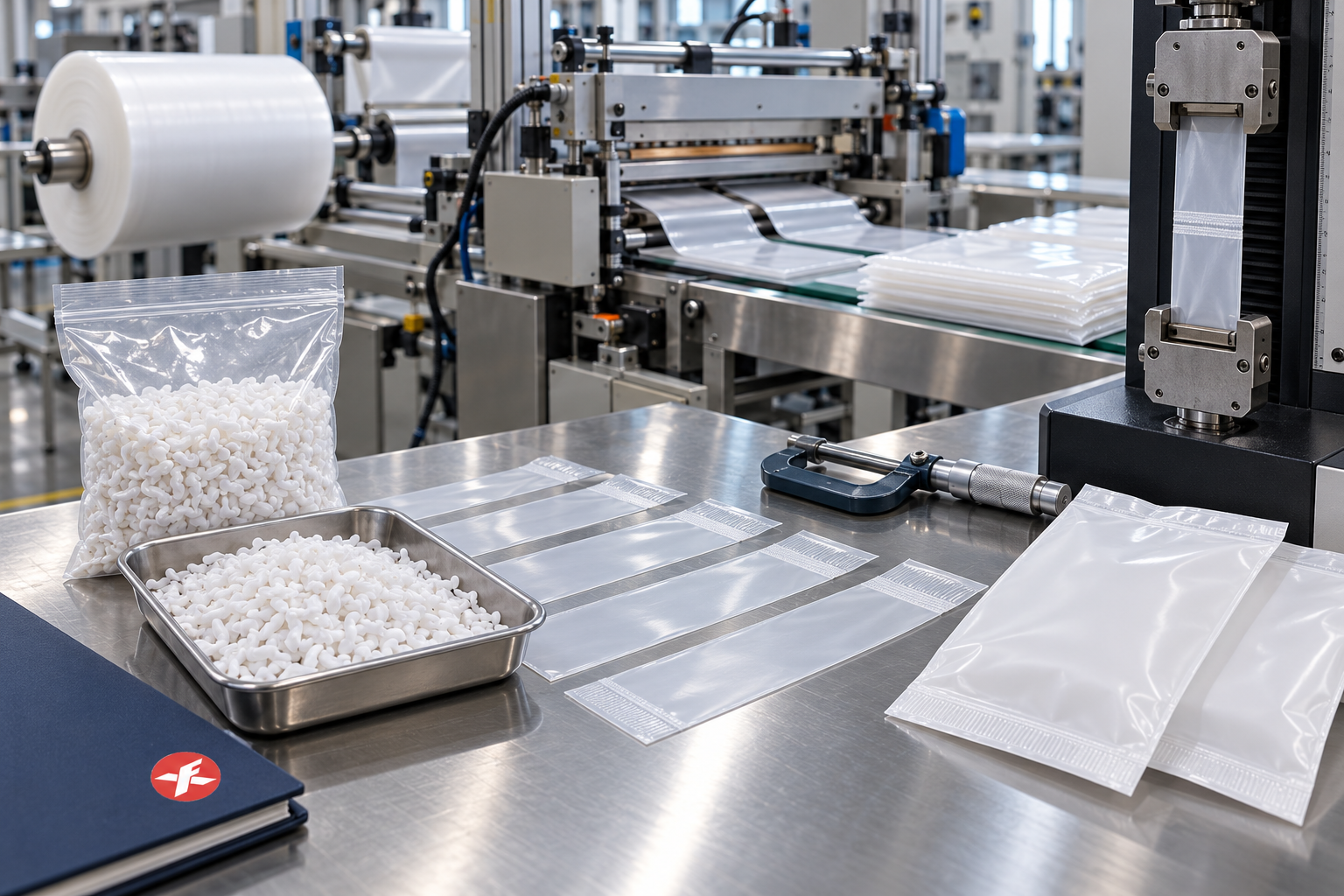
Sodium sulfate filler masterbatch can help PE film and plastic bag manufacturers optimize their material formulations and production costs. However, a successful formulation must provide more than stable film blowing and an acceptable appearance.
For plastic bags, heat-sealing performance is equally important.
After sodium sulfate filler masterbatch is introduced, manufacturers should confirm that the film can still produce a strong and consistent seal under actual bag-making conditions. The evaluation should include sealing temperature, dwell time, seal strength, failure mode and finished-bag performance.
There is no single sealing temperature or filler dosage suitable for every PE film. Testing must reflect the resin, film thickness, production speed and final application.
How Is a PE Film Heat Seal Formed?
Heat sealing joins two thermoplastic film surfaces by applying heat, pressure and contact time.
As the sealing interface becomes hot enough, the polymer softens or melts. Polymer chains from the two film surfaces move across the interface and form a bond as the seal cools.
The three main sealing variables are:
– Temperature
– Dwell time
– Pressure
Research on LLDPE heat sealing indicates that interface temperature and dwell time are particularly important in determining seal strength. The correct settings depend on the film structure and sealing equipment, so a value suitable for one PE formulation should not automatically be copied to another. Research on LLDPE heat sealing
Why Should Heat Sealing Be Retested After Adding Filler Masterbatch?
Introducing sodium sulfate filler masterbatch changes the complete film formulation.
Depending on the dosage and film structure, the change may affect:
– Film thickness and thickness uniformity
– Stiffness and flexibility
– Elongation around the sealed area
– Heat transfer through the film
– Polymer content at the sealing interface
– Seal appearance
– The way the film fails under load
This does not mean that the material cannot be sealed. It means that the original sealing settings may need to be checked again.
A formulation that runs smoothly on the blown-film machine may still produce weak seals if the bag-making settings are not properly matched to the new film.
Understand the Heat-Sealing Window
The heat-sealing window is the range of settings within which the film produces an acceptable seal.
If the sealing temperature is too low, the film surfaces may not bond completely. This can cause:
– Easy peeling
– Partially open seals
– Channels through the seal
– Leakage
– Seal failure during filling
If the temperature is too high, the film may become excessively soft or distorted. Possible defects include:
– Film shrinkage
– Wrinkled seals
– Burn-through
– Excessive thinning
– Film sticking to the sealing jaw
– Tearing next to the seal
– Poor visual appearance
The objective is not simply to find the highest possible seal strength. Manufacturers need a sufficiently wide operating window that remains stable when machine speed or film thickness varies slightly.
Temperature, Time and Pressure Must Be Considered Together
Heat-sealing variables interact with each other.
At a higher production speed, the sealing jaws may remain in contact with the film for a shorter period. A higher temperature may then be required to transfer enough heat to the sealing interface.
Conversely, a longer dwell time may allow effective sealing at a lower jaw temperature.
Pressure is necessary to bring the two film surfaces into contact, but excessive pressure cannot compensate for an unsuitable temperature or insufficient dwell time. Too much pressure may squeeze softened polymer away from the sealing area or leave an unattractive seal impression.
When troubleshooting, change one variable at a time and record the result.
Film Thickness Influences Sealing Conditions
Thicker film generally requires more time for heat to reach the interface. Very thin film responds more quickly but may also be easier to distort, cut or burn through.
If adding filler masterbatch changes the actual film thickness or thickness variation, the previous sealing settings may no longer provide consistent results.
Film samples should therefore be measured at several positions:
– Left side of the roll
– Center of the roll
– Right side of the roll
– Beginning of production
– Middle of production
– End of production
A seal test using only one piece of film may fail to reveal thickness variation across the full production roll.
Check Seal Strength and Failure Mode
Seal strength is the force required to separate a sealed film specimen. It can be used for process validation and production-quality control.
ASTM F88/F88M describes a standardized method for measuring the strength of seals in flexible materials and identifying the specimen’s failure mode. ASTM F88/F88M seal-strength test
In addition to recording the maximum force, observe how the sample fails.
Common failure modes include:
Interface Peeling
The two film surfaces separate directly along the sealed interface.
This may indicate insufficient temperature, insufficient dwell time, contamination or poor interfacial bonding.
Film Tearing Near the Seal
The film tears next to the sealed area while the seal remains closed.
This can indicate that the seal itself is stronger than the surrounding film. However, it may also reveal that the adjacent film has become too thin or brittle, so finished-bag testing is still necessary.
Partial or Uneven Failure
One section of the seal opens while another section remains bonded.
Possible causes include uneven film thickness, contaminated sealing jaws, wrinkled film, inconsistent pressure or nonuniform temperature across the jaw.
The failure mode often provides more useful troubleshooting information than a single numerical result.
Inspect the Sealed Area Carefully
A satisfactory seal should be continuous and consistent across the entire bag width.
Inspect for:
– Open sections
– Pinholes
– Wrinkles
– Channels
– Burn marks
– Excessive film thinning
– Contaminated seal areas
– Uneven seal width
– Sharp edges
– Material sticking to the sealing bar
Special attention should be given to gussets, folds and intersections where multiple layers of film must be sealed simultaneously.
A flat two-layer laboratory sample may perform well even though the finished gusseted bag still leaks at a multilayer junction.
Test the Actual Finished Bag
Laboratory seal-strength testing is useful, but the finished product must also be evaluated under realistic conditions.
Depending on the intended application, testing can include:
– Static load testing
– Drop testing
– Water leakage testing
– Air leakage testing
– Compression testing
– Handle-punch testing
– Repeated lifting
– Storage simulation
– Testing at low or elevated temperatures
For refuse bags, shopping bags and industrial liners, the bottom seal should be tested with a realistic product weight.
For liquid packaging or liners, seal continuity and leak resistance may be more important than appearance alone.
Keep the Seal Area Clean
Dust, moisture, oil, powder and pieces of material can prevent direct contact between the film surfaces.
Even when the extrusion formulation is correct, contamination in the bag-making area may create weak or leaking seals.
Check:
– Film storage conditions
– Workshop cleanliness
– Sealing-jaw surfaces
– Static electricity and dust attraction
– Cutting residue
– Recycled-material contamination
– Oil from nearby machinery
– Moisture or condensation
The film should also be allowed to cool and stabilize properly before conversion where appropriate.
Use a Controlled Comparison Trial
When evaluating sodium sulfate filler masterbatch, compare the new formulation with the current approved production formula.
A practical test procedure is:
1. Produce a reference film using the existing formulation.
2. Record the film thickness and bag-making settings.
3. Introduce the sodium sulfate filler masterbatch at the planned trial level.
4. Keep other major formulation variables unchanged.
5. Produce film under stable extrusion conditions.
6. Measure thickness across the roll.
7. Prepare seals at several temperature settings.
8. Keep dwell time and pressure consistent during the temperature comparison.
9. Measure seal strength and record the failure mode.
10. Produce finished bags and perform application-specific tests.
11. Increase the filler dosage only after the previous stage passes.
12. Retain labeled samples for comparison.
The final formulation should be approved according to repeatable test results, not only the appearance of one sample.
Common Heat-Sealing Problems and Checks
The Seal Opens Easily
Check whether the jaw temperature or dwell time is too low. Also inspect the seal area for contamination and confirm that the film surfaces are correctly positioned.
The Film Burns or Cuts at the Seal
The temperature or dwell time may be excessive. Excessive pressure, a damaged sealing bar or an overly thin section of film may also contribute.
The Seal Is Strong but the Film Tears Beside It
Evaluate the film’s elongation and tear resistance. Check whether the filler dosage, film thickness or processing conditions have reduced the strength of the surrounding film.
Seal Strength Varies Across the Bag
Measure temperature and pressure uniformity across the sealing jaw. Also check film-thickness variation, wrinkles and feeder consistency during film production.
Sealing Becomes Unstable at Higher Speed
The available dwell time may have become too short. Confirm whether the film can maintain an adequate seal within the intended production-speed range.
Information to Provide to the Masterbatch Supplier
To obtain a more appropriate recommendation, manufacturers should provide:
– PE resin type and grade
– LDPE, LLDPE and HDPE blend ratio
– Virgin and recycled material content
– Film thickness
– Bag dimensions
– Current filler dosage
– Existing sealing temperature
– Bag-making speed
– Seal type
– Required loading capacity
– Photographs of the failed seal
– Seal-strength or leakage-test results
The supplier can then evaluate whether the masterbatch grade and formulation are suitable for the intended application.
Conclusion
Sodium sulfate filler masterbatch can be used in suitable PE film and plastic bag formulations, but heat-sealing performance should always be confirmed after the formulation changes.
A reliable evaluation should include the sealing temperature window, dwell time, pressure, film thickness, seal strength, failure mode and finished-bag performance.
The best formulation is not simply the one with the lowest raw-material cost. It is the formulation that produces stable film, reliable seals, an acceptable production speed and a high finished-product qualification rate.
Xinfeng supplies sodium sulfate filler masterbatch for selected PE blown-film and plastic bag applications. Trial recommendations can be developed according to the customer’s resin formula, equipment, film thickness and finished-product requirements.
For samples or technical consultation, visit Xinfeng Masterbatch.
Send us a message now for quotation.
WhatsApp: https://wa.memessage/IRZROGA5F2RQO1
WhatsApp:+86 17835035161