


Sodium Sulfate vs Calcium Carbonate Filler Masterbatch
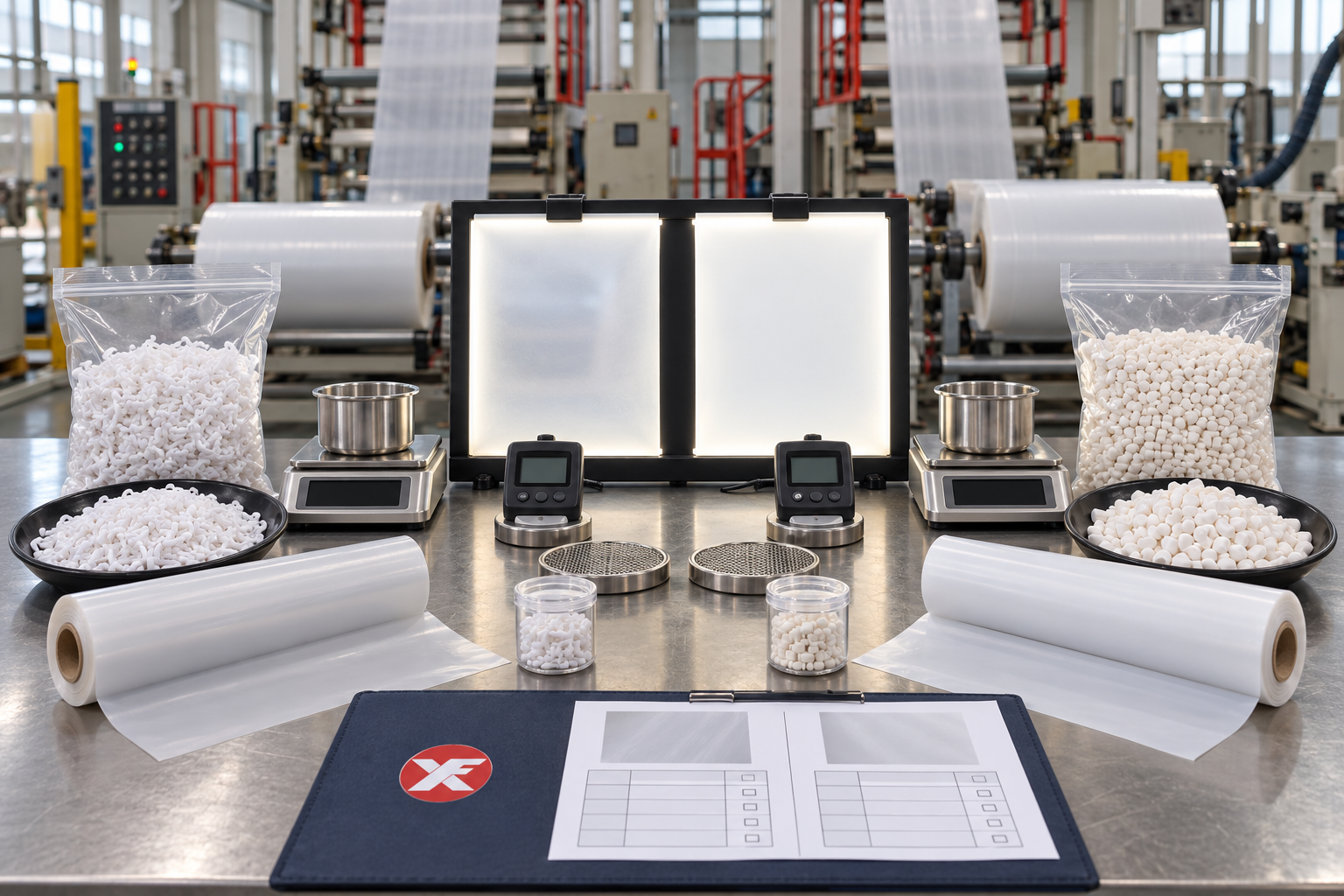
Sodium sulfate and calcium carbonate filler masterbatches can both be used to replace part of the polymer resin in selected plastic products.
However, they are not interchangeable in every application.
The finished result depends not only on the mineral but also on particle size, surface treatment, carrier resin, filler concentration, dispersion and processing conditions.
Manufacturers should compare the two products through controlled trials rather than selecting one based only on price per kilogram.
What Is Sodium Sulfate Filler Masterbatch?
Sodium sulfate filler masterbatch combines treated sodium sulfate with a polymer carrier and processing additives.
It is supplied in pellet form for convenient mixing with PE or other compatible resin systems.
Depending on its formulation, it may be evaluated in:
– PE blown film
– T-shirt bags
– Shopping bags
– Courier bags
– Garbage bags
– Construction film
– Selected PP products
Sodium sulfate crystals have reported refractive-index values around 1.46–1.48, depending on crystal form and reference conditions. This can help explain why carefully formulated sodium sulfate masterbatch is promoted for selected film applications where appearance is important, although final transparency still depends on the complete formulation. PubChem sodium sulfate data
What Is Calcium Carbonate Filler Masterbatch?
Calcium carbonate filler masterbatch combines ground or precipitated calcium carbonate with a polymer carrier and suitable processing additives.
It is widely used in plastic products such as:
– Shopping and garbage bags
– Injection-moulded products
– Extruded profiles
– Pipes
– Woven sacks
– Sheets
– Selected packaging films
Transparency and Optical Appearance
Transparency is one of the main reasons manufacturers compare the two masterbatches.
When particles have an optical behaviour closer to the surrounding polymer and are dispersed effectively, visible light scattering may be reduced.
Sodium sulfate filler masterbatch may therefore be considered for selected translucent film applications. However, it should not be described as completely invisible in every formulation.
Transparency depends on:
– Particle size
– Particle distribution
– Surface treatment
– Carrier resin
– Filler dosage
– Film thickness
– Dispersion
– Resin type
– Processing temperature
Calcium carbonate commonly increases opacity as its content rises, although the result varies with grade and dispersion. Research on calcium-carbonate-filled films also shows that processing and mechanical performance depend strongly on mineral grade, loading and operating conditions. Research on engineered calcium carbonate in PE film
Moisture and Storage
Sodium sulfate is soluble in water, while calcium carbonate is practically insoluble. This makes packaging and humidity control especially important when handling sodium sulfate masterbatch.
Recommended practices include:
– Keep bags sealed before use.
– Store material on raised pallets.
– Protect packaging from rain.
– Reseal opened bags.
– Keep mixers and conveying systems dry.
– Inspect for condensation.
– Check recycled resin for moisture.
Commercial masterbatch contains treated filler inside a polymer carrier, so its behaviour is not identical to loose mineral powder. Nevertheless, poor storage can still contribute to bubbles, pinholes and unstable extrusion.
Calcium carbonate masterbatch should also remain dry and clean. Moisture from its carrier resin, packaging or other formulation components can still affect processing.
Dispersion
Dispersion quality is critical for both products.
Poor dispersion may cause:
– White spots
– Rough film
– Agglomerates
– Pinholes
– Weak points
– Screen blockage
– Surface defects
The mineral name alone does not indicate whether a masterbatch will disperse well.
Important factors include:
– Filler particle size
– Surface treatment
– Mixing quality
– Carrier compatibility
– Extrusion process
– Pellet uniformity
– Masterbatch concentration
Calcium carbonate dispersion in thin blown film can be evaluated by examining the size and distribution of particles and agglomerates. Published research confirms that formulation parameters affect the dispersion state in HDPE film. University of Pretoria research record
Carrier-Resin Compatibility
The carrier resin must melt and mix effectively with the customer’s main polymer.
Before selecting either product, provide:
– HDPE, LDPE or LLDPE grade
– PP grade, when applicable
– Melt-flow information
– Virgin and recycled material ratio
– Processing temperature
– Finished-product application
A well-dispersed calcium carbonate masterbatch may perform better than an incompatible sodium sulfate grade, and the reverse may also be true.
Compare complete commercial products—not only the filler minerals.
Effect on Film Density and Product Weight
Both inorganic fillers have a higher density than PE resin.
Adding filler can increase the density of the material blend. If the product dimensions and thickness remain unchanged, finished bags or rolls may become heavier.
Manufacturers should measure:
– Bag weight
– Film thickness
– Bags per kilogram
– Roll weight
– Material consumption
– Rejection rate
A lower blended material price per kilogram does not always produce a lower cost per finished bag.
Mechanical Performance
Filler addition can change:
– Tensile strength
– Elongation
– Tear resistance
– Impact resistance
– Stiffness
– Puncture resistance
– Seal performance
The effect depends on filler type, particle size, dosage, dispersion and polymer formulation.
Research on calcium carbonate in polyethylene shows that particle size, loading and processing conditions can significantly influence film and composite performance. This is why general statements such as “calcium carbonate always increases strength” or “all mineral filler makes film brittle” are unreliable. Research on calcium-carbonate-filled HDPE
The same principle applies to sodium sulfate masterbatch: the final product must be tested under actual production conditions.
Processing Stability
During a trial, monitor:
– Feeding
– Extrusion pressure
– Motor load
– Melt uniformity
– Film-bubble stability
– Output rate
– Screen condition
– Die buildup
– Film thickness
Do not compare two masterbatches using different resin batches or machine settings.
Keep the production conditions as consistent as possible so the material difference can be evaluated fairly.
Heat Sealing
Changing the filler type or dosage may affect heat transfer and sealing behaviour.
Test:
– Bottom seals
– Side seals
– Handle areas
– Courier-bag flaps
– Seal appearance
– Seal strength after cooling
A film may look acceptable but still fail during bag conversion.
The sealing temperature or dwell time may require adjustment after the formulation changes.
Printing Performance
For printed PE bags, evaluate:
– Corona treatment
– Ink adhesion
– Colour consistency
– Surface smoothness
– Print density
– Rubbing resistance
Mineral filler, carrier resin and other additives can influence film-surface behaviour.
Print trials should use the actual ink and production speed intended for commercial manufacturing.
Which One Is Better for Transparent Film?
A well-formulated sodium sulfate filler masterbatch may be the more relevant candidate when the customer wants to preserve a degree of film clarity.
However, suitability still depends on:
– Required transparency
– Film thickness
– Addition ratio
– Polymer formulation
– Dispersion
– Finished-product strength
For highly transparent or demanding packaging, a filler-free formulation may still be necessary.
Manufacturers should approve the material using physical samples rather than relying on the product name “transparent filler.”
Which One Is Better for Opaque Products?
Calcium carbonate filler masterbatch is widely used in cost-sensitive, opaque or semi-opaque plastic products.
Potential applications include:
– Garbage bags
– Shopping bags
– Injection products
– Sheets
– Profiles
– Woven products
Sodium sulfate masterbatch may also work in selected opaque products, but its potential optical advantage may be less important in those applications.
The choice should then focus more heavily on cost, processing stability and mechanical performance.
Which One Is Cheaper?
The answer varies by:
– Country
– Raw-material market
– Filler concentration
– Carrier resin
– Packaging
– Freight
– Order quantity
– Product grade
Compare the cost per acceptable finished product, including:
– Blended material cost
– Finished-product weight
– Production output
– Rejection rate
– Screen changes
– Energy consumption
– Printing waste
– Sealing failures
The cheaper masterbatch per kilogram may not be the cheaper production solution.
Recommended Comparison Trial
To compare the two masterbatches fairly:
1. Use the same PE resin.
2. Keep film dimensions and target thickness unchanged.
3. Begin with conservative dosages.
4. Use the same machine settings.
5. Record extrusion pressure and output.
6. Measure finished-product weight.
7. Inspect dispersion and appearance.
8. Test mechanical properties.
9. Convert film into finished bags.
10. Calculate the cost per acceptable product.
Retain samples from every trial.
Questions to Ask the Supplier
Before purchasing, ask:
– Which carrier resin is used?
– Which applications is the grade designed for?
– What starting dosage is recommended?
– How should the material be stored?
– Can a sample be provided?
– How is batch consistency controlled?
– Which technical documents are available?
– What production information is needed?
– Can the supplier help troubleshoot?
– Which applications are not recommended?
A responsible supplier should explain limitations as well as potential benefits.
Conclusion
Sodium sulfate and calcium carbonate filler masterbatches offer different advantages.
Sodium sulfate masterbatch may be considered for selected film applications where improved clarity is desired. Calcium carbonate masterbatch is a widely established choice for many opaque and general-purpose plastic products.
Neither option should be selected by mineral name or price alone. Carrier compatibility, dispersion, moisture, finished-product weight and mechanical performance must all be evaluated.
Xinfeng manufactures sodium sulfate filler masterbatch for selected PE blown-film and plastic-processing applications.
To compare formulations or request a sample, visit Xinfeng Masterbatch.
Send us a message now for quotation.
WhatsApp: https://wa.memessage/IRZROGA5F2RQO1
WhatsApp:+86 17835035161